
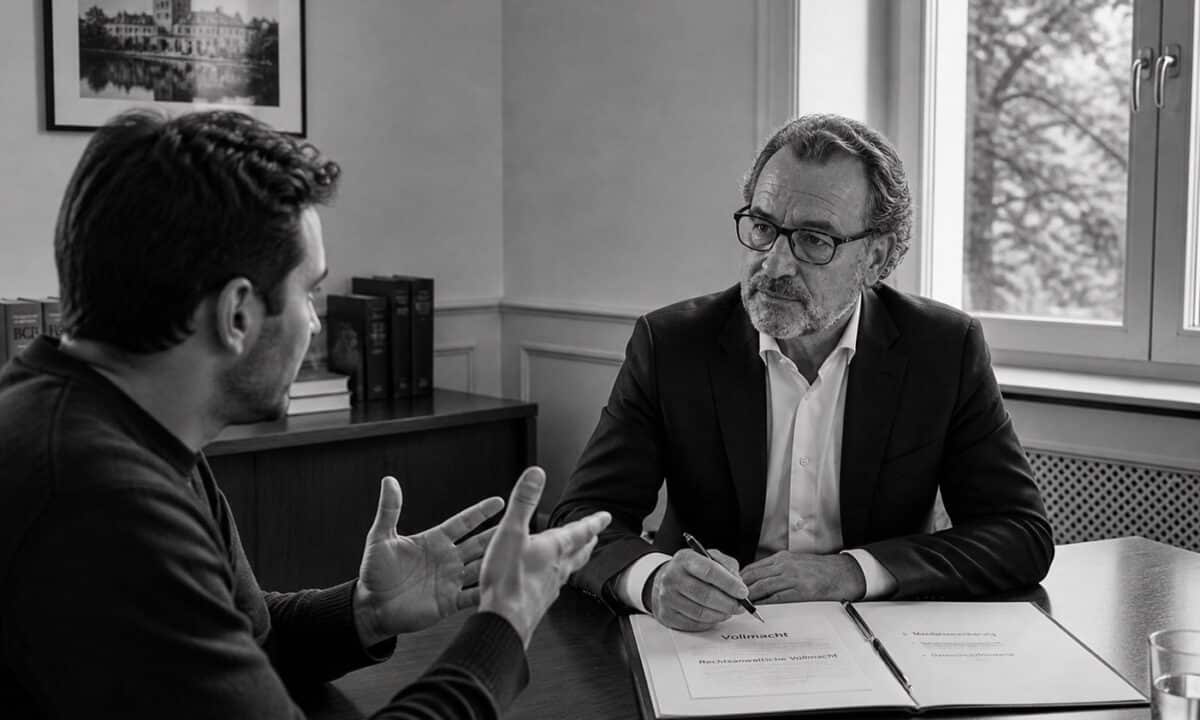
Traffic Law Attorney in Munich — Your Law Firm on Pettenkoferstraße
Anyone looking for a traffic law attorney in Munich usually has a specific problem on their hands: an accident on the Mittlerer Ring, a traffic ticket for the 30 km/h zone at Stachus, a summons to the police headquarters on Ettstraße, an MPU order from the driver’s license office on Ruppertstraße—or a letter from the insurance company’s attorney seeking to reduce the settlement amount. At KLAMERT & PARTNER, we have handled more than 10,000 traffic law cases since 2005: from a simple rear-end collision on Lindwurmstraße to a trial for drunk driving at the Munich District Court, from speed measurements using the PoliScan Speed to diesel emissions damage claims against Volkswagen, Mercedes, and BMW. This is routine in the best sense of the word—structured processes, well-rehearsed arguments, and well-established channels of communication with the district attorney’s office, the police, and insurance companies.
In practice, clients usually come to us in one of four situations: following a traffic accident where liability is unclear, with a traffic ticket issued by the authorities within 14 days, with an order to undergo a medical-psychological assessment (MPU) or facing the threat of a driver’s license revocation, or with a summons as a defendant in a traffic offense case (hit-and-run, drunk driving, coercion). For each of these scenarios, we have established initial review procedures—and within the first 48 hours, it becomes clear whether a case will proceed favorably or unfavorably.
Insights from the Law Firm | What 10,000 Cases Have Taught Us
From over 10,000 traffic law cases since 2005, we have distilled four key principles that we apply to every new case. First: Do not make any statements to the police or the traffic fine authority without a lawyer having reviewed the case file—this applies even if you have nothing to hide. Second: Insurance companies regularly pay significantly less than the objectively justified amount during the initial settlement—a second review is almost always worthwhile. Third: For speed measurements taken with PoliScan Speed, ES 8.0, or TraffiStar S350, there are annual software updates and calibration protocol issues that regularly lead to success in Munich court proceedings. Fourth: In traffic criminal law, it is usually not the trial that decides the case, but the statement made during the preliminary investigation—those who seek legal representation early on often avoid a public trial.
“For many people, traffic law is the first reason they ever hire a lawyer. The pace at which government agencies operate forces quick decisions—traffic tickets, hearing forms, access to case files: everything has a 14-day deadline. That is why we ensure that clients receive an initial response from us within one business day—and do not sign anything beforehand.”
Markus Klamert — Attorney, Founding Partner
Car Accidents & Compensation for Pain and Suffering — Damages Following a Crash
Following a traffic accident in Munich, three types of claims typically arise: repair costs or replacement costs, depreciation, and compensation for pain and suffering in the event of physical injury. In addition, there are incidental expenses such as rental car fees, loss of use, expert witness fees, and attorney’s fees—and this is precisely where insurance companies most often cut costs. Based on our experience with over 10,000 traffic law cases: In a high percentage of cases, initial offers from the opposing party’s liability insurer fall significantly short of the amount materially justified. A traffic law attorney in Munich reviews the statement of damages, assesses the liability shares, and secures the difference.
Compensation after an accident — what you're entitled to
- Repair costs or replacement value (in the event of a total economic loss) — including the often-controversial 130% rule if you wish to keep and repair the vehicle.
- Depreciation in the case of repairable damage, based on a legally binding appraisal by an independent expert.
- Rental car or compensation for loss of use—the amount depends on the vehicle class and daily usage.
- Expert fees, towing costs, parking fees — fully reimbursable in the event of an accident not caused by your own fault.
- Compensation for pain and suffering in cases of injury—from whiplash to broken bones and permanent disabilities—based on current compensation tables.
- Loss of earnings, loss of household income, and related costs — important considerations in the event of a prolonged inability to work.
Hit-and-run accidents — what should you do if the other driver has fled the scene?
If the other party involved in the accident has left the scene, various insurance providers will step in—your own comprehensive insurance (with a deductible), and in cases of personal injury, Verkehrsopferhilfe e.V. The first steps are crucial for enforcing your claim: notify the police, secure witnesses, take photos, and file a criminal complaint. We coordinate the damage assessment, communicate with Verkehrsopferhilfe, and secure compensation for pain and suffering even if the at-fault party remains unknown.
Accident During the Probationary Period — Potential Consequences
An accident during the two-year probationary period is not automatically an A-level violation—the circumstances surrounding the incident are what matter. A refresher course at a driving school, a two-year extension of the probationary period, or, in the worst case, a requirement to undergo an MPU: the range of possible outcomes is broad, and the licensing authority’s assessment can be challenged through legal channels. We review the decision for formal errors and substantive errors in assessment.
Immediate steps to take after an accident: 1) Secure the accident scene and notify the police. 2) Exchange personal and insurance information. 3) Take photos of the accident scene, damage, and evidence. 4) Speak with witnesses and note down their contact information. 5) Do not admit fault—and do not offer any “apologies” to the insurance company. 6) Seek legal advice before signing anything with your own or the other party’s insurance company. We will review your claim details in a free initial assessment.
Traffic Tickets, Speed Cameras, and the 130% Rule — Your Lawyer Will Review Every Measurement
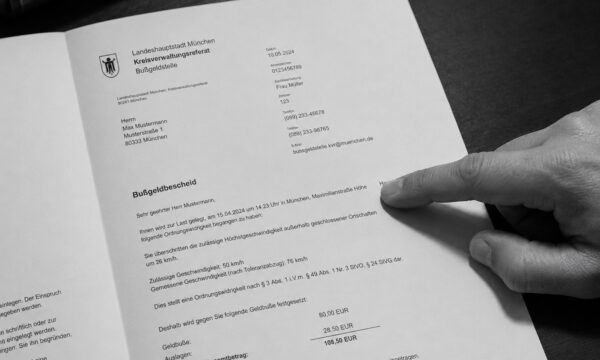
In Munich, traffic violation notices come from three sources: the police (mobile speed enforcement, red-light violations), the Munich City Traffic Violations Office (parking violations), or fixed enforcement cameras (for example, at Heimeranplatz, Mittlerer Ring, and Petueltunnel). The notice almost always begins with a response form—and this is precisely where the strategic course of action is determined. A traffic law attorney in Munich reviews the measurement procedure, the calibration report, and the case file—and files an appeal as soon as the review indicates a chance of success.
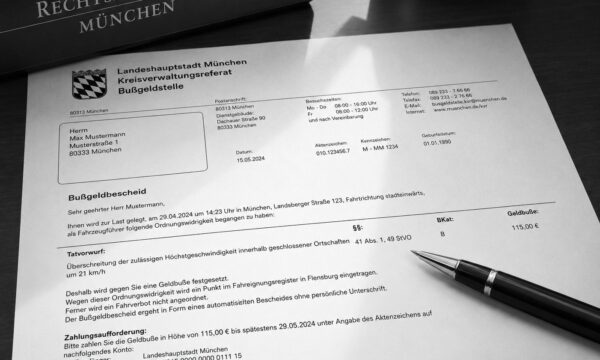
Attorney Blitzer — When It's Worth Filing an Appeal
Speed measurements taken with the PoliScan Speed F1 HP, ES 8.0, TraffiStar S350, or Multanova VR 6F are not technically infallible. Common points of contention include: missing or incorrect calibration; operator errors by personnel; software versions that do not provide access to raw measurement data; and tolerance adjustments that are either not applied or applied incorrectly. For stationary systems, installation location, signage, and maintenance intervals are additional factors. In the Munich metropolitan area, we are well acquainted with these points of contention from ongoing proceedings at the Local Court (Traffic Division, Linprunstraße 22).
From the Law Firm | Access to case files is a requirement, not an option
What many people don’t know: Before a traffic ticket lands in your mailbox, the authorities have already compiled a complete case file—including the measurement report, calibration certificate, proof of training for the measurement personnel, photographs, and the software configuration of the measuring device. The authorities must release this file as soon as a lawyer requests access to it. Only then can the measurement results be properly reviewed—and that is precisely the first step we take in every fine-related case. Without the file, there is no defense; with the file, there is often room for maneuver that remains undiscovered without a lawyer’s review.
The 130% Rule — when the repair costs exceed the vehicle's residual value
The 130-percent rule allows you to have a vehicle professionally repaired and keep it after an accident—even if the repair costs exceed the replacement value by up to 30 percent. Requirements: Repair at a specialized repair shop based on an expert assessment and continued use for six months. Insurance companies often try to settle claims based on the replacement value instead of covering repairs—for collector’s cars, vehicles with a full service history, or specialty vehicles, this can make a significant financial difference. We enforce the 130% rule against the insurer if the requirements are met.
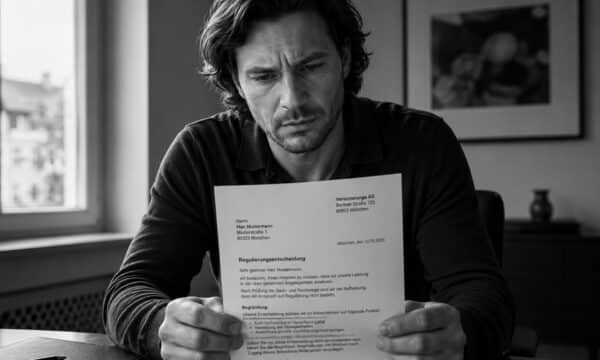
Appeal of a Fine Notice — Deadline and Procedure
The deadline for filing an appeal is two weeks from the date of service. Anyone who misses the deadline is deemed to have accepted the decision—with points on their license, a fine, and, if applicable, a driving ban. During the two-week period, the initial appeal may be filed informally and without providing a statement of grounds; the statement of grounds follows after reviewing the case file. We ensure that the deadline is met, request access to the case file, and then assess the likelihood of success—usually within a few days.
Using a cell phone while driving — 100 euros, one point, and possibly a driving ban
Since 2017, using a cell phone while driving has been punishable by a €100 fine and one demerit point—and if the offense involves endangering others or causing property damage, a one-month driving suspension is also imposed. Defenses include: not making a call, but searching for a location in carousel mode; having the device within reach but not in use; or encountering a traffic obstruction without using the phone. These defenses can be successfully invoked in individual cases.
MPU, Driver's License Suspension & Driver's License — Regaining a License After Suspension
An MPU order (medical-psychological examination) is likely the most expensive and stressful hurdle in German traffic law. In Munich, the State Capital’s Driver’s License Office (Ruppertstraße 19) regularly issues these orders following drunk driving incidents involving a blood alcohol level of 1.6 �� A traffic law attorney in Munich will review whether the MPU order was issued correctly in both form and substance—and can often overturn it if the discretionary decision was based on flawed reasoning.
Request a free initial assessment
Tell us about your case—quickly and with no obligation. We’ll assess your chances of success and get back to you shortly.
or call us directly at: 089 540 239 0
When is an MPU ordered?
An MPU is not mandatory after every traffic violation. The driver’s license office must make a discretionary decision—and it is precisely this discretionary decision that can be challenged by a lawyer. Typical scenarios: Driving under the influence with a blood alcohol level over 1.6
License suspension — provisional suspension in criminal proceedings
In cases of drunk driving with a blood alcohol concentration of over 1.1 In subsequent criminal proceedings, the revocation is then usually made permanent, with a suspension period ranging from six months to five years. Legal leverage: the suspension period is credited against the provisional revocation period, and with active cooperation (traffic psychology counseling, proof of abstinence), the suspension period can be shortened.
Lawyer for Driver's Licenses — Reinstatement After Suspension Period
Once the suspension period has ended, the reinstatement process begins. In Munich, this is handled by the Ruppertstraße Driver’s License Office—requiring an application, a fitness assessment, and, in almost all cases, an MPU. We coordinate the preparation with assessment centers such as TÜV Süd, DEKRA, or pima-mpu, review the authorities’ requirements in advance, and file appeals against denials.
“You can’t prepare for an MPU in your bedroom. Anyone who goes to the assessment center without structured support is highly likely to fail—and will have to pay 700 euros for the next attempt. Our approach: We coordinate the traffic psychology preparation, verify proof of abstinence, and determine the strategy for how and when to submit the application to the driver’s license office. This usually saves at least one attempt—and thus often a six-month wait.”
Marc Frey — Attorney
Traffic Law — Drunk Driving, Hit-and-Run, and Traffic Offenses
It is often a short step from a traffic citation proceeding to criminal traffic law: Anyone who drives with a blood alcohol level of 1.1, causes an accident resulting in personal injury and flees the scene, or commits coercion or endangers others in traffic—none of these cases end up before a traffic court judge, but rather with the district attorney’s office. This fundamentally changes the course of the proceedings, the risks involved, and the defense strategy. A traffic law attorney in Munich with criminal law experience understands these transitions—and intervenes early enough to ensure that a traffic violation case does not escalate into a full trial.
Driving under the influence — §316 StGB / §24a StVG
A blood alcohol concentration of 0.5 � In cases of impaired driving (swerving, accidents), relative unfitness to drive may apply even below 1.1 �
Hit-and-run — §142 StGB; without a lawyer, a penalty is almost always imposed
Hit-and-run—also known as “hit-and-run driving” or “hit-and-run in a traffic accident”—is a criminal offense under Section 142 of the German Criminal Code (StGB). The minimum penalty is a fine; in serious cases, the penalty can be imprisonment for up to three years. If there are injuries or significant property damage, the driver’s license is typically revoked. Important: The legal definition of the offense is narrower than many people think—if you wait, leave a note, and report the incident afterward, you often haven’t committed an offense at all. We carefully examine the objective requirements before engaging with the police.
Coercion in Traffic — §240 StGB
Cutting in on the highway, tailgating with flashing headlights, forcing another driver to brake, or cutting them off: traffic violations can amount to coercion. Penalties: a fine or imprisonment for up to five years, typically accompanied by the revocation of the driver’s license. Key points for the defense: the subjective element (intent to commit the act of coercion), reprehensibility, and the connection to illegality.
Summoned as a defendant — remain silent, then consult
A summons from the police or the district attorney’s office is not an appointment you are required to attend—as a suspect, you have the right to remain silent. It is still important to respond, but not without legal preparation. We request access to the case files, review the allegations, and establish the defense strategy before anyone speaks with the client. In many traffic criminal cases, this approach allows the proceedings to be dismissed at the investigative stage subject to certain conditions—without a trial and without a record on the criminal record.
Insights from the Law Firm | What We See at the Munich District Court
The traffic divisions at the Munich District Court handle a high caseload—in cases involving drunk driving, hit-and-run, and coercion, a standard ruling is often already on the table during the preparatory phase. This is precisely where a structured defense makes all the difference. We use the case file review phase to identify weaknesses in the evidence of the offense—flawed breathalyzer tests, incomplete police reports, and witness statements that contradict one another. We often succeed in having the case dismissed under §153 or §153a of the Code of Criminal Procedure (StPO) even before the main hearing. This spares the client the public hearing, the risk of a criminal record—and, in many cases, their driver’s license.
Emissions Scandal & Buying a Car — Attorney Specializing in Diesel Cases and Automotive Law
The emissions scandal (diesel scandal, Dieselgate) has been a recurring theme in the courts since 2015—and remains unresolved even in 2026. Vehicles affected include those from Volkswagen, Audi, Skoda, Seat, Porsche, Mercedes-Benz, BMW, Fiat (motorhomes), Volvo, and other manufacturers. Following the landmark decisions of the Federal Court of Justice and the case law of the European Court of Justice (C-100/21 regarding Mercedes-Benz liability), claims for damages may take the form of substantial damages (return of the vehicle in exchange for a refund of the purchase price) or minor damages (difference hypothesis, typically five to fifteen percent of the purchase price), depending on the specific circumstances. We have been representing diesel clients since the beginning of the scandal and are familiar with the legal proceedings against the manufacturers.
Which vehicle is affected?
The EA189 engines used by the Volkswagen Group (2.0 TDI, 1.6 TDI, 1.2 TDI) have been known since 2015 for their use of emissions-cheating software. In addition, there are the EA288 successor engines with thermal window control, the EA897 engines in Audi and Porsche, the OM651/OM642 engines in Mercedes-Benz with various defeat devices, and the N47/B47 engines in BMW. We use the VIN to check whether your vehicle is affected—and which claim (major or minor damages) is more economically advantageous.
Statute of limitations in the emissions scandal — time is running out
The standard statute of limitations is three years from the date of discovery (Sections 195, 199 of the German Civil Code (BGB)). For many clients, this period has already expired—depending on the date of purchase, the date on which they became aware of the damage, and any factors that may have tolled the statute of limitations, such as a model declaratory action. In individual cases, the claim under §852 BGB (residual damages after the statute of limitations has expired) may also apply—the ten-year period under §852 BGB significantly postpones the assertion of the claim. The first question in every diesel case: Is the claim still enforceable?
Buying a Car — Warranty, Cancellation, Rescission
When purchasing a car from a private seller or a dealer, Sections 434 et seq. of the German Civil Code (BGB) apply: material defects, repair or replacement, rescission, or reduction of the purchase price. The most common issues in practice: concealed accident damage, tampered odometer readings, and inaccurate descriptions in the sales contract. In private sales, the warranty is often excluded by the terms and conditions—but: this exclusion does not apply in cases of intentional deception. We review the listing, the sales contract, and the description of defects, and enforce your right to rescind the contract or claim damages.
“When it comes to the emissions scandal, the handling process is crucial. In recent years, we have handled a large number of diesel cases against Volkswagen, Mercedes, and BMW—ranging from damage assessments for individual VINs and cost-benefit analyses comparing large versus small damages to lawsuits filed at the Munich I Regional Court. Based on this experience, we know which manufacturers are willing to settle and which will litigate all the way to the highest court.”
Johannes Goetz — Attorney at Law
Traffic Law & Criminal Law in Munich — Local Representation, Short Commutes
Traffic law and criminal law overlap in Munich in several ways—and our clients benefit from the fact that both areas are handled under one roof at KLAMERT & PARTNER. Drunk driving cases are heard by the Traffic Division of the Munich Local Court (Linprunstraße 22, Pacellistraße 5), fine proceedings are handled by the Traffic Division, and driver’s license revocations are processed administratively by the Driver’s License Office on Ruppertstraße. By having everything handled from a single source, you avoid unnecessary delays—and we are familiar with the procedures, practices, and key contacts involved in ongoing cases.
Directions to the relevant government offices — all within a 15-minute radius
- Munich Local Court, Traffic Division — Linprunstraße 22, 80335 Munich
- Munich Local Court, Main Building — Pacellistraße 5, 80333 Munich
- Munich Police Headquarters — Ettstraße 2, 80333 Munich (ten minutes from Pettenkoferstraße)
- Munich City Driver's License Office — Ruppertstraße 19, 80337 Munich (four stops on the U3/U6 subway line from Goetheplatz)
- State Capital Traffic Fines Office — Sebastian-Bauer-Straße 16, 81737 Munich (for parking violations and parking fines)
Best Traffic Law Attorney in Munich — What Sets Us Apart
We do not appear in rankings whose methodology we do not understand—and we do not advertise with statistics that mean nothing in individual cases. Instead, we can back up the following: Over 15,000 traffic law cases handled since 1987. Three licensed attorneys with decades of experience in traffic law. Multilingual team (German, English, Ukrainian, Russian, Portuguese). Response within one business day. Structured initial review as part of our free initial assessment.
Frequently Asked Questions for Your Traffic Law Attorney in Munich
How much does a traffic law attorney in Munich cost?
Our initial assessment of the prospects of success is free of charge and non-binding. We bill subsequent cases in accordance with the RVG (Lawyers’ Fees Act) or based on an individual fee agreement. If you have legal expenses insurance, we will handle the coverage inquiry—the insurer will then cover the costs. In fine proceedings, the procedural fee depends on the amount of the fine; in traffic criminal law, fees are determined by the stage of the proceedings (investigation, trial, appeal).
Will my legal expense insurance cover my attorney's fees?
In traffic law, legal protection insurance generally applies—most policies include traffic legal protection covering fines, traffic criminal law, and liability claims. Important: The coverage request must be submitted before retaining our services. We will handle communication with your insurer and confirm the coverage commitment. In cases involving allegations of intentional misconduct (drunk driving, hit-and-run), coverage is often granted on a provisional basis—the final commitment depends on the outcome of the proceedings.
How long do I have to file an appeal against a traffic ticket?
Two weeks from the date of service of the notice. Service is effected by certified mail or registered letter—the date of service is indicated on the yellow envelope or in the certified mail receipt. The appeal must be received by the fine-imposing authority within these two weeks. No statement of reasons is required—the appeal is initially sufficient even if it is informal. The statement of reasons follows after reviewing the case file.
What should you do if your driver's license has been temporarily suspended?
In cases of drunk driving with a blood alcohol concentration (BAC) above 1.1, the driver’s license is typically confiscated immediately at the scene of the incident. In subsequent proceedings, the court orders the provisional suspension of the driver’s license pursuant to Section 111a of the Code of Criminal Procedure (StPO). The fastest possible legal step: filing a motion to lift the provisional suspension—here, conflicting professional reasons, faulty breathalyzer readings, or claims of post-drinking consumption may be considered. A complete lifting of the suspension is rare but possible; more often, the suspension period is successfully reduced during criminal proceedings.
Is it always worth appealing a speeding ticket?
No. When measurements are accurate—with proper calibration, trained personnel, and a clear tolerance margin—there is little room for challenge. We review all technical and procedural requirements during our review of the case file—and provide an honest assessment of whether an appeal has a realistic chance of success. When a driving ban is at stake, appealing is often more worthwhile than in cases involving only a fine, because the financial stakes are higher.
What happens in the case of a hit-and-run with no personal injury?
In cases of purely property damage under approximately €1,300, the proceedings can often be dismissed in exchange for a fine—usually under Section 153a of the Code of Criminal Procedure (StPO). However, this is typically accompanied by three points on the driver’s license in Flensburg, as well as a request from the insurance company to determine whether the client will be held liable for recourse if they are found to be partially at fault. In cases of higher damages or personal injury, the main trial may result in a fine (often 30 to 90 daily rates) and a driver’s license suspension. Defense strategy: narrowing the scope of the charges (“no legitimate interest of the entitled party,” “reported immediately”).
I was caught driving under the influence of drugs—what now?
Driving under the influence of drugs is punishable under §24a of the Road Traffic Act (StVG) (administrative fine) or §316 of the Criminal Code (StGB) (criminal proceedings in cases of impaired driving). In addition, there are administrative consequences: In cases involving hard drugs (cocaine, heroin, amphetamines), the driver’s license office typically orders the immediate revocation of the driver’s license—even for a single instance of use. With regard to cannabis, the situation has become more nuanced since the legalization of cannabis in 2024. We review the order for an assessment and represent you against the driver’s license office.
How soon can I expect a response?
Within one business day. In traffic law, time is of the essence—hearing forms with 14-day deadlines, appeal deadlines, and provisional driver’s license suspensions. We know that every hour counts, and we’ll get back to you within 24 hours with an initial response—even if the full review takes longer.
Can you also handle cases in foreign languages?
Yes. Our team provides consultations in German, English, Ukrainian, Russian, and Portuguese. This is common in traffic law—international clients involved in accidents while visiting Munich, Ukrainian- and Russian-speaking clients, and Brazilian businesspeople. The legal work is handled by our licensed attorneys; communication in foreign languages is managed by the respective team members.
What does the 130% rule mean in the context of a traffic accident?
If the repair costs for your vehicle after an accident exceed the replacement value by up to 30 percent, you may still have the vehicle professionally repaired and keep it. The insurance company must reimburse the repair costs—provided that you have the vehicle repaired at a specialized repair shop in accordance with an expert’s report and continue to use the vehicle for at least six months. Insurance companies often try to pay out the lower replacement value instead of covering the repair costs. We enforce the 130-percent rule when the conditions are met.
Am I required to make a statement after an accident?
As a party involved in the accident, you have the right to remain silent when speaking to the police—even without being formally informed of your rights as a suspect. The information you are required to provide is limited to your personal details (name, address, date of birth) and insurance information. You are not required to say anything about the circumstances of the accident. Recommendation: Exchange personal information and insurance details, but nothing else—until an attorney has reviewed the facts of the case by accessing the file.
Request a free initial assessment
Tell us about your case—quickly and with no obligation. We’ll assess your chances of success and get back to you shortly.
or call us directly at: 089 540 239 0
Traffic Law Attorney in Munich — Right Next to Theresienwiese
Our office is located at Pettenkoferstraße 37 —right next to Theresienwiese, in the heart of the hospital district of Ludwigsvorstadt-Isarvorstadt. The location is convenient for traffic law matters: it is a ten-minute walk from the Munich District Court at Linprunstraße 22 (Traffic Division), a ten-minute walk from the Police Headquarters on Ettstraße, and four subway stops on the U3/U6 from Goetheplatz to the Driver’s License Office on Ruppertstraße.
Directions by public transportation
- U4/U5 subway: Theresienwiese station (a three-minute walk)
- Subway U3/U6: Goetheplatz Station (five-minute walk)
- Subway lines U1, U2, U7, and U8: Sendlinger Tor station (an eight-minute walk)
- All S-Bahn lines: Munich Central Station (a ten-minute walk)
- Bus: Georg-Hirth-Platz stop (a three-minute walk)
Office Hours and Contact Information
Mon–Fri, 8:00 a.m. to 5:30 p.m., in person at our office. By phone at 089 540 239 0, by fax at 089 540 239 199, or by email via the contact form. Appointments outside of office hours and video consultations are available by individual arrangement—especially important for working clients and clients residing outside of Munich.
Free Initial Consultation with Your Traffic Law Attorney in Munich
In traffic law, every day counts—hearing forms, appeal deadlines, provisional license suspensions, insurance quotes. As part of our free initial assessment, we’ll review your case to determine its prospects of success, with no obligation on your part. Any further legal advice will be provided only after you retain our services and we agree on our fees—this approach is transparent and predictable.
“Over 10,000 traffic law cases since 2005—that’s not just a number. It’s the foundation that allows us to handle traffic tickets, accidents, MPU orders, and traffic criminal proceedings with expertise, but without a one-size-fits-all approach. Every case is unique—we know the ins and outs of navigating Munich’s government agencies, courts, and insurance companies.”
Markus Klamert — Attorney, Founding Partner