
Inheritance Law Attorney
Munich —
KLAMERT & PARTNER
Select your preferred language

Inheritance law in Munich is rarely an abstract topic. It’s the phone call that comes in the morning. It’s the letter from the Munich Probate Court sitting in the mailbox between the junk mail and the electricity bill. It’s the question of whether what Mom or Dad put in writing will even hold up in court. At KLAMERT & PARTNER, we have been advising heirs, beneficiaries of a compulsory share, executors, and testators since 2005—those who wish to organize during their lifetime what cannot be organized later. As estate planning attorneys in Munich, we are not only familiar with the legal provisions—but also with the departments at the Munich Local Court and Probate Court, located at Maxburgstraße 4, where decisions are made regarding whether a handwritten will from 1998 is still valid today. For us, estate planning in Munich means: a free initial assessment, clear language, and no boilerplate templates.
When do you need an estate planning attorney in Munich?
Inheritance cases come to us in two distinctly different situations—and any attorney practicing inheritance law in Munich should be familiar with both. One scenario begins with a death: a parent has passed away, a sibling has filed the will with the Munich Local Court for probate, and suddenly the question arises as to whether the contents are correct, whether the statutory share is sufficient, and whether to apply for a certificate of inheritance or whether it would be better to renounce the inheritance. In this context, inheritance law in Munich is a matter of crisis—emotional, often fraught with conflict between siblings, and sometimes involving second or third marriages with a patchwork of heirs.
The other approach is strategic. A client calls because, in his early 60s, he wants to hand over the family business to his daughter without his second son later asserting claims to a statutory share that would undermine the company. A client asks whether a Berlin will makes sense for her and her husband, or whether the interdependence will become too rigid later on. These cases are not emergencies—but any weakness in the drafting will have consequences decades later, when the parties involved can no longer consult their lawyer.
At KLAMERT & PARTNER, we see both scenarios in Munich’s inheritance law with a frequency that can only be found in a major city with 1.5 million residents and above-average real estate assets. The fact that Munich is one of the most expensive locations in Germany for inheritance matters is not a cliché, but a hard fact: For condominiums in mid-range locations, the market value often ranges from 800,000 to 1.2 million euros—and thus significantly exceeds the tax-free allowance for siblings (€20,000) or domestic partners without a registered partnership. In many Munich inheritance cases, the inheritance tax becomes the actual breaking point. Anyone acting here without professional advice can quickly end up paying a six-figure sum.
FROM OUR PRACTICE – OBSERVATIONS AT THE MUNICH PROBATE COURT
In the divisions of the Munich Local Court, Probate Division, located at Maxburgstraße 4, we frequently find that opening transcripts—particularly for holographic wills—regularly raise questions of interpretation that the court does not resolve during the opening hearing. For heirs, this means: Those who sit on the record and think, “This is now official,” often overlook the fact that the real battle—heir status, statutory share, interpretation of ambiguous wording—only begins afterward. This is precisely where a lawyer’s experience makes the difference: The question is not what the will says, but how the Munich Probate Court interprets it in its case law.
Common issues that clients bring to us:
- My father has passed away—how can I find out if there is a will?
- My brother inherited everything in the will, and I got nothing—can I have my statutory share calculated?
- I received a notice of commencement from the Munich Probate Court—what should I do next?
- We want to draw up a Berlin will, but we're worried about our daughter from our first marriage.
- My husband transferred ownership of the apartment to me three years ago—are the children’s statutory inheritance rights now reduced?
- Should I renounce the inheritance? The six-week period began yesterday.
- The community of heirs, which includes my siblings, has been blocking the sale of the property for eight months.
“In inheritance law, it’s rarely the first day that matters—but almost always the first six weeks. Anyone who misses the deadline for renouncing an inheritance may, in case of doubt, be liable with their personal assets. Anyone who is unaware of the deadline for claiming a compulsory share loses out on cash claims. We’ve seen this happen here on Heimeranstraße for over thirty years—and that’s exactly why we offer a free initial assessment. So that this first call doesn’t fall through because of cost concerns.”
— Markus Klamert, attorney and founder of KLAMERT & PARTNER
Our Areas of Practice as Inheritance Lawyers in Munich
Seven practice areas in which we at KLAMERT & PARTNER, as estate planning attorneys in Munich, work diligently and with meticulous attention to detail. The order is based on the frequency of client cases according to our case statistics—not alphabetically or according to their importance in legal textbooks. We discuss each practice area in practical terms below.
Statutory share and claims for a supplement to the statutory share
The statutory share is the most common point of contention in inheritance law in Munich. According to Sections 2303 et seq. of the German Civil Code (BGB), those entitled to a statutory share include children, the surviving spouse, and—in the case of childless decedents—the parents. The statutory share amounts to half of the legal inheritance. We calculate the statutory share based on the market value of the entire estate as of the date of death, review gifts made in the last ten years to determine the claim for a supplementary statutory share under § 2325 BGB, and, if necessary, assert the right to information under § 2314 BGB if the heir does not voluntarily provide the inventory of the estate.
Drafting, reviewing, and contesting a will
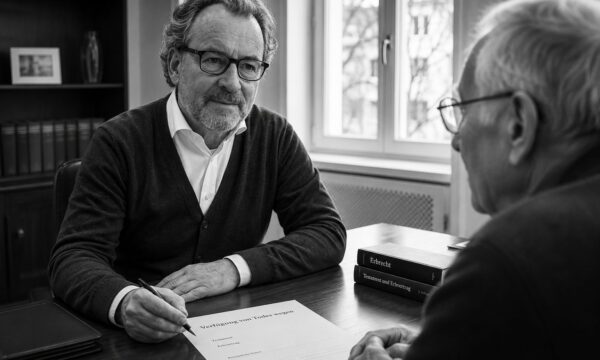
We draft individual wills, joint wills for spouses (Berlin will, § 2269 BGB), and inheritance agreements—and we review existing wills for potential ambiguities, formal validity, and contestability. In practice, we most frequently encounter disputes over holographic wills that were only partially written by the testator themselves, or over wills made during periods of nursing home care where there are doubts regarding testamentary capacity under § 2229 BGB.
Munich Probate Court and Certificate of Inheritance Proceedings
The Munich Local Court, Probate Division, located at Maxburgstraße 4, has local jurisdiction over most probate cases in Munich. We represent clients in probate certificate proceedings, apply for partial probate certificates and joint probate certificates, provide advice on the opening of wills, and conduct appeals against decisions denying probate certificates.
Renunciation of an inheritance, estate liabilities, and estate insolvency
Anyone who accepts an over-indebted inheritance may, in case of doubt, be liable with their own assets. We review the six-week deadline for renouncing an inheritance under § 1944 of the German Civil Code (BGB), apply for estate administration or, if necessary, estate insolvency proceedings, and advise on the defense of insufficiency of assets under § 1990 BGB, which can limit liability to the estate.
Community of Heirs and Distribution of the Estate
In Munich inheritance law, disputes among communities of heirs are among the most intractable—not least because German law has structured them as compulsory communities. In the case of real estate estates in Munich, these disputes regularly arise over the question of who is permitted to sell, when, and what share they may sell. We negotiate partition agreements, represent clients in partition auctions at the Munich Local Court, and assess whether a partition action under Section 2042 of the German Civil Code (BGB) is the faster or the more expensive route.
Gifts during one's lifetime and anticipated succession
Transferring assets during one’s lifetime can reduce claims to a statutory share, inheritance tax, and the potential for disputes—but only if the transfers are structured properly. We draft transfer agreements that include a reservation of usufruct, a right of residence, or clawback clauses, and we plan chains of gifts so that the ten-year period specified in Section 2325(3) of the German Civil Code (BGB) actually begins to run.
International Succession Law and the EU Succession Regulation
For clients with international ties—such as real estate in Italy, a primary residence in Austria, or dual citizenship—we apply the EU Succession Regulation (Regulation (EU) No. 650/2012). We clarify the applicable law, the European Certificate of Succession, and the rules governing jurisdiction. In such cases, inheritance law in Munich is often only the starting point for cross-border proceedings.
The Statutory Share in Inheritance Law — The Most Common Point of Dispute
If we, as estate planning attorneys in Munich, were to rank the reasons why clients first pick up the phone, the statutory share would be by far the number one reason. The situation is almost always the same: a parent has passed away, a child has been omitted from the will or the estate has been transferred to the surviving spouse, and the child who was left out wonders what, if anything, they are still entitled to.
Who is entitled to a statutory share?
Under Section 2303 of the German Civil Code (BGB), those entitled to a compulsory share are the descendants (children, or if the children have predeceased the testator, their children) and the surviving spouse. Parents are entitled to a compulsory share only if the decedent leaves no children. Siblings are never entitled to a compulsory share. Since the 1998 equalization of inheritance rights, children born out of wedlock are also fully entitled to a compulsory share, a fact that is regularly overlooked in older family structures.
How is the statutory share calculated?
The statutory share amounts to half of the legal inheritance. For example, if a married testator with two children names the surviving spouse as sole heir in the will, each child’s legal inheritance is one-fourth—meaning the statutory share is one-eighth of the estate’s value. Calculating the statutory share in Munich inheritance law always involves: the market value of the estate’s assets as of the date of death, the valuation of real estate (usually through an appraisal—which is almost always disputed in Munich due to market dynamics), the deduction of actual estate liabilities, and then the determination of the share.
Claim for a supplementary statutory share under § 2325 of the German Civil Code (BGB)
In this area, we most often see clients in Munich underestimating what they are entitled to under inheritance law. Gifts made by the decedent in the ten years prior to their death are fictitiously added to the estate for the purpose of calculating the claim to a supplementary statutory share—reduced by ten percent for each full year that has elapsed since the gift was made. For gifts between spouses, however, this period does not begin until the dissolution of the marriage or death. So, if someone transferred an apartment to their daughter eight years ago and now passes away, 20 percent of that gift is still taken into account for the bypassed son’s claim to a supplementary statutory share—which can quickly amount to a six-figure sum for a Munich condominium.
Right to information under Section 2314 of the German Civil Code (BGB)
Heirs entitled to a statutory share have a legal right to demand that the heirs prepare an inventory of the estate—even in notarized form, if requested. We enforce this right either out of court or through a staged lawsuit. In our experience, a staged lawsuit is often the decisive lever in Munich cases involving the statutory share: Only when the heirs submit the complete inventory under the pressure of litigation can the statutory share be reliably quantified.
FROM OUR PRACTICE – NEGOTIATIONS REGARDING THE LEGAL SHARE OF AN ESTATE INCLUDING REAL ESTATE APPRAISAL
In the case of a client whose estate included a condominium in Munich, an overlooked child, and an elderly decedent: The initial list of heirs indicated a market value of “€800,000.” Following a staged lawsuit and a court-ordered expert appraisal, the actual market value was determined to be €1.15 million. The difference increased the statutory share by just under €44,000—for an eighth share. We must anonymize such cases because § 6 BORA (as amended) prohibits us from advertising with specific clients—but the logic behind this shows what statutory share negotiations in Munich inheritance law are really about: valuation trumps calculation.
“My favorite line in a statutory share case: ‘But that’s how the notary did it.’ That’s exactly where the problem lies. Notaries authenticate documents—they don’t negotiate on behalf of one party. A waiver of the statutory share or a gift with a reservation of usufruct is drafted by the other party or the tax advisor, not by you. That’s exactly what we review—clause by clause.”
— Marc Frey, Attorney at Law, specializing in contract and property law
Wills in Munich — Drafting, Contesting, and Interpreting
From a legal standpoint, a will is a unilateral, highly personal disposition of property upon death. In practice, it is the document that can either keep families together or tear them apart. At Munich Inheritance Law, we advise clients on drafting new wills as well as challenging existing ones—and in both scenarios, we see recurring mistakes that could be avoided with legal guidance.
Handwritten will
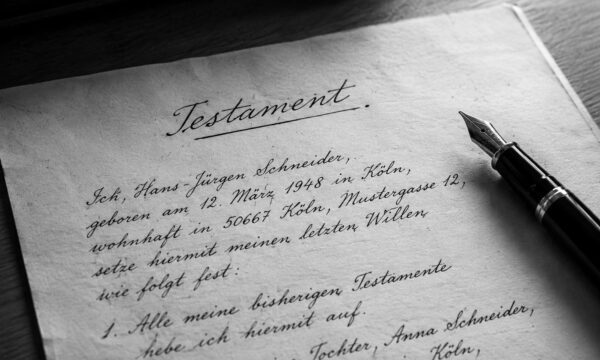
A holographic will under Section 2247 of the German Civil Code (BGB) must be written entirely by hand, signed with the testator’s first and last names, and ideally include the place and date. Computer printouts with a handwritten signature are invalid. At the Munich Probate Court, we regularly see wills in which only a single addition was handwritten or the signature is missing—in these cases, intestate succession applies, often with a result quite different from what the testator intended.
Notarized will
A notarized will is drawn up by a notary public (§ 2232 BGB). Advantage: In most cases, it eliminates the need for a subsequent certificate of inheritance, which saves several thousand euros in certificate fees for real estate estates in Munich. Disadvantage: higher drafting costs, though these are almost always worth it for estates worth more than 250,000 euros.
Berlin Will
The joint spousal will—which is very common in Munich—typically provides that the spouses name each other as sole heirs, with the children inheriting only after the death of the last surviving spouse (residual heir arrangement). What many couples underestimate is that, following the first death, the reciprocal dispositions become legally binding under Section 2271 of the German Civil Code (BGB). Anyone who then spends their twilight years with a new partner and wishes to leave them something has very little legal leeway.
Challenging a Will and Incapacity to Make a Will
Grounds for contesting a will under Sections 2078 et seq. of the German Civil Code (BGB) include, in particular, error as to the subject matter, error as to the motive, and duress. In practice, however, the most common ground is lack of testamentary capacity under Section 2229 of the German Civil Code (BGB)—typically in the case of testators with advanced dementia who drew up a will in favor of a caregiver just a few weeks before their death. In such cases, we review medical records, care documentation, and medical certificates; if necessary, we obtain a subsequent expert opinion; and we conduct contestation proceedings at the Munich Local Court, Probate Division.
Deposit a will
Holographic wills should be filed with the Munich Probate Court. Filing involves a one-time flat fee and ensures that the will can actually be located and opened after death. In the event of death, the Probate Court automatically consults the Central Register of Wills maintained by the Federal Chamber of Notaries.
Request a free initial assessment
Tell us about your case—quickly and with no obligation. We’ll assess your chances of success and get back to you shortly.
or call us directly at: 089 540 239 0
FROM OUR PRACTICE – MULTILINGUAL ESTATE PLANNING CASES
One practical advantage of our firm that we often only mention to clients when asked: At KLAMERT & PARTNER, we provide legal advice in German, English, Ukrainian, Russian, and Portuguese. In the field of inheritance law in Munich, this is not merely a theoretical point but has real-world relevance. A Ukrainian client whose mother, who had her primary residence in Kyiv, has passed away and left real estate in Munich falls into a special category under the EU Succession Regulation—and needs legal advice that can be provided without translation.
Traditional scenarios also arise on a daily basis: Russian-speaking testators with assets in multiple countries, Brazilian-German dual citizens with real estate in São Paulo. Language proficiency alone does not solve a case—but it ensures that nothing falls through the cracks due to translation. Denys Osypenko is the designated contact person for immigration law; in probate matters, he assists licensed attorneys when Ukrainian- or Russian-speaking clients come in.
“What sets our law firm apart from many of our competitors is not a particular area of specialization, but rather a commitment to precision. In the field of inheritance law in Munich, we take every case seriously—even those involving a statutory share of €30,000—not just those involving substantial estates. This is precisely the approach we have upheld for over thirty years on Heimeranstraße. Money, gold, property—and the people behind them.”
— Johannes Goetz, Attorney at Law, specializing in banking and insurance law
Munich Probate Court — What You Can Really Expect There
The Munich Probate Court is part of the Probate Division of the Munich Local Court. Address: Maxburgstraße 4, 80333 Munich, in the courthouse directly on Lenbachplatz, within walking distance of Karlsplatz/Stachus. This is where wills are opened, certificates of inheritance are issued, probate guardianships are ordered, and renunciations of inheritance are accepted. For most inheritance cases in Munich, the Munich Probate Court has exclusive local jurisdiction—depending on the decedent’s last habitual residence (Section 343 FamFG).
Opening of a Will
As soon as a will is received by the probate court—either because it was deposited there or because a privately written will is submitted—the court sets a date for the opening of the will. The statutory heirs and all beneficiaries named in the will receive a record of the opening containing the contents of the will. This record marks the starting point for nearly all subsequent steps: claiming a statutory share, contesting the will, applying for a certificate of inheritance, or renouncing the inheritance. In Munich inheritance law, the record practically always also marks the beginning of strict deadlines.

Application for a Certificate of Inheritance
The heirs apply for the certificate of inheritance by making a statement on the record of the probate court or by means of a notarial deed. The following documents are required in all cases: the death certificate, marriage certificates (if applicable), the heirs’ birth certificates, and an affidavit of inheritance. For larger estates in Munich, we recommend applying for the certificate of inheritance through a notary—this expedites the process and reduces the need for follow-up inquiries.
Renunciation of an inheritance at the probate court
The renunciation of an inheritance must be declared in person before the Munich Probate Court for the record—or by means of a notarized declaration. The deadline is six weeks from the date of becoming aware of the inheritance (§ 1944 BGB); if the heir is residing abroad, the deadline is six months. Anyone who misses the deadline is deemed to have accepted the inheritance and, in case of doubt, is liable for the estate’s debts with their personal assets.
FROM OUR PRACTICE – RENUNCIATION OF AN INHERITANCE UNDER TIME PRESSURE
In about one-third of the inheritance renunciation cases we handle at Erbrecht München, the six-week deadline has already begun when we are first contacted. Our recommendation: if you suspect excessive debt or if the decedent’s financial situation is unclear, consult a lawyer within three weeks at the latest—not only after the bank has sent out account statements. Practical tip: If time is tight, the renunciation of inheritance in Munich can also be submitted through any notary (with a notarized declaration)—faster than an appointment at the probate court. We communicate this option immediately in urgent cases.
Request a free initial assessment
Tell us about your case—quickly and with no obligation. We’ll assess your chances of success and get back to you shortly.
or call us directly at: 089 540 239 0
Certificate of Inheritance, Status as an Heir, and Renunciation of Inheritance
A certificate of inheritance is the probate court’s official document confirming one’s status as an heir. Banks, the land registry, and government agencies require it if there is no notarized will. Without a certificate of inheritance, little can be done in a Munich estate that includes real estate: the land registry requires it for the transfer of title, and the bank will not release any accounts without it.
Should I apply for a certificate of inheritance myself or hire a lawyer?
In straightforward cases involving a clear line of succession and no disputes, the application for a certificate of inheritance can be handled directly through the Munich Probate Court. However, as soon as claims to a statutory share, the interpretation of a will, or multiple lines of heirs come into play, we recommend seeking legal counsel—the application contains sworn statements, and making amendments is a time-consuming process.
Partial certificate of inheritance and joint certificate of inheritance
When there are multiple heirs, there are two options: a joint certificate of inheritance, which lists all heirs and their respective shares, or a partial certificate of inheritance, which documents only the status of a single heir. In disputed communities of heirs in Munich, the partial certificate of inheritance is often the faster option because it does not require the cooperation of all the other heirs.
European Certificate of Succession
In cases involving cross-border inheritance—such as property in Spain, a bank account in Austria, or an inheritance in Italy—the European Certificate of Succession under Article 62 of the EU Succession Regulation replaces the national certificate of inheritance in nearly all EU member states. We apply for the certificate at the Munich Probate Court and assist with the recognition procedures in the respective EU member states.

Renunciation of an inheritance — when is it advisable?
Renunciation of an inheritance should always be considered if the estate is insolvent, if tax liabilities exceed the value of the assets, or if, for personal reasons, the heir wishes to sever all ties with the decedent. Important: Renunciation takes effect retroactively as of the date of death. Anyone who renounces the inheritance is deemed not to have become an heir—which in turn triggers the inheritance rights of the next in line (the children of the person renouncing the inheritance, then the testator’s siblings). In Munich inheritance law, we regularly see parents who wish to renounce the inheritance on behalf of their minor children without considering that this declaration requires approval from the family court.
Gifts during one's lifetime and anticipated succession
Transferring assets during one’s lifetime is one of the most effective tools in Munich inheritance law—both for tax purposes and to reduce future claims to a statutory share. For real estate assets in Munich valued at 500,000 euros or more, structured gift planning advice is worthwhile in almost every case.
Take advantage of tax deductions
The gift tax exemptions (which can be used again every ten years) are €500,000 per spouse, €400,000 per child, and €200,000 per grandchild. Anyone who directly bequeaths a Munich condominium with a market value of €1.2 million to a child will pay between 11% and 19% in inheritance tax on the €800,000 taxable portion, depending on their tax bracket. A gift spread out over two ten-year periods can significantly reduce this tax burden.
Usufruct, right of residence, clawback clause
A gift does not necessarily mean that the donor relinquishes control. We regularly draft transfer agreements that include a reservation of usufruct (income remains with the donor), a right of residence (use remains with the donor), or a clawback clause (reversal of the transfer in the event of the donee’s insolvency, divorce, or predecease). These arrangements simultaneously reduce the tax value of the gift.
Supplement to the Statutory Share — The Underestimated Pitfall
Gifts reduce claims to a compulsory share only if the ten-year period specified in § 2325(3) of the German Civil Code (BGB) has expired—and even then, only if the gift is properly structured. Anyone who has an apartment transferred to them by a notary but reserves a lifetime usufruct has not, in the legal sense, “parted with” the apartment—according to established Federal Court of Justice (BGH) case law, the period does not even begin to run in such cases. Inheritance law in Munich has its own market relevance here: the scenario where parents transfer an apartment to a child while retaining usufruct arises among clients almost weekly—usually with the mistaken belief that the claim to a supplementary statutory share “expires in ten years.”
Advance Succession Planning for Businesses and Family Assets
For family businesses and complex estate structures, we combine gift agreements with corporate structuring—including voting rights arrangements, preliminary and subsequent inheritance, and foundation solutions. Markus Klamert leads this work, integrating the firm’s estate planning expertise with its core practice areas in property law.
FROM OUR PRACTICE – HOW OUR FREE INITIAL ESTIMATE WORKS
At Heimeranstraße, we have deliberately streamlined the initial consultation process for inheritance law in Munich. You describe your case to us in two to three sentences—the reason, the date, and your question. Within one business day, you’ll receive an initial assessment of whether you have a valid claim, what the applicable deadline is, and what steps would be advisable next. This initial assessment is free of charge and non-binding.
Only then do you decide whether you want to retain us. We believe that those who don’t need legal representation shouldn’t be given it—we consciously uphold this principle because it works better for both parties in the long run. Clients who return to us later with larger inheritance or statutory share cases are often the very ones to whom we said, upon their initial inquiry, that legal action wasn’t worth pursuing.
“We’ve handled many probate cases over the past few decades. What this experience means isn’t that ‘we know every possible scenario’—no law firm does. What it means is that we’ve learned where the real leeway lies in Munich probate law—and where it only appears to exist. Recognizing this difference is the most important task in the early stages of a case—especially when it comes to statutory shares and lifetime gifts.”
— Markus Klamert, attorney and founder of KLAMERT & PARTNER
How Your Inheritance Lawyer in Munich Works — Four Steps
1. Free initial assessment within 24 hours
Please describe your situation to us—via the contact form, by phone, or in person at Heimeranstraße 37. We’ll get back to you within one business day with an initial assessment of the situation: what claims you may have, what deadlines are in effect, and what documents we’ll need. There are no costs to you at this stage—the free initial assessment is a standard service we provide at Erbrecht München before accepting any case.
2. Review of documents and strategy development
Once retained, we review wills, applications for certificates of inheritance, gift agreements, opening records, and estate inventories. We develop a concrete strategy: out-of-court negotiations, staged litigation, certificate of inheritance proceedings, or contestation. In cases involving the statutory share, we simultaneously calculate realistic best-case and worst-case scenarios so that you know exactly what you’re fighting for.
3. Hearing, lawsuit, or proceeding at the Munich Probate Court
Most of the probate cases we handle are settled out of court—through a settlement regarding the statutory share, a distribution agreement, or the issuance of a certificate of inheritance by mutual consent. When negotiations break down, we file a lawsuit with the competent Regional Court of Munich I (for claims regarding the statutory share with a value in dispute of €5,000 or more) or proceed before the Probate Court of Munich at Maxburgstraße 4.
4. Finalization — Payment, Registration, Tax Return
It is only during the enforcement phase that a judgment or settlement is converted into actual assets. We assist with the disbursement of funds, the transfer of title in the land registry, the filing of the inheritance tax return, and—if necessary—the subsequent distribution of the estate among the heirs. For us, inheritance law in Munich does not end with the judgment, but rather with the funds being deposited into the account and the entry being made in the land registry.
Frequently Asked Questions About Inheritance Law in Munich
When do I need an estate planning lawyer in Munich?
At the very latest when you have received a notice of probate from the Munich Probate Court, when claims to a statutory share are at issue, when you need to consider renouncing an inheritance, or when you wish to draft a will that will remain valid in the future. In Munich inheritance law, the deadlines are short—six weeks for renouncing an inheritance, and a three-year statute of limitations for claims to a compulsory share starting from the date of knowledge (§ 199 BGB). Those who act early almost always have more options.
How much does an estate planning lawyer cost in Munich?
KLAMERT & PARTNER offers a free initial assessment of your case. Any further consultation regarding inheritance law in Munich will be provided after you retain our services—either based on RVG fees calculated according to the value of the matter (in inheritance proceedings, this is typically the statutory share or the estate interest) or according to an individual fee agreement. If you have legal expense insurance that includes an inheritance law component, we will handle the coverage inquiry. Practical note: In claims for the statutory share, the cost risk is almost always lower than the expected statutory share claim—which makes the lawsuit economically justifiable.
How long do I have to renounce the inheritance?
Six weeks from the date of becoming aware of the inheritance and the grounds for contesting it (Section 1944 of the German Civil Code). If the heir’s habitual residence is abroad, the period is six months. The deadline cannot be extended. Anyone who misses this deadline is deemed to have accepted the inheritance and is liable for all estate debts—including with their own assets—unless estate administration or estate insolvency proceedings are ordered.
Where is the Munich Probate Court located?
The Munich Local Court, Probate Division, is located at Maxburgstraße 4, 80333 Munich, in the courthouse on Lenbachplatz. You can reach the switchboard via the main number of the Munich Local Court. The mailing address is the same. The court is accessible by subway (Karlsplatz/Stachus, Odeonsplatz), S-Bahn (Karlsplatz/Stachus), and several tram lines. From our law office at Heimeranstraße 37, the court is easily accessible by subway (U4/U5).
How is the statutory share calculated?
The statutory share amounts to half of the legal inheritance. It is calculated based on the market value of the entire estate as of the date of death, minus the estate’s actual liabilities (funeral costs, outstanding claims, tax debts), plus eligible gifts made in the last ten years for the purpose of determining the claim for a supplementary statutory share under Section 2325 of the German Civil Code (BGB). In Munich inheritance cases involving real estate assets, valuation is often the core of the dispute—we regularly collaborate with Munich real estate appraisers whose expert opinions are upheld in court.
Do I need a will if the order of statutory succession is sufficient?
It’s not mandatory, but it’s usually worth it. The statutory order of succession rarely reflects the specific circumstances of an individual family—and it doesn’t protect against disputes over the statutory share. At Inheritance Law Munich, we recommend a will drafted with legal counsel in almost all cases involving blended families, childless marriages, unmarried couples living together, self-employed individuals with business assets, and Munich real estate holdings valued at 500,000 euros or more—or an inheritance contract if legally binding effect is desired.
What happens if the will is invalid?
If the will is invalid, the intestate succession rules apply. This is the risk most frequently underestimated in practice when it comes to holographic wills. Anyone who writes a handwritten will that does not meet the written form requirements of § 2247 of the German Civil Code (BGB) leaves their family in exactly the situation they wanted to avoid. We review wills for both formal and substantive compliance before they are executed—a review that takes hours but has an impact for decades.
Can I exclude my children from receiving their statutory share of the estate?
In practice, no. Under Section 2333 of the German Civil Code (BGB), a complete disinheritance is possible only in very limited exceptional cases—such as severe physical abuse, an intentional criminal offense against the decedent, or a malicious breach of the legal duty to provide support. Mere disagreements or the fact that “the son hasn’t been in touch for years” are not sufficient grounds. Instead, we often recommend agreements to waive the statutory share during the testator’s lifetime in exchange for a settlement—a solution well-established in Munich inheritance law for wealthy families.
How long can a community of heirs exist?
Theoretically unlimited—in practice, it usually becomes a burden. Any co-heir may demand the division of the estate at any time (Section 2042 of the German Civil Code). In the case of a community of heirs with real estate in Munich, this often leads to a partition auction at the local court—a type of forced sale in which the property may be sold below market value. We strive to resolve disputes out of court, through payment plans or sale to a co-heir—in Munich inheritance law, a partition auction is almost always the worst economic outcome for all parties involved.
What is the claim for a supplementary statutory share?
The claim for supplementation of the statutory share (§ 2325 BGB) allows the beneficiary of the statutory share to fictitiously add gifts made by the decedent during the ten years prior to his or her death to the estate. One-tenth is deducted for each full year that has elapsed since the gift was made—a gift made seven years ago is therefore still taken into account at 30%. For gifts between spouses, the period does not begin until the dissolution of the marriage or death. According to Federal Court of Justice (BGH) case law, it does not begin at all for gifts subject to a right of usufruct—a detail that regularly makes the difference in Munich inheritance law when it comes to real estate gifts.
What is the inheritance tax rate in Munich?
Inheritance tax is not based on the place of residence, but on the relationship between the decedent and the heir. Exemptions: Spouses €500,000, children €400,000, grandchildren €200,000, siblings €20,000, and domestic partners without a registered partnership €20,000. Tax rates in tax bracket I (spouses, children) range from 7% to 30%. In Munich’s inheritance law landscape, with its high real estate values, standard cases quickly fall into the taxable range—in such situations, we collaborate with partner tax advisors who handle the inheritance tax portion.
How much does a certificate of inheritance cost?
The fee for a certificate of inheritance is based on the value of the estate in accordance with the German Act on Court and Notary Fees (GNotKG). For a Munich estate valued at €800,000, the certificate of inheritance fee typically amounts to around €3,000—once for the issuance and, if necessary, again for the affidavit. If there are multiple heirs, a joint certificate of inheritance is issued; otherwise, a partial certificate of inheritance. Those who have left a notarized will generally save these costs entirely under Munich inheritance law.
Free Initial Consultation with Your Inheritance Law Attorney in Munich
Describe your situation to us in two or three sentences—we’ll review, with no obligation, what claims you may have and what deadlines are currently in effect. Contact us online via our contact form, by phone at 089 540 239 0, or in person at Heimeranstraße 37 near Theresienwiese in Munich. If you’re renouncing an inheritance, claiming a statutory share, or have an urgent question about a will, we’ll get back to you within one business day. At KLAMERT & PARTNER, inheritance law in Munich isn’t just a side practice for a generalist—it’s an integral part of our comprehensive property law practice—money, gold, real estate. Partner in Charge of Inheritance Law: Markus Klamert. Issues at the intersection of estate and inheritance law are handled jointly with Marc Frey and Johannes Goetz.