
Labor Law Attorney
Munich —
KLAMERT & PARTNER
Select your preferred language

Did you receive your notice of termination this morning, are you expected to sign a termination agreement by Friday, or are you currently negotiating a severance package that feels strangely low? At KLAMERT & PARTNER, we’ve been handling exactly these kinds of calls since 2005—and in recent years, we’ve represented more than 20,000 clients in total. As employment law attorneys in Munich, we represent both employees and employers, from shift workers at the logistics center near the main train station to the HR manager of a tech company in Schwabing. And because the most important day in an employment law case is almost always the first—the three-week notice period under Section 4 of the German Employment Protection Act (KSchG) begins upon receipt of the notice of termination—you’ll receive a response from us within one business day.
When do you need an employment lawyer in Munich?
Labor law in Munich has its own distinct character. Unlike in Berlin or Hamburg, no single corporate headquarters dominates our client base here—we represent employees of Allianz and Linde AG as well as staff at medium-sized IT companies in the Werksviertel district, service workers in the hotel and hospitality industry around Marienplatz, and construction workers in residential building projects in the outskirts. What these cases have in common is not the industry, but a recurring pattern of conflict: termination, severance pay, termination agreements, and employment references. These are the four issues that account for over 80 percent of our labor law cases—and in which the first 14 days almost always determine the outcome.
Unlike traditional mass-market providers, we do not work on a piecework basis. For each case, we conduct our own assessment of the situation, review the written documentation, authority to act, and grounds for termination individually, and disclose our negotiation strategy before drafting the first legal letter. This level of detail is particularly worthwhile because the Munich Labor Court (Winzererstraße 104, 80797 Munich) has developed its own distinct case law—anyone litigating here should be familiar with the chambers and their particularities.
FROM OUR PRACTICE – OBSERVATIONS AT THE MUNICH LABOR COURT
In the chambers of the Munich Labor Court, we have observed that settlement offers from employers typically do not improve significantly until the second conciliation hearing. In practical terms, this means that clients who do not allow themselves to be pressured during the first hearing but instead proceed to a second round of negotiations tend to secure significantly higher severance payments. This is precisely where a lawyer’s experience makes the difference—the question is not whether a settlement will be reached, but at what stage of the process.
Common issues that clients bring to us:
- I found a termination notice in my mailbox this morning—what happens if I don't do anything for the next three weeks?
- The employer has presented a severance agreement with a severance payment—is it fair or below market value?
- I'm on sick leave, and I've received a notice of immediate termination while I'm on sick leave—is that even allowed?
- This is the first warning I've received in 15 years on the job, and the allegations aren't true—what should I do?
- The reference reads well, but my HR contacts take issue with two phrases—and rightly so?
- A fixed-term contract that was suddenly extended by three months—does that mean it’s now a permanent position?
“In employment law, the first week is crucial. Anyone who seeks legal advice immediately after receiving a notice of termination almost always has more options than someone who waits two weeks. We’ve seen this firsthand here on Heimeranstraße for over thirty years—and that’s exactly why we offer a free initial consultation. So that this first day doesn’t fall through because of cost concerns.”
— Markus Klamert, attorney and founder of KLAMERT & PARTNER
Our Areas of Practice as Employment Lawyers in Munich
Ten practice areas in which we at KLAMERT & PARTNER, as employment law attorneys in Munich, work diligently and with meticulous attention to detail. The order is based on the frequency of client cases according to our case statistics—not alphabetically or according to their importance in legal textbooks. We discuss each practice area in practical terms below.
Termination in labor law — the most common reason
On average, we at KLAMERT & PARTNER receive several employment law cases involving termination each week. We review each termination in four steps: written form pursuant to Section 623 of the German Civil Code (BGB), authority of the signatory, grounds for termination pursuant to Section 1 of the German Employment Protection Act (KSchG) (conduct-related, personal, or operational), and special protection against dismissal for severely disabled individuals, pregnant women, parents on parental leave, or works council members. In our experience, terminations most frequently fail at the Munich Labor Court due to formal deficiencies—an incorrect chain of authority, inadequate consultation with the works council under Section 102 of the Works Constitution Act (BetrVG), or failure to provide notice of mass layoffs under Sections 17 et seq. of the Unfair Dismissal Protection Act (KSchG). Before we dispute the content, we review the form.

Termination During Sick Leave — The Most Common Misconception
“My employer can’t fire me while I’m on sick leave.” We hear this statement almost every week at our office on Heimeranstraße—and it’s legally incorrect. Termination during sick leave is permissible. At most, there may be a dispute over whether the requirements for termination due to illness are actually met: a negative health prognosis, a significant disruption to business operations, and a balancing of interests in favor of the employer. We examine each of these three points individually—and regularly see at the Munich Labor Court that employers are unable to provide the documentation they should have submitted regarding the prognosis and the balancing of interests.
Severance pay upon termination — a matter of negotiation, not a matter of calculation
There is no legal entitlement to severance pay. Anyone who tells you otherwise is mistaken. However, there are many situations in which severance pay can be negotiated—and often at a rate significantly higher than the rule of thumb of half a month’s gross salary per year of employment (Section 1a of the German Unfair Dismissal Protection Act). Based on our settlements at the Munich Labor Court, the typical range is between 0.5 and 1.5 months’ salary per year, and in individual cases—such as those with weak grounds for termination or a high value in dispute—it can be significantly higher. What matters is not Excel spreadsheets, but negotiating position: How tenable is the termination really? How much pressure is on the employer? What costs does a lengthy proceeding entail? We clarify these questions in the first hour—before we discuss figures.
FROM OUR PRACTICE – NEGOTIATING SETTLEMENTS
In the case of a client from a Munich-based tech company—three years of service, termination for operational reasons with a questionable selection of employees for redundancy: The employer’s initial offer was one month’s salary. After filing a lawsuit and a brief exchange of pleadings, a settlement was reached at four months’ salary. The difference wasn’t due to Excel, but to the fact that the selection process had not been documented. We must anonymize such cases because Section 6 of the BORA (as amended) prohibits us from advertising with specific clients—but the logic behind it shows what severance negotiations are really about.
Negotiating a termination agreement — the underestimated risk factor
Termination agreements may look like an offer of peace—but in practice, they are often the opposite. The most important point we review in every termination agreement is the waiting period for unemployment benefits under Section 159 of SGB III: Anyone who signs without good cause risks going twelve weeks without benefits. In addition, we review the severance pay amount, remaining vacation entitlement, bonus provisions, non-compete clauses, and the wording of the employment reference—the latter often being an underestimated stumbling block, because the rating in the reference is virtually impossible to correct later in the termination agreement. We regularly advise clients: Do not sign anything that has not been on the table for 24 hours.
Leave of Absence Under Labor Law — Four Types, Four Legal Consequences
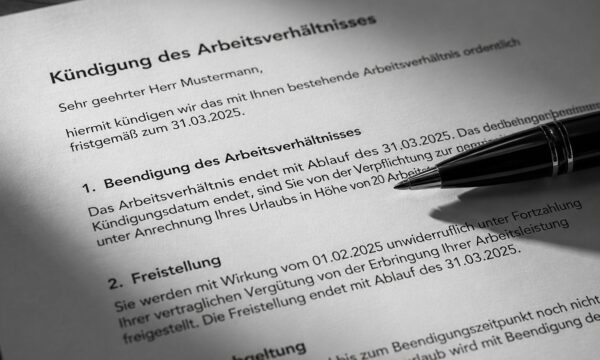
Paid or unpaid, revocable or irrevocable—the terms surrounding leave of absence may sound similar, but the legal consequences differ significantly. In our initial consultation, we clarify four key points: Are you actually released from your work obligations, or is the possibility of revocation always on the table? What happens to your remaining vacation time—does it expire, is it credited toward future leave, or must it be paid out? What happens to pending bonuses and variable compensation? And are you allowed to start a new job during your leave of absence without violating a post-employment non-compete clause? Particularly for clients in the IT and consulting industries, the answers to these four questions are often worth more than the severance pay itself.
“My favorite line in a severance agreement case: ‘But that’s just standard.’ That’s exactly where the problem lies. Standard clauses are drafted by the employer’s legal department, not by you. A termination agreement in which you haven’t yet negotiated your own terms is usually worth less than what you could get. That’s exactly what we review—clause by clause.”
— Marc Frey, Attorney at Law, specializing in labor and contract law
Warning Letter and Reminder — Preliminary Step or Disturbance Signal
We receive written warnings in two forms: in writing on the employer’s letterhead or verbally during a performance review, which is later recorded in the personnel file as a “memo.” We evaluate both using the same criteria: notification of the breach of duty, reprimand, and a warning with the threat of consequences under labor law. If any of these three elements is missing, the warning is often not legally effective. We then file a counterstatement in the personnel file or file a lawsuit to have it removed. Based on our experience at the Munich Labor Court, unlawful warnings can be resolved out of court in the vast majority of cases—often because the employer does not anticipate that the warning will be reviewed by an attorney.
Limitation Periods and the Removal of Limitation Periods — The Underestimated Statute of Limitations
When filing a lawsuit to convert a fixed-term contract into a permanent one, clients often overlook the fact that the deadline does not depend on the date the contract was signed, but rather on the agreed-upon end date of the fixed-term contract. So, if you have a two-year contract that ends on June 30, you have until July 21 to file the lawsuit—three weeks after the contract ends, not after it begins (Section 17 of the German Part-Time and Fixed-Term Employment Act). We review fixed-term contracts without objective grounds under Section 14(2) of the TzBfG (maximum of two years, three extensions) and fixed-term contracts with objective grounds under Section 14(1) of the TzBfG. We particularly often see situations with clients in the education sector and the public sector where the fixed-term contract is legally invalid, without the employee being aware of it.

Have your employment contract reviewed—before you sign it
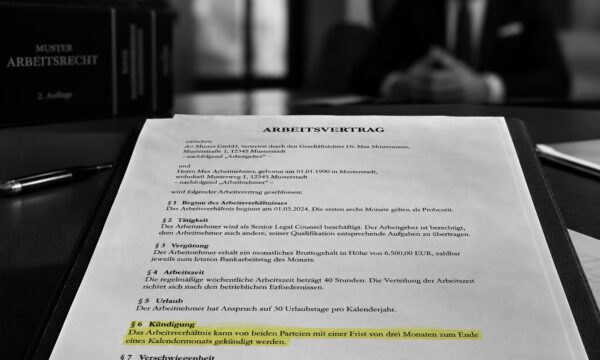
At KLAMERT & PARTNER, we review employment contracts before they’re signed faster than most clients expect—an initial review usually takes less than an hour. What we most frequently flag: overly long probationary period clauses, overly restrictive post-contractual non-compete clauses without compensation for the waiting period, bonus provisions with cut-off date clauses that forfeit the entire bonus in the event of termination, flat-rate overtime payments that are invalid under Section 307 of the German Civil Code (BGB), and restrictions on secondary employment with blanket approval requirements. Anyone who has a contract reviewed before signing it has a stronger negotiating position afterward in 80 percent of cases—we know the clauses that are most frequently incorrectly worded in Munich contracts.
Workplace Bullying — The Legal Implications
Legally speaking, workplace bullying is not a distinct offense in itself, but rather a collective term for repeated violations of personal rights in the workplace. Legal action can be taken under Section 280 of the German Civil Code (BGB) (compensation for breach of duty), the employer’s duty of care, and Section 823 of the German Civil Code (BGB) (tort liability). In our experience, workplace harassment cases in labor court typically fail not because of substantive law, but due to insufficient evidence. Anyone wishing to assert a claim for workplace bullying should keep a bullying diary starting from the first incident, recording the date, time, people involved, and the exact wording of the remarks. We discuss this during the initial consultation and, if necessary, set up an email account to which the diary is sent on the same day—serving as a digital timestamp in the event of a dispute.
Have your employment reference reviewed — the secret language of HR
A qualified employment reference must be truthful, favorable, and complete (Section 109 of the German Trade Regulation Act). In practice, this leads to disputes over codes that have been in use in HR departments for decades. “Always to our full satisfaction” is a different rating than “to our full satisfaction” (the standard “good” rating versus “satisfactory”). “Made an effort” is a warning sign. “Completed all assigned tasks” is a non-graded assessment and is therefore below average. We review your reference letter word for word against the case law of the Federal Labor Court and enforce corrections either out of court or before the labor court—the latter is less often necessary than most clients expect. More than 70 percent of the reference letter corrections we handle are resolved before a lawsuit is filed.
FROM OUR PRACTICE – MULTILINGUAL CASES IN EMPLOYMENT LAW
One practical advantage of our firm that we often only mention to clients when they ask: At KLAMERT & PARTNER, we provide legal advice in German, English, Ukrainian, Russian, and Portuguese. In employment law, this isn’t just a theoretical point—it’s relevant to everyday practice. The most common scenario involves a Ukrainian tech employee at a Munich-based startup who signed an English-language employment contract without a German translation.
But we also encounter classic scenarios on a daily basis: Russian-speaking service staff in the hotel industry, Polish caregivers on temporary contracts, and Brazilian employees at international companies. Language proficiency alone does not solve every case—but it ensures that nothing falls through the cracks in translation. Denys Osypenko is the designated contact person for immigration law; in labor law, he assists the licensed attorneys when Russian- or Ukrainian-speaking clients come in.
How Your Employment Lawyer in Munich Works — Four Steps
1. Free initial assessment within 24 hours
You describe your situation—in writing via our contact form, by phone, or in person. We will get back to you within one business day with an initial assessment of the situation: what claims you may have, what deadlines apply, and whether legal action is financially worthwhile. There are no costs at this stage.
2. Strategy and Negotiations with the Employer
We will work with you to develop a concrete strategy. Whenever possible, we conduct negotiations in writing and avoid going to labor court for as long as is reasonable—this saves time, money, and friction. With the three-week deadline in effect, we will, of course, prepare the lawsuit in parallel.
3. Lawsuit filed with the Munich Labor Court
If no agreement can be reached, we will file a lawsuit with the Munich Labor Court, located at Winzererstraße 104, 80797 Munich—we are familiar with the individual chambers and their hearing styles. In the first instance, you will not be liable for the opposing party’s attorney’s fees, even if you lose (Section 12a of the German Labor Court Act [ArbGG]). This is one of the major differences from all other areas of law.
4. Settlement or Judgment — and Enforcement
Most labor court cases end with a settlement that includes a severance payment. If a judgment becomes necessary, we enforce enforceable claims—wage garnishment, applications for enforcement, and enforcement by a bailiff. Only through enforcement does an enforceable judgment turn into actual money in the account.
“What sets our law firm apart from many of our competitors is not a particular area of specialization, but rather our meticulous attention to detail. We take the clients who come to us seriously—even when the amount in dispute is small. We have maintained this very approach for over thirty years on Heimeranstraße, and it has brought us more than 20,000 cases. Money, gold, property—and the people behind them.”
— Johannes Goetz, Attorney at Law, specializing in labor and insurance law
Frequently Asked Questions for Your Employment Lawyer in Munich
How long do I have to file a wrongful termination lawsuit?
Three weeks from the date of receipt of the written notice of termination (Section 4 of the German Employment Protection Act). “Receipt” in this context means: delivery to a mailbox, hand delivery at the office, at a hospital, or to a family member. Even being away on vacation does not extend the deadline. Anyone who misses this deadline can practically no longer defend themselves—the termination is considered valid, even if its content was contestable. Exceptions are rare and subject to strict conditions (Section 5 of the German Employment Protection Act). We recommend to all our clients: If you receive a notice of termination, it’s better to call the same day rather than wait two days.
Can I be fired while on sick leave?
Yes. Termination during sick leave is not automatically invalid—sick leave does not protect against termination. However, termination due to illness is subject to strict requirements: a negative prognosis regarding the employee’s health, significant operational impacts, and a balancing of interests in favor of the employer. In our practice, we see that employers often have not documented the prognosis and the balancing of interests as thoroughly as they should have—and this is precisely where we come in.
What is a reasonable severance package in Munich?
The rule of thumb is half a month’s gross salary per year of employment (Section 1a of the German Employment Protection Act). In the settlements we negotiate at the Munich Labor Court, the typical range is between 0.5 and 1.5 months’ salary per year of employment—depending on the reason for termination, length of employment, negotiating position, and how far the proceedings have already progressed. Higher severance payments are possible if the grounds for termination are hardly tenable or if the employer has an economic need for a quick resolution of the proceedings.
What is the waiting period if I resign or enter into a mutual termination agreement?
If an employee resigns voluntarily or enters into a termination agreement without good cause, the Federal Employment Agency typically imposes a twelve-week waiting period for unemployment benefits (Section 159 of SGB III). The waiting period also reduces the duration of eligibility by that amount of time. Before entering into any termination agreement, we assess whether a valid reason can be demonstrated (such as workplace bullying, health issues, or operational changes) or how the agreement can be structured to avoid a waiting period. In cases of doubt, this assessment is worth more than a few thousand euros in severance negotiations.
How much does an employment lawyer in Munich cost?
At KLAMERT & PARTNER, the initial assessment of your case is free of charge. Any further consultation will be provided after you retain our services—either based on RVG fees or an individual fee agreement. If you have legal expenses insurance, we will handle the coverage inquiry. A practical note: In the first instance before the labor court, each party bears its own attorney’s fees—regardless of who wins (Section 12a ArbGG). This significantly reduces cost risks in labor law, unlike in almost all other areas of law.
Where is the Munich Labor Court located?
The Munich Labor Court is located at Winzererstraße 104, 80797 Munich, in the Schwabing-West district. It has subject-matter and territorial jurisdiction over most disputes involving employees from the Munich metropolitan area and part of the surrounding region. The appellate court is the Munich Regional Labor Court, also located in Munich (Winzererstraße 106). From our law office on Heimeranstraße, you can easily reach the Labor Court by subway.
What can I do if my job reference is negative?
You have a legal right to a truthful, favorable, and qualified reference (Section 109 of the German Trade Regulation Act). When evaluating a reference, the average rating (“to our full satisfaction”) is considered the standard. If you want a better grade, you generally have to prove it yourself. In our practice, we review references word for word against the case law of the Federal Labor Court. More than 70 percent of the reference corrections we handle can be resolved out of court—a higher percentage than many clients expect.
Do I have to sign a termination agreement?
No. No one can be forced to sign. If your employer tries to pressure you (“sign now or face termination”), you should not sign immediately and should seek legal advice instead. In our experience, applying pressure usually weakens the employer’s negotiating position—employees represented by a lawyer almost always get an extension of the deadline that the employer had previously declared non-negotiable.
Will a written warning remain in my personnel file forever?
In practice, a written warning remains in your personnel file for as long as it can still have legal consequences under labor law—typically two to three years, depending on the severity of the allegation. If the written warning is unlawful, you are entitled to have it removed from your personnel file. In most cases, we resolve this out of court—going to labor court is the less common route.
Does my fixed-term contract count as a permanent contract if the fixed term is invalid?
Yes. If the fixed-term provision is invalid (e.g., more than three renewals without objective grounds under Section 14 of the German Part-Time and Fixed-Term Employment Act (TzBfG), failure to specify the fixed term in writing, or a prohibition on prior employment), the employment contract is deemed to have been entered into as an indefinite-term contract. This can be enforced through an action to convert the contract to an indefinite-term contract. Important: The three-week period begins at the agreed-upon end of the contract, not at the start of the contract (Section 17 of the German Part-Time and Fixed-Term Employment Act). Therefore, if you were given a two-year contract and file the lawsuit ten months later, it is too late.
FROM OUR PRACTICE – HOW OUR FREE INITIAL ESTIMATE WORKS
On Heimeranstraße, we have intentionally streamlined the initial contact process. You describe your case to us in two to three sentences—the reason, the date, and your question. Within one business day, you will receive an initial assessment of whether you have a valid claim, what the applicable deadline is, and what steps would be advisable next. This initial assessment is free of charge and non-binding.
Only then do you decide whether you want to retain us. We believe that those who don’t need legal representation shouldn’t be given it—we consciously uphold this principle because it works better for both sides in the long run. Clients who return to us later with larger cases are often the very ones to whom we said, upon their initial inquiry, that legal action wasn’t worth pursuing.
“We’ve handled more than 20,000 cases in recent years. This figure doesn’t mean that ‘we know every case’—no law firm does. What it does mean is that we’ve learned where the real leeway in labor law lies—and where it only appears to lie. Recognizing this difference is the most important task in the very first moments of a case.”
— Markus Klamert, attorney and founder of KLAMERT & PARTNER
Labor Law Attorney in Munich — Right Next to Theresienwiese
Our law firm at Heimeranstraße 37 is located right next to the Theresienwiese in Munich’s Westend (Schwanthalerhöhe). Clients from all over Munich—from Schwabing to Bogenhausen, Pasing, Sendling, and Au-Haidhausen—can reach us by subway (U4/U5 Schwanthalerhöhe, U3/U6 Goetheplatz, U1/U2/U7/U8 Sendlinger Tor) and tram lines 18 and 19. Appointments outside of office hours and online cases with encrypted communication are available by arrangement—a practical advantage, particularly in employment law, when clients are under time pressure or are still employed and require discretion.
Free Initial Consultation with Your Employment Law Attorney in Munich
Describe your situation to us in two or three sentences—we’ll review your case with no obligation to see what claims you have and what deadlines are currently in effect. You can reach us online, by phone at 089 540 239 0, or in person at Heimeranstraße 37 near Theresienwiese. If you’ve received a termination notice, a mutual termination agreement, or a warning letter, we’ll get back to you within one business day.