Law Firm in Munich /
Lawyer in Munich —
KLAMERT & PARTNER
Select your preferred language
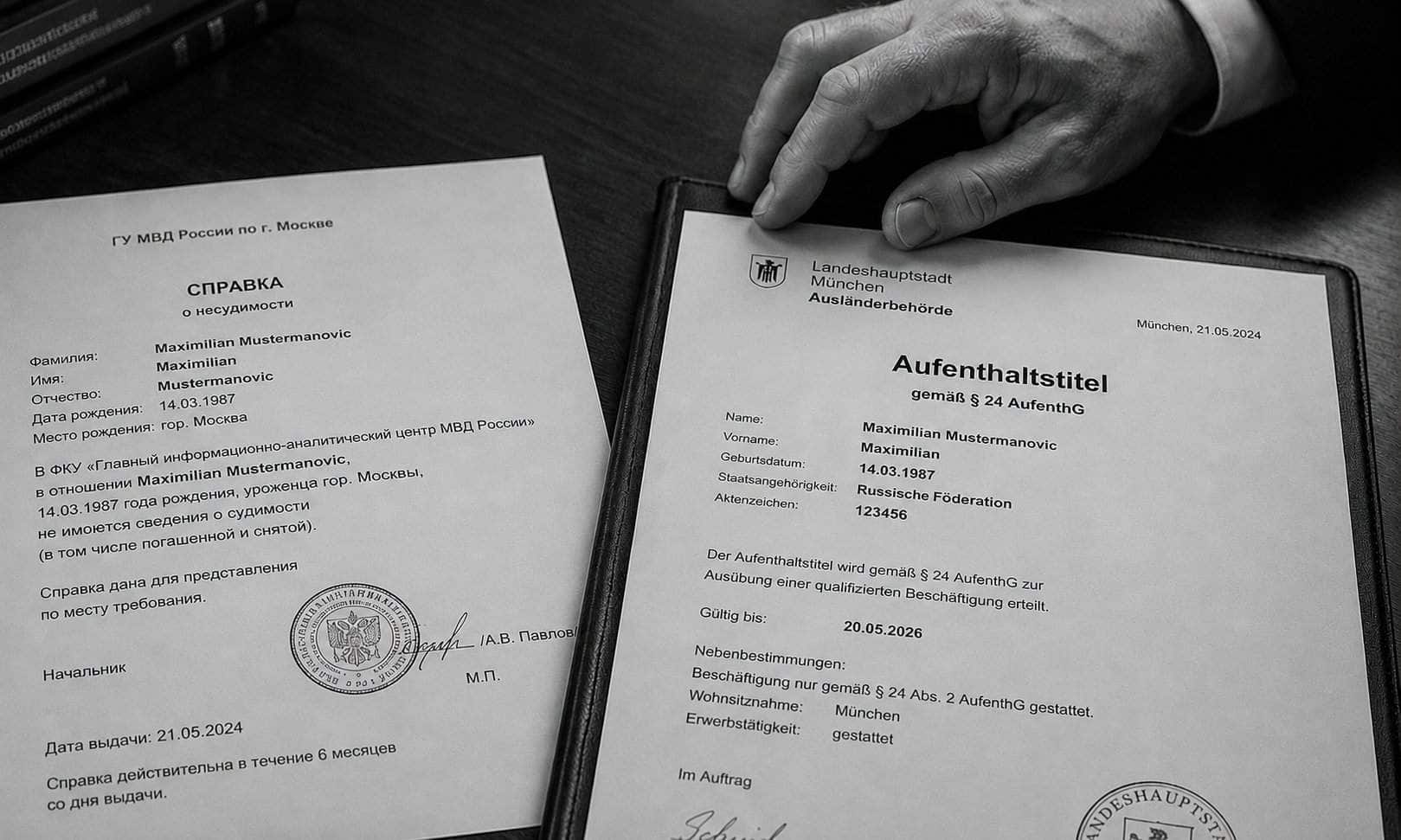
Ukrainian- or Russian-speaking clients in Munich who need legal assistance have limited options in the city: While there are many law firms, few have staff who speak Ukrainian or Russian—and virtually none that offer this service systematically across all areas of law. At KLAMERT & PARTNER, we have established a dedicated service line specifically for this purpose. With Denys Osypenko, a Ukrainian- and Russian-speaking attorney, and a team of other Ukrainian-speaking colleagues, we guide clients through the German legal system in their native language—from the initial consultation to correspondence with authorities and courts. The legal work is handled by the licensed attorneys Markus Klamert, Marc Frey, and Johannes Goetz; Denys Osypenko and his team ensure that language is never a barrier. Consultations in all eight practice areas of the firm: immigration law, estate law, labor law, tenancy law, traffic law, investment law, criminal law, and general civil law. Initial assessment free of charge.
Why offer legal services in Ukrainian and Russian in Munich?
In a legal context, language is not a matter of convenience, but a matter of function. Anyone holding a decision from the Munich KVR, an eviction order from the local court, or a summons from the district attorney’s office must understand what it says—word for word, not just roughly. Anyone who cannot describe their own case freely and precisely during the initial consultation misses out on legally crucial details. This is precisely why the need for a lawyer who speaks Ukrainian or Russian in Munich is not merely an added service, but often a prerequisite for the case to be handled properly at all.
The situations we encounter on Heimeranstraße—whether in Ukrainian or Russian—vary widely. A Ukrainian family that has been living in Munich since February 2022 with a residence permit under Section 24 of the Residence Act (AufenthG) and is now planning to transition to a settlement permit and, later, naturalization. A Russian-speaking client from Kazakhstan with a family business who wants to transfer assets to Germany and, at the same time, restructure his estate for inheritance purposes. A Russian-German repatriate who inherited an apartment in Munich and is in a dispute with the community of heirs. A man summoned as a defendant in criminal proceedings who does not understand what the German public prosecutor’s office wants from him.
What all these cases have in common is that legal advice only works if both parties are using the same terms. In legal German, this is a skill in itself—residence permits, claims for a supplementary statutory share, termination without notice, summary judgment, and notices of fines. Those who are not familiar with these terms in their native language will find it difficult to understand legal explanations. We solve this by conducting the initial consultation in Ukrainian or Russian—and then having licensed attorneys draft the legal explanations, complaints, and contracts in German.
FROM OUR PRACTICE – WHY LANGUAGE IS A SEPARATE ISSUE IN INHERITANCE LAW
A common example from our practice: A Russian-speaking client inherits a condominium in Munich, and a sibling asserts a claim to a statutory share. From our experience: The calculation of the statutory share itself is legally clear (Sections 2303 et seq. of the German Civil Code (BGB)). What is not clear are the valuation issues—the market value of the apartment, gifts from the past ten years that are taken into account under § 2325 BGB, and earlier transfers with a reservation of usufruct from the home country. These transfers are often documented in Russian and were notarized in Russia or Kazakhstan. Without preliminary consultation in Russian, our assessment would depend on the translation. Thanks to Denys Osypenko’s preliminary work, the file analysis is completed within a few days. We had to anonymize the documents—§ 6 BORA (new version)—and the logic behind this shows: In inheritance law, language is a temporal lever, not a convenience.
“Clients often come to us after trying three or four other law firms—they’ve tried to explain their case there in English or with the help of a translator, and left feeling that they weren’t understood. That’s exactly what we want to avoid. Language access isn’t an added value—it’s a prerequisite. Everything else—the legal strategy, the case work, the correspondence with the Munich Commercial Register—comes after that.”
— Markus Klamert, attorney and founder of KLAMERT & PARTNER
Denys Osypenko — Lawyer at the firm, fluent in Ukrainian and Russian
Denys Osypenko is the key figure in Ukrainian- and Russian-language legal services at KLAMERT & PARTNER. He is a trained lawyer with ties to Ukraine and serves as the primary point of contact for many clients. It is important to clarify at this point: Denys Osypenko is not a licensed attorney at the firm under German professional law—legal case management, pleadings, contract drafts, and all correspondence with courts and authorities are signed and handled by the licensed attorneys Markus Klamert, Marc Frey, and Johannes Goetz. Denys Osypenko serves as the linguistic and cultural bridge between our Ukrainian- or Russian-speaking clients and our team of attorneys.
In practical terms, this means that anyone who calls in Ukrainian or Russian or submits an inquiry via the contact form will usually speak with Denys Osypenko first. He listens, organizes the facts from a legal perspective, reviews the original documents—Ukrainian birth certificates, Russian marriage certificates, Kazakh commercial register extracts—and translates their content for the client consultation with the responsible attorney. When it comes to contract renewals and correspondence with government agencies, he translates the German official notices back into understandable language so that clients can follow the legal steps taken by their attorney.
To the best of our knowledge, this setup—a German-licensed attorney paired with a Ukrainian- and Russian-speaking legal professional within the same firm, with clear segregation of client matters—is rare in the Munich legal landscape. Most Munich law firms rely on external interpreters for language support, which works for consultation meetings but creates significant inefficiencies in day-to-day case management. At our firm, Ukrainian- and Russian-language preliminary case work is integrated into our daily client practice.
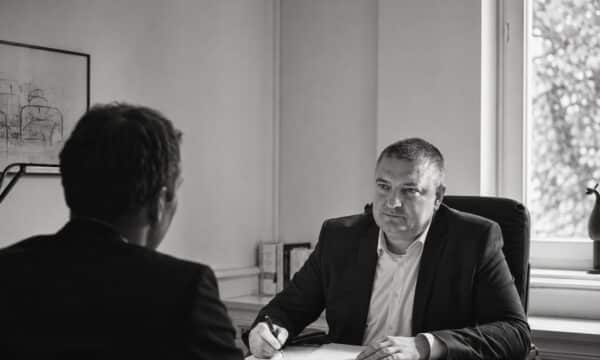
The team — licensed attorneys and Ukrainian-speaking colleagues
Markus Klamert — Partner in charge of estate planning, investment law, and general civil law
Markus Klamert is the founder of the firm and has been personally handling cases in the areas of inheritance law, investment law, property law, and general civil law since 2005. For Russian-speaking clients with asset structures spanning multiple countries (family businesses, holding structures, international inheritance cases), he is typically the attorney in charge—initial consultations are conducted in Russian or Ukrainian by Denys Osypenko, while Klamert assumes responsibility for the case.
Marc Frey — Partner in charge of tenancy law, real estate law, and general civil law
Marc Frey specializes in contract and property law and regularly handles cases involving tenancy law, traffic law, and general civil law. He typically manages cases for Ukrainian families in Munich who need to have their lease agreements reviewed or who have received a notice of termination for personal use. Marc Frey also handles traffic law cases—such as traffic tickets, points in Flensburg, and driver’s license matters.
Johannes Goetz — Partner in charge of labor law, banking, and capital markets law
Johannes Goetz handles cases involving employment law and capital markets law. For Russian-speaking clients in Munich, employment law cases often arise in connection with corporate employment—spousal reunification for corporate employees, employment law issues at tech and pharmaceutical companies, and terminations during the probationary period. Goetz is the partner in charge of capital investment law matters involving capital originating from Russia or Kazakhstan.
Denys Osypenko and other Ukrainian-speaking colleagues
Denys Osypenko typically conducts the initial consultation in Ukrainian and Russian on his own. For cases involving a very high volume of work or specialized topics (such as Ukrainian civil status documents, Ukrainian inheritance law in an international context, or Kazakh corporate law), we collaborate with other Ukrainian-speaking colleagues who contribute specialized legal or linguistic expertise. This collaboration is project-based—the key point is that, for you as the client, the lead attorney remains clear: one of the three licensed attorneys plus Denys Osypenko as the linguistic liaison.
Request a free initial assessment
Tell us about your case—quickly and with no obligation. We’ll assess your chances of success and get back to you shortly.
or call us directly at: 089 540 239 0
For which client groups — Ukraine, Russia, CIS countries, ethnic Russians in Russia
Russian is widely spoken as a lingua franca in a considerable number of countries—beyond the Russian Federation. Ukrainian is also the native language of approximately 40 million people worldwide. Those seeking Ukrainian- or Russian-language counseling in Munich typically come from one of these groups.
Ukraine
Since February 2022, Ukrainian clients in Munich have constituted the largest group in terms of numbers. Many hold residence permits under Section 24 of the Residence Act (AufenthG), are employed, have arrived in Munich with their families, and are planning to transition to a settlement permit and naturalization. In addition, there are Ukrainian clients who have been living in Germany for a long time—students, tech workers, and families with dual citizenship. Consultation language: Ukrainian (or Russian, if the client prefers).
Russian Federation
Our Russian clients have a variety of residency statuses—ranging from long-term settlement permits and current residence permits to special cases involving sanctions. Language of consultation: Russian.
Belarus
Many Belarusian clients have been living in Munich since the political upheaval of 2020; some are seeking asylum, while others hold residence permits issued under previous circumstances. Belarusian is not really recognized as a separate language in Germany—consultations are conducted in Russian.
Kazakhstan, Uzbekistan, Kyrgyzstan, Tajikistan, Turkmenistan
We serve clients from the Central Asian republics who come from a wide variety of backgrounds—businesspeople with German subsidiaries, families with German passports who migrated from Russia in the 1990s and 2000s, students, and specialists working for Munich-based corporations. Language of consultation: Russian.
Azerbaijan, Georgia, Armenia
Clients from the South Caucasus often have complex migration histories—whether they have traveled through Russia or Turkey or come directly to Germany. Russian is widely spoken in this region as a lingua franca; consultations in Russian are generally possible.

Moldova
Moldovan clients speak either Romanian (the official language) or Russian (the lingua franca, particularly in Transnistria and in the larger cities). We offer our services to Russian-speaking Moldovan clients.
Israel — Russian-speaking community
Israel is home to a large Russian-speaking community—approximately one million people who immigrated to Israel from the Soviet Union in the 1990s. Israeli clients with ties to Germany (inheritance law, real estate matters, German-Israeli family relationships, business ties) receive legal advice in Russian.
Latvia, Lithuania, Estonia — Russian-speaking minorities
The Baltic states are home to a Russian-speaking minority (accounting for about a quarter of the total population in Latvia and Estonia). For Russian-speaking clients in the Baltic states who have legal matters involving German law, consultations are conducted in Russian.
Russian-Germans and ethnic German immigrants
One specific group consists of Russian-Germans and ethnic German immigrants who have been living in Germany since the 1990s and 2000s—many of whom hold German passports, are often bilingual, and have family ties in Russia, Kazakhstan, or other CIS countries. This group frequently involves probate matters (inheritance in their former homeland plus assets in Germany), real estate matters, and occasionally criminal or traffic law cases. Consultations are available in Russian or German, as preferred.
Eight areas of law — Consultations in Ukrainian and Russian
At KLAMERT & PARTNER, we provide legal advice in Ukrainian or Russian across all eight practice areas of the firm—not just immigration law, which is the only area covered in those languages by many of our competitors. Here, we examine each practice area individually, focusing on the specific scenarios that are particularly common among our Ukrainian- and Russian-speaking clients.
Immigration Law — Section 24 of the Residence Act, Settlement Permit, Naturalization
Immigration law accounts for the largest share of our Ukrainian- and Russian-speaking client base. For Ukrainian clients, the process typically involves transitioning from a residence permit under Section 24 of the Residence Act to a settlement permit and, later, to naturalization. For Russian-speaking clients, special circumstances arise—sanctions issues, renewal of residence permits in a changed political landscape, and family reunification across multiple CIS states. Practice area: /immigration law/. Cases are typically handled by Klamert or Frey.
Inheritance Law — Statutory Share, International Inheritance Law, Gifts from the Home Country
In the area of inheritance law, we regularly encounter three scenarios with Russian- and Ukrainian-speaking clients: first, intra-German inheritance cases involving estates whose market values in Munich often run into the six- or seven-figure range and raise issues regarding the statutory share. Second, international inheritance cases involving assets in multiple countries (an apartment in Munich plus a dacha near Kyiv plus a bank account in Israel)—here, the EU Succession Regulation or the law of the home country applies. Third, lifetime gifts from the home country that become relevant to claims for a supplement to the statutory share in Germany. Spoke: /inheritance-law-munich/. Case management: Klamert.
Employment Law — Probationary Period, Termination Without Notice, Mutual Termination Agreement
We regularly handle employment law cases involving Russian- and Ukrainian-speaking clients in Munich’s tech, pharmaceutical, and automotive industries: termination during the probationary period in a corporate group after three months, termination without notice due to alleged breach of duty, mutual termination agreements with severance pay, and disputes over bonuses and company cars. We review the statute of limitations (three weeks from receipt of the notice of termination — § 4 KSchG), the validity of the termination, and file unfair dismissal claims with the Munich Labor Court. Practice area: /labor-law-munich/. Case management: Goetz.
Tenancy Law — Personal Use, Rent Reduction, Eviction Proceedings
For Ukrainian- and Russian-speaking clients in Munich, tenancy law matters are often a matter of survival: With rents starting at €1,500 (including utilities), a termination for personal use effectively means losing a home that is nearly impossible to replace. We review the validity of termination for personal use both formally and substantively, represent clients in eviction proceedings at the Munich Local Court (Pacellistraße 5), and advise on rent reductions due to defects, cosmetic repairs upon moving out, and rent increases pursuant to § 558 BGB. Spoke: /mietrecht-muenchen/. Case management: Klamert or Frey.
Traffic Law — Traffic Citation, Points in Flensburg, Driver's License
Traffic law is the “national pastime” of Munich law firms—and for Russian- and Ukrainian-speaking clients, it often involves unique situations: foreign driver’s licenses and their recognition in Germany, speeding tickets, points in Flensburg before the probationary period expires, and MPU orders. We review traffic violation notices for procedural errors, represent clients in traffic violation and criminal traffic proceedings, and advise on regaining a driver’s license after revocation. Practice area: /traffic-law-munich/. Case management: Frey.
Securities Law — Misleading Advice, Banking Law, International Money Transfers
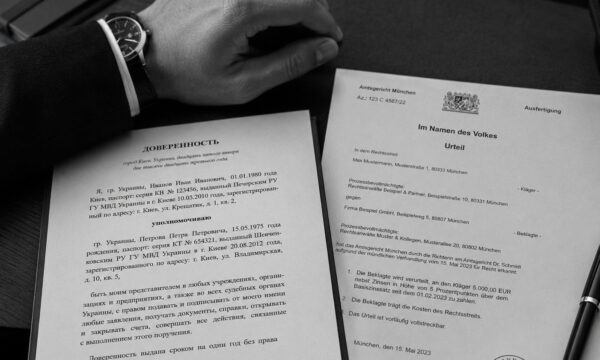
For high-net-worth Russian- and Ukrainian-speaking clients, investment law is a recurring topic: misadvice regarding the purchase of investments in Germany, banking law matters (opening and closing accounts, compliance issues), and sanctions-related issues involving international capital transfers. We review claims for damages against investment advisors under Sections 280 and 311 of the German Civil Code (BGB), represent clients in dealings with German banks, and advise on situations involving sensitive sanctions law issues. Practice area: /investment-law-munich/. Case management: Goetz or Klamert.
Criminal Law — Criminal Complaint, Summons, Summary Judgment, Appeal
Criminal law cases are highly sensitive and particularly delicate in terms of language: Anyone who receives a summons from the public prosecutor’s office as a defendant, receives a summary judgment by mail, or has been the victim of a crime and wishes to file a criminal complaint needs legal representation in their own language. We represent defendants and victims in proceedings at the Munich Local and Regional Courts and in appeals before the Higher Regional Court. Practice area: /criminal-law-munich/. Case management: Frey or Goetz, depending on the matter.
General Civil Law — Contracts, Damages, Debt Collection
General civil law encompasses all cases that do not fall under one of the specialized practice areas: contract disputes involving the purchase of cars, furniture, or travel; claims for damages arising from accidents or breach of contract; debt collection against delinquent debtors; and lawsuits challenging standard terms and conditions. Practice area: /civil-law-munich/. Case management: Frey.
In Ukrainian — for Ukrainian clients in Munich
This section is written in Ukrainian for Ukrainian clients looking for a lawyer in Munich. We have been working at KLAMERT & PARTNER since 2005. Denis Osipenko, a lawyer at our firm, speaks Ukrainian and Russian; legal work is handled by licensed attorneys Markus Klamert, Mark Frey, and Johannes Götz.
Lawyer in Munich — in Ukrainian
If you live in Munich and need legal assistance, we can advise you in your native language—Ukrainian or Russian. Our office at Heimeranstraße 37, near Theresienwiese, provides services in eight areas of law: immigration law (Section 24 of the Residence Act [AufenthG], residence permits, obtaining citizenship), inheritance law, labor law, tenancy law, traffic law, investment law, criminal law, and civil law.
Attorney Denis Osipenko provides an initial consultation in Ukrainian. Legal responsibility for the case lies with the assigned attorneys—Marcus Klamert, Mark Frey, or Johannes Getz—depending on the area of law.
The first consultation is free. Call us at 089 540 239 0 or contact us via the contact form. We will respond within one business day. In urgent cases (threat of deportation, one-month deadline for filing an appeal, eviction)—we will respond even sooner.
The most common issues Ukrainian clients bring to us include: renewing residence permits, transitioning from a § 24 residence permit to a permanent residence permit (Niederlassungserlaubnis), obtaining German citizenship, family reunification, rental issues (eviction by the landlord due to personal use), labor disputes (dismissal during the probationary period), and inheritance matters involving property in Ukraine and Germany.
In Russian — for Russian-speaking clients in Munich
This section is written in Russian for Russian-speaking clients looking for a lawyer in Munich. KLAMERT & PARTNER has been in practice since 2005. Denis Osipenko, a lawyer at our firm, speaks Russian and Ukrainian; legal responsibility for handling cases lies with the licensed attorneys Markus Klamert, Mark Frey, and Johannes Götz.
Lawyer in Munich — in Russian
If you live in Munich and need legal assistance, we can advise you in your native language—Russian or Ukrainian. Our office at Heimeranstraße 37, near Theresienwiese, handles eight areas of law: immigration law (residence permits, permanent visas, citizenship), inheritance law, labor law, tenancy law, traffic law, investment law, criminal law, and civil law.
Attorney Denis Osipenko provides an initial consultation in Russian. Legal responsibility for the case lies with the assigned attorneys—Marcus Klamert, Mark Frey, or Johannes Götz—depending on the area of law.
Our initial case assessment is free and non-binding. Call us at 089 540 239 0 or contact us via the form on our website. We’ll get back to you within one business day. In urgent cases (imminent deportation, a one-month deadline for filing a lawsuit, eviction), we’ll respond even faster.
Common issues raised by Russian-speaking clients: renewal of residence permits, obtaining permanent residency (Niederlassungserlaubnis), application for German citizenship, family reunification, rental disputes (termination of a lease due to the landlord’s personal need for the property), labor disputes (dismissal during the probationary period), inheritance cases involving assets in multiple countries, investment disputes with banks, criminal cases (summons to the police, penalty order).
We advise clients from Russia, Belarus, Kazakhstan, Uzbekistan, Kyrgyzstan, Tajikistan, Turkmenistan, Azerbaijan, Georgia, Armenia, Moldova, Israel, the Baltic states, as well as Russian Germans and recent immigrants.
Here's how the process works—four steps
1. Initial contact in Ukrainian or Russian
You can call us at 089 540 239 0, contact us via the contact form, or stop by in person at Heimeranstraße 37. Languages available for the initial consultation: Ukrainian, Russian, German, English, Portuguese—whichever you prefer. If you make initial contact in Ukrainian or Russian, you will usually speak with Denys Osypenko first. We’ll get back to you within one business day.
2. Fact-finding and legal preparation
Denys Osypenko will listen to your case, translate documents from your home country—Ukrainian birth certificates, Russian marriage certificates, Kazakh contracts, Israeli certificates of inheritance—and organize the facts from a legal perspective. For clearly defined situations (standard cases in immigration law, tenancy law, or labor law), one appointment is often sufficient; for more complex cases (inheritance law with international implications, or investments involving sanctions issues), a second appointment with the relevant attorney will follow.
3. Legal representation
Once the case file is in order, the assigned attorney—Klamert, Frey, or Goetz—will take over responsibility for the case. Correspondence with government agencies, courts, banks, and insurance companies is conducted in German and signed by the licensed attorney. Upon request, you will receive a summary of important notices and agreements explained in Ukrainian or Russian—either by phone or via a brief translation note from Denys Osypenko.
4. Follow-up assignments and long-term support
For many Ukrainian- and Russian-speaking clients, the initial case leads to follow-up cases— family reunification after a successful residence permit has been granted, naturalization after many years of residence, estate planning following the acquisition of assets, and corporate structuring after the establishment of a business. We handle these follow-up mandates in an integrated manner—the initial attorney in charge typically remains the same, ensuring that familiarity with the case files and language proficiency are maintained over the years.
Frequently Asked Questions About Counseling in Ukrainian and Russian
Is Denys Osypenko a licensed attorney?
No. Denys Osypenko is a trained lawyer and is responsible for serving Ukrainian- and Russian-speaking clients at the firm—but he is not a lawyer admitted to practice under German law. Legal case management, all pleadings, contracts, and correspondence with authorities are signed and handled by the licensed attorneys Markus Klamert, Marc Frey, and Johannes Goetz. This separation of responsibilities is clear—and in day-to-day consultations, it is not an obstacle but a mark of quality: You have a language liaison who listens and organizes matters, and a lawyer who bears legal responsibility.
In which languages are consultations available?
German, English, Ukrainian, Russian, Portuguese. The initial consultation will be conducted in the language of your choice. Denys Osypenko is the designated consultant for Ukrainian and Russian; depending on the area of law, one of our licensed attorneys will handle the legal representation. For cases involving other languages (English, Portuguese), Klamert, Frey, or Goetz will provide the consultation directly—each of them speaks multiple languages.
How much does the Ukrainian/Russian-language consultation cost?
At KLAMERT & PARTNER, the initial assessment of your case is free of charge—regardless of the language. Any further consultation will be provided after you retain our services—either based on RVG fees calculated according to the value of the matter or according to an individual fee agreement. The preliminary consultation in Ukrainian or Russian with Denys Osypenko is included in the retainer fee and will not be charged separately. If you have legal expenses insurance, we will handle the coverage inquiry.
What areas of law does the firm handle in Ukrainian and Russian?
All eight practice areas of our law firm: immigration law (residence permits, settlement permits, naturalization, family reunification), estate law, employment law, housing law, traffic law, investment law, criminal law, and general civil law. In other words, we don’t just handle immigration cases in Russian or Ukrainian —we handle everything you’d expect from a Munich law firm.
If I am from Ukraine, Russia, or another CIS country, can I become a client?
Yes. We serve Ukrainian- and Russian-speaking clients from all countries where Ukrainian or Russian is the native or common language: Ukraine, Russia, Belarus, Kazakhstan, Uzbekistan, Kyrgyzstan, Tajikistan, Turkmenistan, Azerbaijan, Georgia, Armenia, Moldova, Israel (Russian-speaking community), the Baltic states (Russian-speaking minority), and, of course, Russian-Germans and ethnic German immigrants in Germany.
Will my documents from my home country be accepted?
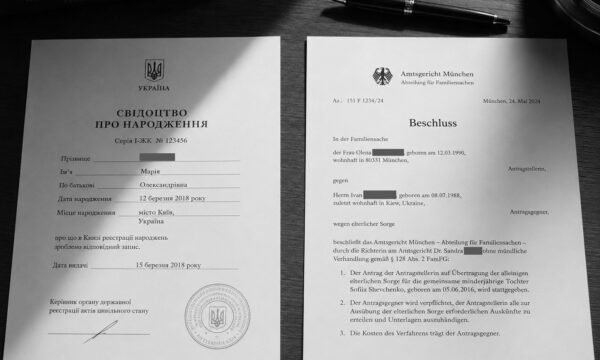
Documents from the home country—such as Ukrainian birth certificates, Russian marriage certificates, and Kazakh commercial register extracts—are generally accepted by German authorities if they are accompanied by an apostille (Hague Convention) and a certified translation. In the case of Russia and some CIS countries, there are special circumstances—we coordinate the procurement of documents with the German Consulate General in the country of origin and with local notaries. Denys Osypenko provides a preliminary translation of the document content; the formal certified translation is handled by sworn interpreters with whom we routinely collaborate.
Can you handle cases related to Ukraine or Russia directly from your home country?
Under the professional regulations of their home countries, German attorneys are generally not permitted to appear directly before Ukrainian or Russian courts—we therefore require local correspondent attorneys. We have reliable correspondent attorneys in Kyiv, Lviv, Almaty, and other cities for a wide range of cases, and we coordinate these matters jointly. KLAMERT & PARTNER retains responsibility for the German clients.
My case is a bit of a legal gray area—can you help?
Sanctions-related situations—particularly those involving Russian or Belarusian clients—are highly sensitive and are examined by us with the utmost care. Before accepting any case, we conduct a preliminary compliance review: Is the client or the matter subject to EU sanctions, U.S. sanctions, or German embargo policies? If the answer is yes, we first determine whether the legal advice itself is permissible (generally yes—legal advice is privileged under sanctions law), and then what actions we are permitted to take within the framework of sanctions law. In cases of uncertainty, we collaborate with specialized sanctions lawyers.
How can I contact Denys Osypenko?
You can reach the office by calling the main number at 089 540 239 0. The receptionist will connect you with Denys Osypenko—or, if he is unavailable, will schedule an appointment for you. Any inquiries in Ukrainian or Russian submitted via the contact form on the website are forwarded directly to him. Responses are typically provided within one business day; for urgent matters with tight deadlines, responses are provided more quickly.
Are there any Russian- or Ukrainian-language appointments available at the law firm?
Yes. You can schedule an appointment at Heimeranstraße 37, where Denys Osypenko and the attorney in charge will meet with you. Translation will be provided live during the appointment. For simpler cases, a phone or video call is often sufficient—for complex estate or inheritance matters, we recommend an in-person appointment at the law office.
Do you also offer contracts in Russian or Ukrainian?
We draft contracts in German for agreements entered into in Germany that are intended to be enforceable in German courts. Upon request, we can provide a Ukrainian or Russian translation of the contract’s content so that you can understand it—however, the legally binding language remains German. For contracts with cross-border implications (such as executive contracts with a Ukrainian subsidiary), bilingual originals are often advisable—we coordinate this with local counsel in the home country.
I am a Russian-German/late repatriate and speak German fluently—do I need Denys Osypenko?
Not necessarily. You can also conduct your case directly with Klamert, Frey, or Goetz in German. However, many Russian-Germans and ethnic German immigrants appreciate having legal terms explained in Russian when needed—especially in cases involving documents from their home country, relatives living there, or culturally specific circumstances. Language support is an option with us, not a requirement.
Free initial assessment in Ukrainian or Russian
Please describe your situation to us in two to three sentences—in Ukrainian, Russian, German, or English. We’ll review—with no obligation—what claims you have, what deadlines are currently in effect, and which attorney from our team will take on your case. Contact us online via our contact form, by phone at 089 540 239 0, or in person at Heimeranstraße 37 in Munich. In cases involving imminent filing deadlines, the threat of deportation, or other urgent matters, we’ll get back to you within a few hours. At KLAMERT & PARTNER, “Attorney for Ukrainians and Russians in Munich” is not just a marketing label, but a dedicated service line with clearly defined areas of responsibility—Denys Osypenko, a Ukrainian- and Russian-speaking attorney, supported by other Ukrainian-speaking colleagues, along with the licensed attorneys Markus Klamert, Marc Frey, and Johannes Goetz, who are responsible for the legal representation of clients.
Request a free initial assessment
Tell us about your case—quickly and with no obligation. We’ll assess your chances of success and get back to you shortly.
or call us directly at: 089 540 239 0
Consultations in Ukrainian and Russian — Denys Osypenko
At KLAMERT & PARTNER, we have Denys Osypenko on our team, a lawyer who assists Ukrainian- and Russian-speaking clients. Denys Osypenko is originally from Ukraine; he is a trained lawyer with many years of experience in international law—and understands German immigration law from a client’s perspective. He is not admitted to practice as an attorney under German law—this clarification is legally important (in compliance with the RDG) and means in practice: The legal work—filing applications, drafting pleadings, representing clients before authorities, and filing lawsuits with the Munich Administrative Court—is handled by the admitted attorneys Markus Klamert, Marc Frey, and Johannes Goetz.
What Denys Osypenko does is build a linguistic and cultural bridge—and this bridge is crucial, especially in cases involving Section 24 mandates. He records the facts of the case in a structured manner in the client’s native language, translates Ukrainian and Russian documents from the client’s home country (college transcripts, marriage certificates, vocational training certificates), prepares correspondence with the Munich KVR and with the German diplomatic mission in Kyiv or Warsaw, and accompanies clients to appointments with the authorities. In a § 24 status change case, this means: The client explains their situation once—in Ukrainian or Russian—and then receives an application package from a Munich lawyer formulated in the official language of the German authorities.
FROM OUR PRACTICE – § 24 CASES FROM 24PARAGRAF.DE AND OTHER RESOURCES
In recent months, we have seen an increasing number of clients who first encountered the issue of status change through Russian- and Ukrainian-language online resources such as 24paragraf.de. These platforms provide useful initial information in the client’s native language; however, they are no substitute for a lawyer’s case-by-case review. We structure our initial consultation with such clients in a way that builds on the online information they have already gathered—and translates it into a practical strategy for their specific case. This saves consultation time and provides the client with more concrete guidance right from the start.
We had to anonymize the cases—§ 6 BORA (as amended)—and the reasoning behind this is that multilingual online information opens the door, while individual case reviews by attorneys ensure that the status change under § 24 actually takes place. The two complement each other.
“In my daily work, I see the same thing over and over again—Ukrainian clients who have waited four years to see if Section 24 would be extended and now finally want to have independent status. Every week, I hear the same phrase in Ukrainian and Russian: ‘I don’t want to wait any longer; I want clarity.’ That is exactly what we offer our clients—an initial consultation conducted in their native language, three fixed-price packages to choose from, and a clear plan for the next step at the Munich Regional Court.”
— Denys Osypenko, attorney (not admitted to practice in Germany), client services in Ukrainian and Russian
How Your Attorney Handles Section 24 of the Residence Act in Munich — Four Steps
1. Free initial assessment within 24 hours
Please describe your situation to us—by phone at 089 540 239 0, via the contact form, or in person at Heimeranstraße 37. Languages: German, English, Ukrainian, Russian, Portuguese. We’ll get back to you within one business day with an initial assessment: Which residence permit is appropriate for your situation (EU Blue Card, § 18a, § 18b, § 16b, § 17(1), § 18d), does the § 19f restriction apply, and which of the three packages (Quick Check, Complete Status Change, Settlement Plan) is right for you? There are no costs for you at this stage.
2. Anabin/accreditation review and contract review
Once we have been retained, we verify the applicant’s university or vocational training degree in Anabin (or initiate a recognition procedure if necessary), review the employment contract with regard to the salary thresholds for the EU Blue Card or the requirements of § 18a / § 18b of the Residence Act, and gather the remaining application documents—certified translations, apostilles, proof of sufficient funds, and health insurance confirmation. Depending on the specific circumstances, this phase takes two to six weeks.
3. Submitting an application to the KVR Munich
We submit the application to the Munich Foreigners’ Registration Office (KVR München, Ruppertstraße 11)—for the EU Blue Card under the expedited skilled worker procedure pursuant to § 81a of the Residence Act (AufenthG), and for § 18a / § 18b of the Residence Act (AufenthG), either under the expedited procedure or the regular application procedure in parallel with the existing § 24 residence permit. For suspended permits (Section 16b, Section 18d), we coordinate the declaration of surrender under Section 24 of the Residence Act with the issuance of the new permit to ensure there is no gap in residency. We respond to requests for additional documentation within a few days and utilize provisional certificates under Section 81(3) or (4) of the Residence Act where appropriate.
4. Issuance of the new residence permit and consolidation strategy
Once the new residence permit has been issued, we assist with the subsequent steps: family reunification (with simplified procedures for the EU Blue Card), renewal of the permit upon expiration, and, in the medium term, a settlement permit under Section 18c of the Residence Act (for the EU Blue Card, this is possible after 21 or 33 months; for Section 18a / § 18b), and, if applicable, naturalization under § 10 of the Nationality Act (StAG) after five years or, in cases of exceptional integration, after three years. With the Settlement Plan Package, this multi-year strategy is integrated from the very beginning.
Request a free initial assessment
Tell us about your case—quickly and with no obligation. We’ll assess your chances of success and get back to you shortly.
or call us directly at: 089 540 239 0
Frequently Asked Questions About Section 24 of the Residence Act and Change of Status
Does Section 24 of the Residence Act expire on March 4, 2027?
Section 24 of the Residence Act (the Act) itself does not expire—it remains part of the Residence Act. What ends on March 4, 2027, is the current period of validity of the EU Mass Influx Directive for refugees from Ukraine. Whether the Council of the European Union will extend the Mass Influx Directive beyond March 4, 2027, is expected to be decided in the summer of 2026. To date, the Council has extended it every year (most recently by Decision 2025/1460 of July 15, 2025); a further extension is possible but not guaranteed.
What will happen to me if Section 24 of the Residence Act expires on March 4, 2027, and I haven’t changed my status?
If the EU does not extend temporary protection again and you do not have any other residence permit at that time, you would generally be required to leave the country as of March 5, 2027. A blanket transitional arrangement would be legally conceivable, but is not guaranteed. Anyone who already has an independent residence permit in 2026 (EU Blue Card, Sections 18a, 18b, and 16b of the Residence Act) is not affected by this issue—and that is precisely the strategic value of the status change.
Do I need to submit an application to extend the validity until March 4, 2027?
No. Residence permits issued under Section 24 of the Residence Act (AufenthG) that were valid as of February 1, 2026, are automatically extended until March 4, 2027, pursuant to the Regulation on the Continued Validity of Ukrainian Residence Permits (Federal Law Gazette 2025 I No. 252 of October 27, 2025) — without the need to apply for an extension at the Foreigners’ Registration Office and without a new electronic residence permit. The permission to work, entitlement to social benefits, and freedom of travel also remain unchanged.
Can I apply for an EU Blue Card at the same time as my § 24 AufenthG?
According to the Federal Ministry of the Interior’s interpretation (Guidance Notes dated August 11, 2025), the simultaneous issuance of a § 24 permit and an EU Blue Card (§ 18g of the Residence Act) is not possible under § 19f of the Residence Act—they can only be issued one after the other. The § 24 permit must be surrendered before or at the same time as the EU Blue Card is issued. We coordinate this so that there is no gap in residency status.
Can I apply under Section 18a or Section 18b of the Residence Act in addition to my application under Section 24 of the Residence Act?
Yes. Section 18a of the Residence Act (skilled workers with vocational training) and Section 18b of the Residence Act (skilled workers with academic training) are not subject to the restriction under Section 19f and can be applied for in addition to an existing residence permit under Section 24—without the need to revoke the latter first. This is precisely what makes § 18a / § 18b 2026 the safest path for changing status.
What exactly does the Section 19f ban entail?
- Section 19f of the Residence Act contains an interpretation by the Federal Ministry of the Interior (BMI) according to which certain residence permits may not be issued in conjunction with Section 24 of the Residence Act. This applies to: § 16b (Study), § 16e (EU Internship), § 17(2) (Application for Study), § 18d (Research), § 18g (EU Blue Card), § 19e (European Voluntary Service). They may be issued after § 24 has been waived—the issuance must take place sequentially. The restriction expressly does not apply to § 18a and § 18b of the Residence Act.
What is a certificate of fiction—and when do I need one?
When an application for a new residence permit is submitted before the existing permit expires, the Foreigners’ Registration Office issues a provisional certificate pursuant to Section 81(4) of the Residence Act—this certifies that the existing residence status remains valid until a final decision is made on the new application. The right to work, entitlement to social benefits, and freedom of travel are maintained during this transitional period. For cases involving a change of status under Section 24, the provisional certificate is the most important safeguard against gaps in residence status.
Does my time count toward the residence permit and naturalization under Section 24 of the Residence Act?
Yes—the period of residence under Section 24 of the Residence Act generally counts as lawful residence for the purposes of the regulations governing the settlement permit(Sections 9 and 18c of the Residence Act) and naturalization (Section 10 of the Nationality Act; typically five years, or three years in cases of exceptional integration). This is precisely why the change in status is now strategically important: Those who change their status in 2026 will typically become eligible for a settlement permit in 2027 or 2028 and for naturalization in 2027.
How much do your consulting packages cost?
Quick Check § 24: starting at €480 net. Comprehensive Status Change and Branch Office Plan: Flat fee depending on the specific circumstances; fixed price provided before retaining our services. The free initial assessment is part of our standard service—you’ll know the total cost to expect before retaining our services.
Do you provide counseling in Ukrainian and Russian?
Yes. Through our legal advisor, Denys Osypenko, we offer client support in Ukrainian and Russian—including case intake, document translation, and assistance with appointments at government agencies. The legal work—such as filing applications, drafting pleadings, and representing clients before government agencies—is handled by the licensed attorneys Klamert, Frey, and Goetz.
Where can I find the Munich Foreigners' Registration Office?
The Munich Foreigners’ Registration Office is part of the District Administration Department (KVR) of the City of Munich, located at Ruppertstraße 11, 80337 Munich. It is accessible by subway (U3/U6 Implerstraße). The KVR is easily accessible by subway from our law office at Heimeranstraße 37.
Free Initial Consultation — Attorney Specializing in Section 24 of the Residence Act in Munich
Describe your situation to us in two or three sentences—we’ll review, with no obligation, which residence permit is right for your situation (EU Blue Card, § 18a, § 18b, § 16b, § 17(1), § 18d of the Residence Act), whether you can circumvent the § 19f restriction, and which of the three packages (Quick Check, Complete Status Change, Settlement Plan) makes the most sense for you. Online via our contact form, by phone at 089 540 239 0, or in person at Heimeranstraße 37 in Munich. Languages: German, English, Ukrainian, Russian, Portuguese. § 24 status change cases at KLAMERT & PARTNER are handled through our Immigration Law Hub—responsible partners: Markus Klamert, Marc Frey, and Johannes Goetz. Preliminary consultations in Ukrainian and Russian are provided by our legal advisor Denys Osypenko; legal representation is handled by our licensed attorneys.