Law Firm in Munich /
Lawyer in Munich —
KLAMERT & PARTNER
Select your preferred language
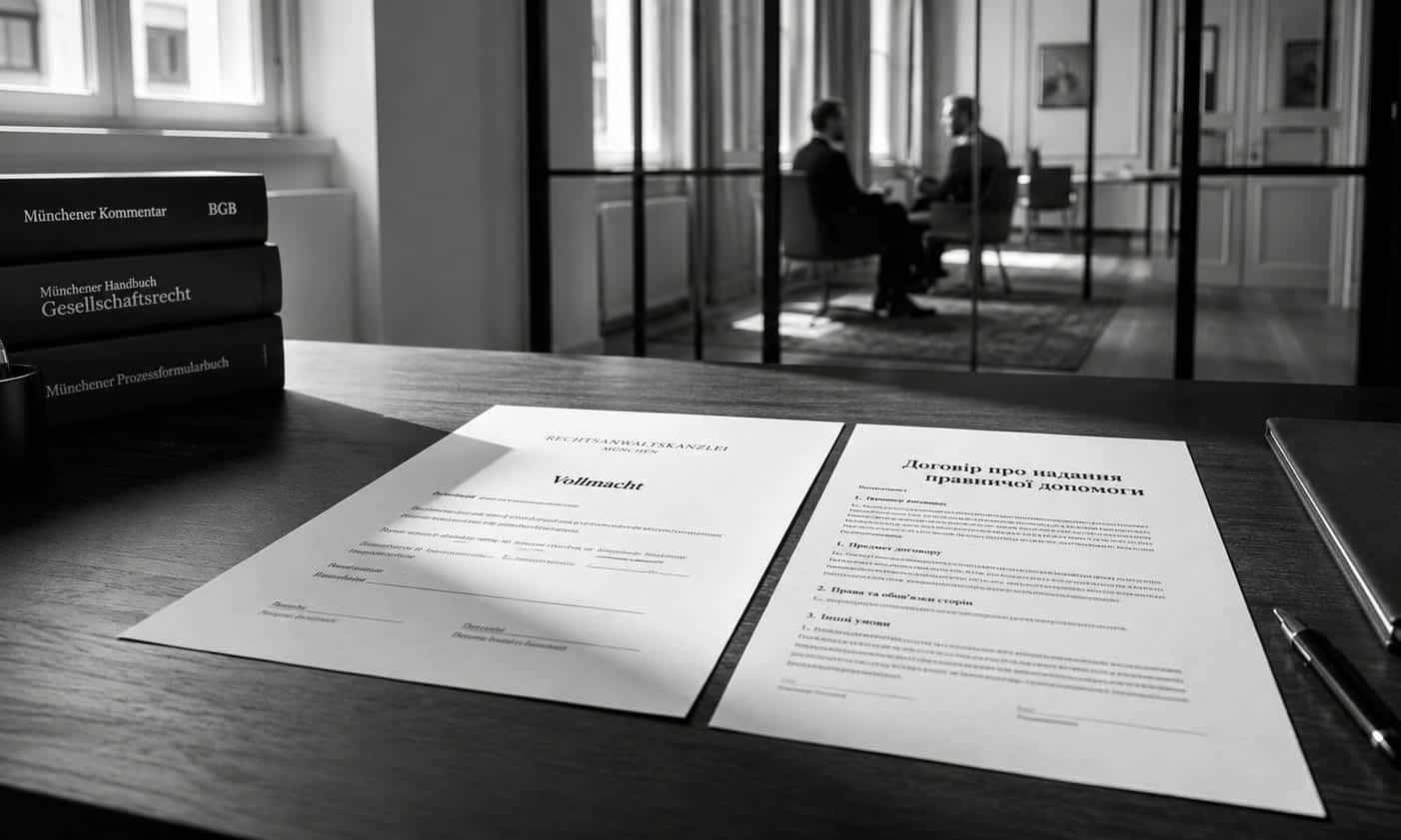
If you live in Munich and are looking for a Russian-speaking attorney, you’ve come to the right place. KLAMERT & PARTNER is a law firm in the heart of Munich that has been in business since 1987 and has been advising Russian-speaking clients from various countries—including Russia, Belarus, Kazakhstan, Uzbekistan, Israel, and the Baltic states—as well as Russian-Germans and recent immigrants for many years. We offer consultations in Russian at our office at Heimeranstraße 37—just a stone’s throw from Theresienwiese, near Sendlinger Tor and the Hauptbahnhof. An initial assessment of your case is free of charge and without obligation. Russian-language services at our firm are provided by attorney Denis Osipenko; Legal responsibility for handling your case rests with the licensed German attorneys Markus Klamert, Mark Frey, and Johannes Götz. We provide legal advice on immigration, inheritance, labor, tenancy, traffic, investment, criminal, and civil law.
01. Why do you need a Russian-speaking lawyer in Munich?
The legal situation in Germany is often complex, and documents are written in legal German, a language in which even fluent German speakers can miss important details. A letter from the KVR Munich regarding the extension of a residence permit, a summons from the public prosecutor’s office as a suspect, termination of an employment contract during the probationary period, an eviction lawsuit from the apartment owner, a traffic citation following a car accident—each of these documents contains legal terms and deadlines that must be understood precisely, not just roughly. That is precisely why a Russian-speaking lawyer in Munich is not a luxury, but a tool for serious case management.
At KLAMERT & PARTNER, we work with Russian-speaking clients in a wide variety of situations. A family from Kazakhstan who moved to Munich under a resettlement program and, ten years later, found themselves dealing with an inheritance case involving property in Almaty and an apartment in Munich. A young professional from Uzbekistan with a Blue Card working at a Munich-based technology conglomerate, whose employment contract was terminated one week before the end of his probationary period. A businesswoman from Israel who is investing in a German company and requires comprehensive advice on corporate, investment, and tax law. A family of Russian Germans living in Munich since 1995, who speak German fluently but wish to discuss complex inheritance matters in their native language. A woman from Belarus who received a summons from the Munich public prosecutor’s office regarding the submission of accurate information to the Foreigners’ Registration Office. These situations are fundamentally different—what they have in common is that they all require precise communication, not approximate.
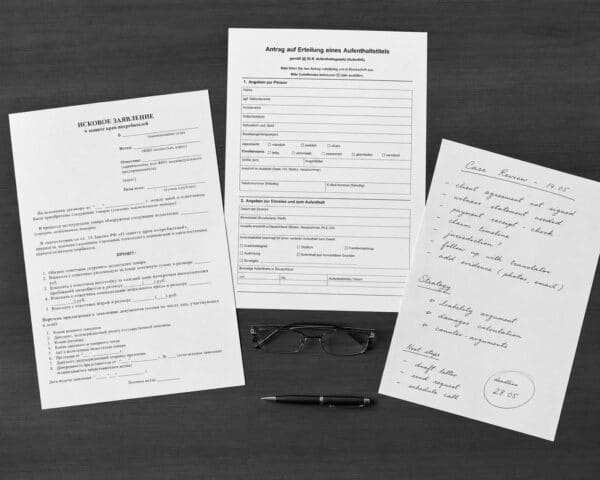
Legal German is a craft in its own right. Terms such as *Aufenthaltstitel*, *Pflichtteilsergänzungsanspruch*, *fristlose Kündigung*, *Strafbefehl*, and *Bußgeldbescheid* do not have exact single-word equivalents in Russian—they require explanation. When we use these terms in Russian during consultations and explain the consequences and deadlines, the client understands not only what we are doing, but also why we are doing it. This is the foundation of any good legal representation.
FROM OUR PRACTICE — INHERITANCE FROM KAZAKHSTAN AND THE GERMAN MANDATORY SHARE
A common scenario in our practice: a Russian-speaking client inherits an apartment in Munich and, at the same time, a house in Almaty. Her brother, who remained in Kazakhstan, claims his share—and at the same time, another relative in Munich asserts her right to a compulsory share (Pflichtteil). Documents from Kazakhstan—death certificates, notarized property deeds, and gift agreements from the past ten years—are in Russian and require an apostille and a certified translation. From our practice: proper coordination of German inheritance law (§ 2303 BGB Pflichtteil, § 2325 BGB Pflichtteilsergänzung) with Kazakhstani documents and the application of the EU Succession Regulation requires two steps—legal analysis in Russian by Denis Osipenko, followed by strategic case management by Markus Klamert. We have anonymized the case—§ 6 BORA—but the logic is clear: without Russian-language support, such international cases drag on for months, whereas with it, they are resolved in weeks.
Common questions that Russian-speaking customers ask us:
- I live in Munich on a temporary residence permit—how do I renew it or obtain a permanent residence permit?
- What are my chances of obtaining German citizenship, and do I need to renounce my Russian/Kazakh/Belarusian citizenship?
- My employer fired me during my probationary period—is it worth filing a lawsuit?
- The landlord sent me a notice of termination of the lease agreement citing personal need—what can I do?
- I have an apartment in Russia and another one in Germany. My father has passed away—how do I handle the inheritance proceedings in both countries?
- I am starting a business in Germany, and the owner is from Kazakhstan—how should I structure it given the sanctions?
- I was in a car accident and received a traffic citation—do I need a lawyer?
- I received a summons as a suspect—what should I do?
“Russian-speaking clients often come to us after trying several other law firms in Munich. It’s not because the lawyers there are bad—they work in German, and for most clients this creates a communication barrier that cannot be resolved simply by bringing in an interpreter. Language work is part of legal work. For us, it is integrated into every step of handling a case.”
— Marcus Klamert, attorney and founder of KLAMERT & PARTNER
02. Denis Osipenko — Lawyer (Russian and Ukrainian)
Denis Osipenko is a key figure in our firm’s Russian- and Ukrainian-language advisory services. He is a highly educated lawyer with professional experience in Ukraine; for most Russian-speaking clients, he is the first point of contact at KLAMERT & PARTNER. An important clarification for transparency: Denis Osipenko is a lawyer (Jurist in German), but not a licensed attorney under German professional law (Rechtsanwalt). Legal responsibility for handling cases, all pleadings, contracts, and official correspondence with courts and government agencies lies with the licensed attorneys—Markus Klamert, Mark Frey, and Johannes Götz. What Denis Osipenko provides is a linguistic and cultural bridge between Russian-speaking clients and our legal team.
Specifically, this means the following: when you call 089 540 239 0 and speak Russian, or submit a request via the contact form on the website in Russian, you will typically speak with Denis Osipenko first. He listens to your situation, makes a preliminary legal assessment of it, reviews documents from your countries—Russian marriage certificates, Kazakhstani family composition certificates, Uzbek contracts, Israeli inheritance certificates—and translates them accurately for a working meeting with the responsible attorney. During the course of a lengthy case and correspondence with authorities, he translates German court decisions into plain language so that you understand what your lawyer is doing and why.
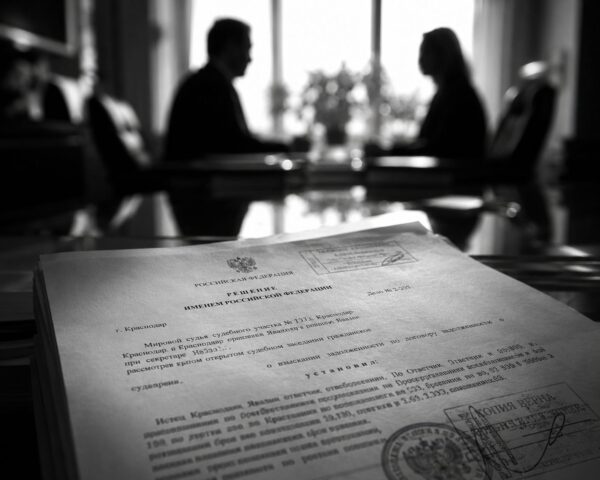
In the Munich legal market, this combination—a lawyer admitted to the German bar plus a Russian-speaking attorney in the same firm with a clear division of cases—is a rare model. Most Munich firms rely on external translators for language support, which works for consultations but results in significant delays in day-to-day case work. At our firm, Russian-language preliminary processing is integrated into our daily workflow—it is not an additional service, but a structural solution.
03. Team — Licensed Attorneys and Russian-Speaking Colleagues
The Russian-language legal services at KLAMERT & PARTNER are provided through a collaborative effort between Denis Osipenko, additional Russian-speaking colleagues, and three licensed attorneys at the firm. The partner in charge of a case varies depending on the area of law.
Marcus Klamert — Partner in charge of estate planning, investment law, and civil law
Marcus Klamert is the founder of the law firm and has been practicing law since 1987 in the areas of inheritance law, investment law, property law, and general civil law. For Russian-speaking clients with asset structures in multiple countries (family businesses in Russia and Kazakhstan, holding structures via Cyprus or the United Arab Emirates, international inheritances involving Russia, Israel, and Germany), he is typically the lead attorney. Initial consultations are conducted in Russian through Denis Osipenko; Klamert is responsible for handling the case.
Mark Frey — Partner in Charge of Real Estate, Transportation, and Civil Law
Mark Frey specializes in contract and property law and regularly handles cases involving tenancy, traffic, and general civil law. For Russian-speaking families in Munich who are reviewing lease agreements or have received a termination notice due to the landlord’s own needs, he is usually the attorney in charge. Mark Frey also handles traffic cases—including fines for traffic violations, points on the Flensburg record, driver’s license issues, and the recognition of foreign driver’s licenses.
Johannes Götz — Partner in charge of labor, banking, and investment law
Johannes Götz handles employment and investment matters. For Russian-speaking clients in Munich’s technology, pharmaceutical, and automotive industries, employment matters are a regular topic: termination of employment within a corporate group, disputes over bonuses and company cars, and severance agreements. In investment matters involving capital from Russia, Kazakhstan, or Israel—especially when compliance and sanctions issues arise—Götz serves as the primary point of contact.
Denis Osipenko and other Russian-speaking colleagues
Denis Osipenko typically conducts Russian-language preliminary consultations on his own. For large caseloads or specialized topics (Russian notarial law, Kazakhstani corporate structures, Israeli inheritance documents), we work with additional Russian-speaking colleagues who contribute specialized legal or linguistic expertise. This collaboration is project-based—for you as a client, there is always a clear point of contact leading the case: one of the three licensed attorneys, plus Denis Osipenko as the linguistic liaison.
Request a free initial assessment
Tell us about your case—quickly and with no obligation. We’ll assess your chances of success and get back to you shortly.
or call us directly at: 089 540 239 0
04. For which clients—Russia, Belarus, CIS countries, Israel, Russian Germans
Russian is the native language or the language of communication in a significant number of countries—far beyond the borders of the Russian Federation. Therefore, our Russian-language consultation service in Munich is aimed not only at Russian citizens, but at a much broader group of clients.
Russia
Russian clients in Munich have a wide range of residency statuses—from long-term residence permits (Niederlassungserlaubnis) to current residence permits and special arrangements. Since 2022, this has been supplemented by specific situations involving sanctions and compliance (see the separate section below). Consultation language: Russian.
Belarus
Belarusian clients have often been living in Munich since the political changes that took place after 2020; some are there as asylum seekers, while others hold existing residence permits. The Belarusian language is rarely offered as a separate service in Germany—consultations are conducted in Russian, which most Belarusian clients speak fluently.
Kazakhstan, Uzbekistan, Kyrgyzstan, Tajikistan, Turkmenistan
Clients from the Central Asian republics come from a wide variety of backgrounds: entrepreneurs with German subsidiaries, families with German passports who migrated from Russia in the 1990s and 2000s, students, professionals working for Munich-based corporations, and investors. We regularly see complex asset structures spanning multiple countries, particularly among our clients from Kazakhstan. Consultation language: Russian.
Azerbaijan, Georgia, Armenia
Clients from the South Caucasus often have complex migration histories—traveling through Russia, Turkey, or directly to Germany. Russian is the common language in this region, so consultations in Russian are usually possible.
Moldova
Moldovan clients speak either Romanian (the official language) or Russian (the language of communication, especially in Transnistria and major cities). Our consultation service is available to Russian-speaking Moldovan clients.
Israel — Russian-speaking community
Israel is home to a large Russian-speaking community—about one million people who emigrated from the Soviet Union in the 1990s. Israeli clients with ties to Germany (inheritance, real estate, German-Israeli family structures, business relationships, investments in Germany) receive consultations in Russian.
Latvia, Lithuania, Estonia — Russian-speaking minorities
There is a significant Russian-speaking minority in the Baltic states (about a quarter of the population in Latvia and Estonia). For Russian-speaking clients in the Baltic states with German legal matters, we provide consultations in Russian.
Russian Germans and later immigrants
A special group consists of Russian Germans and later immigrants who have been living in Germany since the 1990s and 2000s: many hold German passports, are often bilingual, and have family ties in Russia, Kazakhstan, or other CIS countries. This group often deals with inheritance matters (inheritance in their homeland plus property in Germany), real estate matters, and sometimes criminal or traffic law cases. Consultations are available in Russian or German—the choice is yours.
05. Eight Areas of Law — Consultation in Russian
At KLAMERT & PARTNER, we provide consultations in Russian across all eight areas of law covered by our firm—not just immigration law, which is the only area covered in Russian by many of our competitors. Here we provide a brief overview of all our practice areas; the most important ones—immigration, inheritance, labor, and tenancy law—are covered in their own sections below.
Overview of regions:
- Immigration Law: residence permits, permanent residence permits (Niederlassungserlaubnis), German citizenship, family reunification—more details below.
- Inheritance Law: reserved share, international inheritance involving assets in multiple countries, wills, inheritance agreements—more details below.
- Labor Law: termination, probationary period, termination agreement, suspension from work, bonus disputes—more details below.
- Tenancy Law: termination at the tenant’s discretion, rent reduction due to defects, repairs upon moving out, rent increases—see below for more details.
- Traffic Law: fines for traffic violations, points on the Flensburg record, driver’s license issues, traffic accidents. Specifically for Russian-speaking clients: recognition of driver’s licenses from CIS countries.
- Investment and Banking Law: Improper advice when purchasing investments in Germany, banking law, transferring capital from Russia and CIS countries, and sanctions-related issues.
- Criminal Law: Representation of suspects, defendants, and victims in criminal cases. A summons from the police or the prosecutor’s office is a situation where Russian-language legal advice is particularly important.
- Civil Law: Contract disputes involving the purchase of cars, furniture, and travel. Debt collection. General civil claims.
06. Immigration Law — Residence Permits, Citizenship, Family Reunification
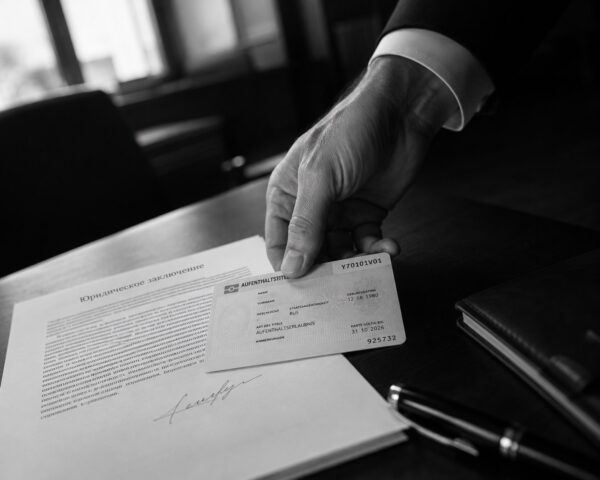
Immigration law accounts for the largest group of Russian-speaking clients at our firm. We handle cases ranging from the initial issuance of a residence permit to the acquisition of German citizenship. A Munich-based immigration lawyer is someone who is familiar not only with the law but also with the specific practices of the KVR München at Ruppertstraße 19.
Permanent residence permit (Niederlassungserlaubnis)
A settlement permit is a permanent residence permit that grants almost all the rights of a permanent resident in Germany. For Russian-speaking clients, it is generally obtainable after 5 years of legal residence, provided the following conditions are met: German language proficiency at the B1 level, ability to support oneself through one’s own work (without social assistance for the past 12 months), paid pension contributions, and adequate housing. We review your documents, length of stay, and income—and prepare your application so that the KVR München has no grounds for rejection.
German Citizenship — StAG Reform 2024
The 2024 reform of the Citizenship Act (StAG) made it possible to obtain German citizenship after just 5 years (previously 8 years), and in special cases, after 3 years. Dual citizenship is now possible in principle—this is an important change for Russian-speaking clients who previously had to renounce their Russian, Kazakh, or Belarusian citizenship. Russian clients, however, face a specific situation: the procedure for renouncing Russian citizenship through Russian consulates abroad has become significantly more complicated in recent years. We analyze your specific situation and determine whether the dual citizenship procedure is realistic in your case, or whether it is a matter of recognizing the impossibility of renunciation.
Family Reunification — Relatives in Russia and the CIS
Many of our Russian-speaking clients want to bring their relatives—parents, siblings, and adult children—to Munich. Under German law, family reunification is strictly limited: only reunification with a spouse and minor children is automatically permitted. Reunification with parents is possible only in exceptional cases—primarily in the event of serious illness or the inability to provide care in the country of origin. We honestly assess your chances from the very beginning—without making promises we cannot keep.
Recognition of Foreign Diplomas and Qualifications
Alongside immigration issues, the question of the recognition of diplomas and professional qualifications often arises—especially for doctors, engineers, IT specialists, and lawyers from Russia, Kazakhstan, Belarus, and other countries. We coordinate the process with the relevant authorities in Bavaria and prepare the necessary documents (apostille, certified translation, equivalence assessment).
07. Inheritance Law — Compulsory Share, International Inheritance
Inheritance law for Russian-speaking clients in Munich is often a complex matter involving multiple jurisdictions: the father died in Moscow, and the estate includes an apartment in Moscow, a dacha in the Moscow region, a Swiss bank account, and a stake in a German company. A lawyer in Munich who is unfamiliar with the realities of the CIS countries cannot properly handle such a case. We integrate German inheritance law with documents and realities from Russia, Kazakhstan, Belarus, Israel, and other countries—through the Russian-language services of Denis Osipenko and through a network of correspondent attorneys in Moscow, Almaty, Minsk, and Tel Aviv.
Statutory share (Pflichtteil) — § 2303 BGB
Under German law, even if you have been disinherited, as a close relative (child, parent, spouse) you are entitled to a compulsory share—half of the share you would have received under the statutory order of succession. This is Section 2303 of the German Civil Code (BGB). If there have been gifts made in the last 10 years, you have an additional right to compensation (Section 2325 of the German Civil Code (BGB), claim for supplementary statutory share). We review documents from CIS countries regarding gifts, transfers of ownership, and usufruct—and calculate your share.
International Succession Law — EU Succession Regulation
If the deceased had their habitual residence in Russia or Kazakhstan but owned property in Germany, the EU Succession Regulation (European Regulation on Succession) applies. As a rule, the law of the country of habitual residence applies to the succession—in our example, Russian or Kazakh law. However, there are exceptions: if the deceased specified in their will that German law should apply, or if there is real estate in Germany. We analyze the documents under both legal systems and determine which law applies.
Certificate of Inheritance in Munich
To claim an inheritance in Germany (withdrawing funds from an account, transferring ownership of real estate), a certificate of inheritance (Erbschein) is often required. The application is filed with the probate court—in Munich, this is the court located at Maxburgstraße 4. If there is a will from Russia or another CIS country, we submit it with an apostille and a certified translation. We guide you through the process and have specific experience with documents from Russia, Kazakhstan, Belarus, and Israel.
A special provision for Russian Germans
Russian Germans and later immigrants often face a unique situation: property in Germany plus an inheritance in Kazakhstan, Kyrgyzstan, or Russia left behind by parents who did not move to Germany. We coordinate the matter with local attorneys in the country of origin and develop a comprehensive solution that takes into account both German and local law
08. Labor Law — Termination, Probationary Period, Termination Agreement
Labor disputes involving Russian-speaking clients are common in Munich—especially at technology companies (Google, Microsoft, Amazon, local startups), pharmaceutical firms, automakers, hospitals, and restaurants. A labor law attorney in Munich must act quickly: a lawsuit against dismissal can only be filed within 3 weeks of receiving notice (§ 4 KSchG). Anyone who misses this deadline will lose the case, regardless of whether the dismissal was lawful.
Protection against dismissal (action for unfair dismissal)
If you have worked for a German company with more than 10 employees for more than 6 months, you are protected under the German Unfair Dismissal Protection Act (KSchG). Dismissal is only valid for valid reasons: economic (job cuts), personal (e.g., long-term illness), or behavioral (breach of employment duties). We review the notice of termination for formal errors and file a claim with the Munich Labor Court. This often results in compensation (severance pay) amounting to half a month’s salary for each year of service.
Probationary period
During the first 6 months of employment (probationary period), dismissal is possible without cause with 2 weeks’ notice. This is a classic source of frustration for Russian-speaking clients working at Munich-based companies—after 5 months, an unexpected dismissal one week before the end of the probationary period. Legally, such a situation leaves almost no room for challenge unless there is discrimination or a violation of formalities. We examine precisely these exceptions—sometimes we find a procedural error that renders the dismissal invalid.
Termination Agreement
Employers often offer not a dismissal but a “termination agreement”—a contract to terminate the employment relationship by mutual agreement, often with compensation. You should not sign such an agreement without consulting a lawyer: the compensation is often less than what you could receive through a lawsuit, and you lose your right to unemployment benefits for 3 months (waiting period for ALG-I). We review the proposed amount and terms and help you negotiate better terms.
09. Lease Law — Termination by the Landlord, Reduction of Rent
In Munich, tenancy law is one of the most important areas for Russian-speaking families. Rent prices have risen dramatically: a three-bedroom apartment in Munich often costs €1,500–2,000, including heating. Losing an apartment due to termination by the landlord is practically equivalent to having to move out of the city—finding a replacement is nearly impossible. A Munich attorney specializing in tenancy law protects you from this situation to the extent permitted by German law.
Termination for personal use (termination for personal use) — § 573 BGB
If your landlord sends a notice of termination due to personal need (for themselves or their immediate family), German law allows for this—but only under strict conditions. The landlord must specifically name the person who wishes to move into the apartment and provide a reasonable explanation as to why this particular apartment is needed. We review the notice both formally (deadline, justification, person) and substantively (whether there is a genuine need, or if it is a feigned need to vacate the apartment prior to sale). If there are errors, the termination is invalid.
Reduction of Rent — Section 536 of the German Civil Code (BGB)
If there are defects in the apartment—such as mold, heating system malfunctions, noisy neighbors, or leaks—you have the right to reduce your rent. Section 536 of the German Civil Code (BGB). The amount of the reduction depends on the severity of the defect: a discount of 5% to 100% is possible. We assess your options and help you file a claim with the landlord in the proper form. Important: Defects must be documented from the very beginning—with photos, letters, and witnesses.
Cosmetic repairs upon move-out
Many standard lease agreements in Munich include clauses requiring cosmetic repairs upon moving out. Many of these clauses are invalid according to the case law of the Constitutional Court and the Federal Court of Justice (BGH)—and when a landlord demands thousands of euros for painting walls or replacing flooring, we often find that these demands have no legal basis.
10. Sanctions and Compliance — What We Can and Cannot Do
We have included this section intentionally because, for many Russian-speaking clients, the issue of sanctions and compliance has become a pressing concern since 2022—and it often remains unclear what is and isn’t permitted under these circumstances. We want to address this transparently.
Legal Consultation — Sanctions and Legal Status
Legal consultation in Germany is, in principle, an activity exempt from sanctions. This means that even if your case or your background is subject to EU or U.S. sanctions or German embargo policies, we, as attorneys, are still able to provide you with legal advice. The right to legal representation is a fundamental right and is not superseded by sanctions. This is particularly important in criminal cases, immigration law cases, and for general legal guidance.
What we do before every committee meeting
Before accepting any mandate, we conduct a compliance check: Is the client or the matter subject to EU sanctions? Are they subject to U.S. or U.K. sanctions, which may be relevant for international bank transfers? Is the client or any entity under their control on any sanctions lists (OFAC SDN List, EU sanctions, U.K. sanctions)? This check usually takes a few hours and is conducted before we officially accept the mandate.
What can we do in complex sanction scenarios?
For complex structures, we advise on which actions are permitted, which require approval from national regulatory authorities (in Germany, the Bundesanzeiger or the Bundesbank, depending on the matter), and which are not possible. We collaborate with sanctions law experts from other law firms when the case requires it—particularly for matters involving bank transfers, corporate structures, and trade. We are upfront from the very beginning about what is possible and what is not—we make no promises we cannot keep.
What we don't do
We do not provide advice on circumventing sanctions, do not assist with arrangements that could be construed as circumventing sanctions regulations, and do not accept mandates from individuals or entities on EU or UN sanctions lists. This is a clear ethical and legal boundary for us. If your situation falls into this category, we will be upfront about it during the initial consultation—which remains free of charge, just as it is for all other clients.
11. How the case is handled—four steps
1. First contact in Russian
You can call 089 540 239 0, contact us via the contact form on our website, or visit our office in person at Heimeranstraße 37. Languages for initial communication: Russian, Ukrainian, German, English, Portuguese—the choice is yours. If you submit a request in Russian, you will generally speak with Denis Osipenko first. We respond within one business day; in urgent cases, we respond sooner.
2. Case Analysis and Legal Preparation
Denis Osipenko reviews your case, translates documents from CIS countries—Russian marriage certificates, Kazakhstani certificates, Belarusian contracts, Israeli certificates of inheritance—and performs a preliminary legal classification of them. In straightforward cases (standard immigration cases, lease agreements, labor law), a single meeting is sufficient; in more complex cases (inheritance with international implications, investment law involving sanctions issues), a second meeting is held with the attorney in charge.
3. Legal representation
Once the documents have been reviewed, the attorney in charge—Klamert, Frey, or Götz—takes responsibility for the case. Correspondence with government agencies, courts, banks, and insurance companies is conducted in German and signed by a licensed attorney. We explain important decisions and agreements to you in Russian—either by phone or via a brief translation note from Denis Osipenko.
4. Follow-up matters and long-term support
Often, additional matters arise from the initial case: family reunification following the successful granting of a permanent residence permit, German citizenship after a long-term stay, estate planning after the acquisition of property, and corporate structuring after the establishment of a company. We handle such follow-up cases in an integrated manner—the same partner remains in charge of the case so that knowledge of the matter and the language connection are maintained over the years.
12. Frequently Asked Questions — About a Lawyer in Munich in Russian
How much does a Russian-language legal consultation cost?
The initial assessment of your case at KLAMERT & PARTNER is free of charge, regardless of the language of the consultation. Further work on the case is carried out after a retainer agreement has been signed—either based on German RVG attorney rates (calculated on the basis of the value of the matter in dispute) or by individual agreement on fees. Denis Osipenko’s preliminary work in Russian is included in the attorney’s fee and is not charged separately. If you have German legal expenses insurance (Rechtsschutzversicherung), we will check your coverage.
Is Denis Osipenko a licensed attorney?
No. Denis Osipenko is a qualified lawyer responsible for client relations in Russian and Ukrainian. However, he is not a lawyer admitted to practice under German law (Rechtsanwalt). Legal responsibility for handling the case, all pleadings, contracts, and correspondence with courts and authorities lies with the licensed attorneys—Markus Klamert, Mark Frey, and Johannes Götz. This division is not a shortcoming but a mark of quality: you have a language partner who listens and analyzes, and a lawyer partner on the case who bears legal responsibility.
In which languages do you offer consultations?
German, English, Ukrainian, Russian, Portuguese. For preliminary consultations in Russian or Ukrainian, please contact Denis Osipenko. Legal responsibility for the case is assumed by the firm’s licensed attorneys: Klamert, Frey, or Götz, depending on the area of law.
What areas of law do you practice in Russian?
All eight practice areas of our law firm: immigration law (residence permits, permanent residence permits, citizenship, family reunification), inheritance law, labor law, real estate law, traffic law, investment law, criminal law, and general civil law. In other words, not just immigration cases in Russian—but everything you’d find at a Munich law firm.
What country do I need to be from to become a customer?
We serve Russian-speaking clients from all countries where Russian is the native language or the language of communication: Russia, Belarus, Kazakhstan, Uzbekistan, Kyrgyzstan, Tajikistan, Turkmenistan, Azerbaijan, Georgia, Armenia, Moldova, Israel (Russian-speaking community), the Baltic states (Russian-speaking minority), as well as Russian Germans and recent immigrants in Germany. A person’s nationality is irrelevant—what matters is the language requirement.
Will my documents from Russia or the CIS be recognized by German authorities?
Documents from CIS countries (birth certificates, marriage certificates, diplomas) are generally recognized by German authorities if they are accompanied by an apostille (Hague Convention) and a certified translation. Russia and some CIS countries have specific requirements—we coordinate the processing of documents with the German Consulate General in the country of origin and with local notaries. Denis Osipenko provides substantive translations of documents for business purposes; we handle formal certified translations through certified translators with whom we regularly collaborate.
What is the situation regarding sanctions—as a Russian customer, can I become your client?
In principle, yes—legal consultations in Germany are exempt from sanctions, and we will continue to advise Russian clients after 2022. Before accepting a case, we conduct a standard compliance check (to determine whether you are on any sanctions lists or whether the case itself raises sanctions concerns). For most private matters—immigration, inheritance, leasing, labor law—sanctions issues do not arise. In commercial and investment matters, we analyze the situation in greater detail and openly discuss what is possible and what is not. For more details, see the “Sanctions and Compliance” section above.
What should I do if I need a lawyer right away—say, within three weeks?
Please call 089 540 239 0 as soon as possible or contact us via the contact form. Deadlines under German law are strict—for example, you can only file a lawsuit against dismissal within 3 weeks (§ 4 KSchG); against an agency’s decision—only within 1 month. In urgent cases, we respond within a few hours, not a full day.
Can I bring my family to the office?
Yes—in inheritance and family law matters, this is often even recommended. A meeting at the office at Heimeranstraße 37 usually lasts 60–90 minutes; if there are several parties involved in the case, it’s best to schedule a longer meeting. Denis Osipenko can attend in person or via video conference if you do not live in Munich.
What makes a Russian-language consultation better than the services of a regular translator?
A translator translates words. A lawyer with language skills understands the context. When we explain in Russian why the mandatory share under German law is calculated this way and not another, or why your notice of termination is formally invalid, we use legal concepts that aren’t found in a standard dictionary. Denis Osipenko is familiar with both systems—German and Russian—and can bridge them. This represents a qualitatively different level of service compared to working with an external translator.
Where is the office located?
KLAMERT & PARTNER, Heimeranstraße 37, 80339 Munich. This is in the heart of Munich, in the Schwanthalerhöhe (Westend) district—just a stone’s throw from Theresienwiese (Schwanthalerhöhe U4/U5 subway station), near Sendlinger Tor (U1/U2/U3/U6/U7/U8) and Munich Central Station (all S-Bahn lines, all regional trains). The office is open Monday through Friday from 8:00 a.m. to 5:30 p.m.; appointments outside of business hours are available by separate arrangement.
Request a free initial assessment
Tell us about your case—quickly and with no obligation. We’ll assess your chances of success and get back to you shortly.
or call us directly at: 089 540 239 0
13. Free initial consultation in Russian
Tell us briefly about your situation—in Russian, Ukrainian, German, or English. We’ll review your rights, the current deadlines, and which attorney from our team will take on your case—all free of charge. You can reach us via the contact form on our website, by phone at 089 540 239 0, or in person at our office at Heimeranstraße 37 in Munich. For urgent matters—such as lawsuits against government agencies, the threat of deportation, eviction from an apartment, or a summons from the prosecutor’s office—we respond within a few hours. “A Munich attorney for Russian-speaking clients at KLAMERT & PARTNER” is not just a marketing slogan, but a dedicated service line with clearly defined roles: Denis Osipenko as a Russian-speaking attorney, plus additional Russian-speaking colleagues, plus licensed attorneys Markus Klamert, Mark Frey, and Johannes Götz, who assume legal responsibility for the case.