
Deutsche Finance Group: BaFin Special Representative — What Rights Investors Have Now
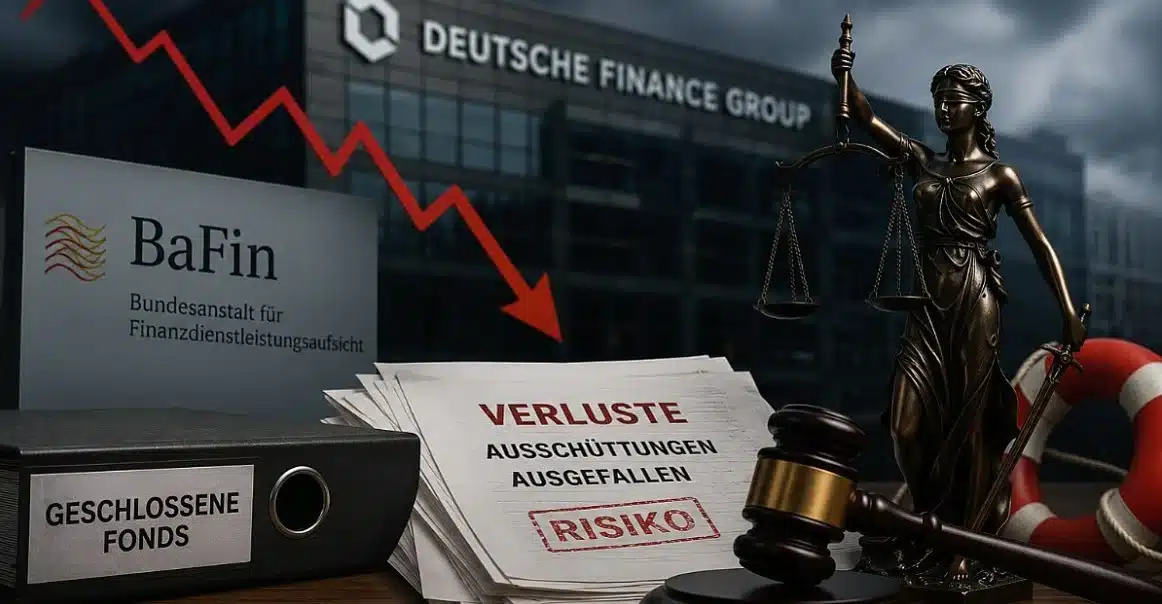
BaFin has appointed a special representative at DF Deutsche Finance Investment GmbH. For the approximately 50,000 investors in the group’s closed-end funds, this is a clear warning sign—but not a verdict. Financial losses do not mean that you have no legal rights. Conversely, they do not automatically mean that you have a claim. The decisive factor is whether you were properly informed of the material risks before subscribing and whether your advisor recommended the investment as appropriate for your personal investment goals. At the time, many investors were enticed by statements such as “secure retirement planning” or “manageable risk,” even though there were in fact significant business risks, including the possibility of total loss. Such errors in advice can give rise to claims for damages. However, these claims are subject to a statute of limitations—and time is running out, especially for older investments.
Key Points at a Glance
• BaFin announcement dated June 19, 2026: Order requiring DF Deutsche Finance Investment GmbH to provide information and submit documents, as well as the appointment of a special representative.
• The measures are not yet final, but are immediately enforceable.
• A regulatory action is not a court ruling and does not constitute proof of a breach of duty.
• Claims are not directed against BaFin, but against advisors, brokers, banks, or other parties against whom claims are brought.
• Premature terminations, sales, waivers, or settlement agreements may affect existing rights.
• The following documents will be reviewed: subscription form, sales prospectus, consultation records, and correspondence.
What BaFin has ordered DF Deutsche Finance Investment GmbH to do
The notice issued by the Federal Financial Supervisory Authority (BaFin) on June 19, 2026, concerns DF Deutsche Finance Investment GmbH. The company is an asset management firm and is therefore subject to the provisions of the German Capital Investment Code. The authority is requesting information and documents to investigate whether the closed-end public funds managed by the company are being administered properly. A special representative is monitoring compliance with the order and reporting back to BaFin. According to the regulator, it intends to form its own assessment of whether the funds are being managed properly. The measures are not yet final but are immediately enforceable.
Why a Special Envoy Is More Than Just a Routine Matter
The appointment of a special representative is not a court ruling nor is it evidence of a breach of duty. However, it goes well beyond a routine request for information. According to general information from BaFin, special representatives are appointed in supervisory practice, in particular, when more intensive oversight of a company’s organizational structure or the implementation of regulatory requirements appears necessary.
This does not automatically entitle affected investors to a refund of their investment. However, this measure provides a concrete reason to have their investment, the investment advice they received at the time, and the sales materials used reviewed from a legal perspective. Investors should therefore not rush to terminate their investment, sell their holdings, or sign waiver or settlement offers. First, it must be determined in which fund the investment was made, what the fund’s financial situation is, and what individual rights exist.
About 50,000 individual investors, approximately 1.5 billion euros
According to media reports, approximately 50,000 individual investors have invested about 1.5 billion euros in Deutsche Finance funds. Stiftung Warentest reports that the group manages billions in assets for individual and institutional investors, and its analysis of the available figures raises concerns.
The Handelsblatt also reports on heavy losses at publicly traded funds, missing or delayed financial statements, and auditors’ doubts about the ability of individual funds to continue as a going concern. Among other things, the report mentions complex fund structures and losses in the tens of millions.
Economic loss is not the same as a claim for damages
A distinction must be made between a fund’s financial losses and legally enforceable claims for damages. In principle, a risky investment may incur losses; that alone does not give rise to liability. However, damages may be awarded if investors were not properly informed of the material risks, costs, conflicts of interest, and characteristics of the investment prior to subscription.
Which Deutsche Finance funds may be affected
The BaFin measure applies to the closed-end public funds managed by DF Deutsche Finance Investment GmbH. In particular, investments in various series of the Deutsche Finance Group may be affected, such as funds with names like:
- DF Deutsche Finance Investment Fund
- DF Deutsche Finance Investment Fund 14
- DF Deutsche Finance Investment Fund 15
- DF Deutsche Finance Investment Fund 16
- DF Deutsche Finance Investment Fund 17
- DF Deutsche Finance Investment Fund 18
- DF Deutsche Finance Investment Fund 19
- DF Deutsche Finance Investment Fund 20
- DF Deutsche Finance Investment Fund 21
In addition, there are other closed-end investment and real estate funds within the corporate group. Whether a specific fund is in fact the subject of the BaFin audit and whether any legal claims exist with respect to this investment must be determined on the basis of the contractual documents and the current fund information.
Can investors get their money back?
There is no direct claim against BaFin. As a general rule, the financial supervisory authority does not enforce individual claims for damages brought by individual investors. Those affected must assert their claims themselves against the respective responsible companies, advisors, brokers, or other defendants.
A full or partial rescission of the investment may be considered, in particular, if the investment advice was flawed. Under Section 280 of the German Civil Code (BGB), damages may be claimed if a contractual obligation was breached and this resulted in damage.
If the claim is successful, the investor may generally be restored to the position he would have been in had he not received the erroneous advice. This may result in the repayment of the invested principal, less any distributions received, in exchange for which the investor transfers his interest. Whether such a reversal is actually enforceable depends on the specific advice provided, the documentation, the causal link, and the financial capacity of the opposing party.
Appropriate for the investor and the investment: what needed to be explained
A claim for damages against an investment advisor, a bank, or a broker may arise, in particular, if the investment was not recommended in a manner appropriate to the investor or the nature of the investment. In the case of closed-end real estate and private equity funds, investors had to be clearly informed on a regular basis that
- the investment is of a business nature,
- it is possible that the entire invested capital could be lost,
- Dividends are not guaranteed,
- Distributions may not constitute profits,
- the capital is tied up for the long term,
- there is no functioning secondary market for the investment,
- an early sale may be difficult or result in significant losses,
- There are exchange rate, financing, and real estate market risks,
- complex corporate and tax risks may arise, and
- Significant costs and sales commissions can reduce the return on investment.
If, instead, the investment was presented as a secure retirement plan, a real estate investment with manageable risk, or an investment that could be liquidated at any time—even though there were in fact significant business risks involved—the recommendation may have been flawed.
Were commissions and conflicts of interest disclosed?
Of particular importance is the question of what compensation the advisors or intermediaries received for the recommendation. Investors must be able to identify potential conflicts of interest. High sales commissions can be a key factor in investment decisions because they reveal what portion of the investment is not being invested directly and what financial interest the intermediary had in making the recommendation.
For the legal review, therefore, not only the subscription form and the prospectus but also consultation records, product information sheets, emails, handwritten notes, and promotional materials should be evaluated.
Claims Arising from Faulty Prospectuses and Investor Information
In addition to claims arising from improper advice, claims may also arise from inaccurate, misleading, or incomplete sales documents. A sales prospectus must set forth the material factual and legal circumstances that are relevant to the evaluation of the investment. For example, it may be decisive whether risks, costs, personal and economic ties, use of funds, financing, forecasts, and potential conflicts of interest were described accurately and in a comprehensible manner.
The Investment Act contains specific liability provisions regarding incorrect or missing prospectuses and investment information sheets. Whether these provisions apply to a specific Deutsche Finance investment, however, depends on the legal classification of the product, the date of subscription, and the applicable legal regulations at the time.
In the case of investment funds governed by the German Capital Investment Code (KAGB), the information, organizational, risk, and administrative obligations set forth therein must also be taken into account. Among other things, the KAGB contains provisions regarding organization, risk management, conflicts of interest, and the appointment and duties of a special representative. However, the BaFin order alone does not prove either an error in the prospectus or specific harm to a particular investor.
Should I cancel my Deutsche Finance account or sell my stake?
Closed-end funds generally cannot be redeemed at any time, unlike ordinary investment funds. Ordinary redemption is often not permitted or is only possible after a long minimum term has expired.
A sale on the secondary market is, in principle, possible. However, significant discounts are often demanded there. A hasty sale can therefore be financially disadvantageous and may also make it more difficult to enforce claims for damages at a later date. Before terminating a contract or making a sale, the following should be considered:
- What term was agreed upon?
- Are there any contractual rights to terminate or return the item?
- What is a realistic selling price?
- What are the tax implications of the sale?
- Are there any priority claims for damages?
- Can the equity interest be transferred as part of a rescission?
Statute of Limitations: Why Investors Shouldn't Wait Too Long
Claims for damages are subject to a statute of limitations. Both time limits based on knowledge and absolute maximum time limits may be decisive (Sections 195, 199 of the German Civil Code (BGB)). Among other factors, the decisive factor is when the investor became aware of the circumstances giving rise to the claim and the identity of the potential defendant, or when the investor should have become aware of them had it not been for gross negligence.
The publication of critical reports or the BaFin’s action does not automatically result in all claims becoming time-barred immediately. However, it may play a role in the subsequent assessment of the investor’s knowledge. Particularly in the case of older investments, there is therefore a risk that claims are already time-barred or will become time-barred in the foreseeable future. A mere inquiry to the advisor or the fund company generally does not reliably toll the statute of limitations.
What Determines the Chances of Success
It is not possible to make a general assessment of the chances of success. They depend, in particular, on the following:
-
- when and in which funds investments were made,
- who arranged or recommended the investment,
- what investment objective was pursued,
- which risks were actually explained,
- which version of the brochure was submitted,
- whether the documents were submitted on time,
- whether errors in advice can be proven,
- whether claims are already time-barred and
- whether the respective defendant has the financial means to pay.
An investigation may be particularly promising if the investment was presented as secure, stable in value, suitable for retirement planning, or readily available in the short term. The absence of disclosures regarding the risk of total loss, long terms, limited liquidity, high commissions, or business risks may also be legally relevant. The appointment of a special representative does not, in and of itself, create a claim for damages. However, it can yield new insights and confirms that investors should not ignore future developments.
What Documents You Should Back Up Now
Investors should first secure all documents related to their investment. These include, in particular:
- the subscription form,
- the prospectus,
- Key Investor Information,
- Counseling and placement records,
- Declarations of Membership and Articles of Association,
- Bank statements showing the deposits,
- Statements regarding distributions,
- Annual Reports and Shareholder Information,
- correspondence with the consultant or broker, as well as
- Recent correspondence from the fund management company.
In addition, the details of how the consultation went should be recorded as accurately as possible. It is particularly important to note which investment objectives were mentioned, what statements were made regarding security, term, availability of capital, and expected distributions, and whether the possibility of a total loss was discussed.
What You Shouldn't Sign Without Reviewing First
Investors should not sign any new declarations, margin call agreements, waivers, or settlement offers without first having them reviewed by legal counsel. Such declarations may impair existing claims or result in a permanent loss of legal rights.
Conclusion: Check your rights early on; don't sell in a panic
The latest developments at Deutsche Finance Group should be taken seriously. BaFin is investigating whether closed-end mutual funds are being managed in accordance with regulations and has appointed a special representative to oversee its investigation. At the same time, Stiftung Warentest and Handelsblatt are reporting on financial problems, losses, and transparency issues.
However, there is no need to panic. Investors should not rush to sell their holdings or waive any potential rights. Instead, it makes sense to conduct a case-by-case review of the contractual documents, the advisory process, the financial performance of the respective fund, and any applicable statutes of limitations.
Frequently Asked Questions from Deutsche Finance Investors
Does the BaFin special representative mean that the money I invested is lost?
No. The appointment of a special representative is a regulatory measure, not a court ruling, and does not constitute evidence of a breach of duty. It means that BaFin is conducting a closer examination of the proper management of closed-end mutual funds and is having the implementation of its order monitored. This measure says nothing about the value of your investment or about any individual claims. However, it is a concrete reason to have your own investment, the advice you received at the time, and the sales documents reviewed, rather than waiting to see how the situation develops.
Can I file a claim directly with BaFin?
No. There is no direct claim against the financial supervisory authority, and BaFin generally does not enforce individual claims for damages brought by individual investors. Claims must be asserted against the respective responsible companies, the investment advisor, the broker, a participating bank, or other defendants. Who the defendant is in each individual case is determined by the subscription process, the contractual documents, and the course of the advice provided at the time.
Can I easily cancel my Deutsche Finance subscription?
Generally not. Closed-end funds are not ordinary investment funds that can be redeemed at any time. Ordinary termination is often not permitted or is only possible after a long minimum term has expired. A sale on the secondary market is possible, but significant discounts are often required there. A hasty sale can be financially disadvantageous and make it more difficult to enforce claims for damages later on. Before terminating the investment, the term, contractual redemption rights, tax consequences, and any priority claims for damages should be reviewed.
When might investment advice be considered flawed?
A recommendation may be flawed if it was not appropriate for the investor or did not align with the nature of the investment. For closed-end real estate and private equity funds, it was necessary to clearly and regularly point out that the investment is of an entrepreneurial nature, that a total loss of the invested capital is possible, that distributions are not guaranteed and may not constitute profits, that the capital is tied up for the long term, and that there is no functioning secondary market. If, instead, the investment was presented as a secure retirement plan or as an investment that could be liquidated at any time, this may constitute a breach of the duty to advise.
I have received distributions. Does that preclude my entitlement to benefits?
Not necessarily. Distributions may not necessarily constitute profits, but can be returns on the capital invested. In the context of a rescission, distributions received are typically taken into account: The claim is then for the amount invested minus the payments received, while the investor, in return, transfers his or her interest. Whether a claim exists and, if so, in what amount, depends on the specific advice provided, the documentation, the causal relationship, and the financial capacity of the opposing party.
How long do I have to file a claim for damages?
Claims for damages are subject to a statute of limitations. Both time limits based on knowledge and absolute maximum time limits may apply (Sections 195, 199 of the German Civil Code (BGB)). The time limit based on knowledge begins, among other things, when the investor has become aware of the circumstances giving rise to the claim and the identity of the potential defendant, or should have become aware of them had it not been for gross negligence. Critical reports or regulatory actions do not automatically trigger the immediate commencement of the statute of limitations, but they may play a role in assessing when knowledge was acquired. Particular attention must be paid to the risk of the statute of limitations expiring in the case of older investments.
Is contacting the advisor enough to stop the statute of limitations?
Not on a regular basis. Simply making an inquiry with an investment advisor, a broker, or a fund company does not reliably suspend the statute of limitations. Anyone wishing to suspend the statute of limitations must use the procedures provided for that purpose; which ones apply in a specific case depends on the circumstances of the claim and the status of the statute of limitations. Therefore, the status of the statute of limitations should be clarified early on, rather than simply making an informal inquiry at first.
What documents do I need for the exam?
Particularly helpful documents include the subscription form, sales prospectus, key investor information, advisory and brokerage records, the declaration of membership and articles of association, bank statements showing deposits, statements of distributions, annual reports and shareholder information, correspondence with the advisor, and recent letters from the fund company. In addition, you should document how the advisory meeting proceeded: what investment objectives were discussed, what statements were made regarding security, term, and liquidity, and whether the possibility of a total loss was discussed.
Should I accept a severance or settlement offer?
Do not accept them without review. New statements, additional payment agreements, waivers, and settlement offers may affect existing claims or result in a permanent loss of legal rights. Before accepting such an offer, you should clarify which claims are even applicable, against whom they are directed, and how strong the evidence is. Only then can you assess whether a settlement makes financial sense for you.
How much does the initial review of my investment cost?
As part of our free initial assessment, we will review your case without obligation to determine whether it has a reasonable chance of success. Any legal advice beyond this will be provided only after you retain our services and we reach an agreement on fees; compensation will then be based on the RVG or an individual agreement. If you have legal expense insurance, we will handle the coverage inquiry on your behalf.
Have your claims related to your Deutsche Finance investment reviewed
Have you invested in a Deutsche Finance Group fund, are you receiving no distributions or reduced distributions, or are you concerned about losing your investment? As part of our free initial assessment, we will review your case without obligation to determine whether there are any apparent prospects for success. Any further legal advice will be provided only after you retain our services and we reach an agreement on fees.
In particular, we review:
- whether you received incorrect advice,
- whether significant risks were concealed or downplayed,
- whether commissions and conflicts of interest were adequately disclosed,
- whether the sales documents contain errors or omissions,
- whether compensation for damages or rescission is an option, and
- which statutes of limitations apply in your case.
Please send us, if possible, the subscription form, the offering circular, the advisory documents, and any recent correspondence regarding the investment. After reviewing the documents, we will provide you with an assessment of your legal and financial options.
Free Initial Assessment: 089 540 239 0 (Mon–Fri, 8:00 a.m.–5:30 p.m.) or via our contact form.
Investment Law in Munich — How to Reach Us
KLAMERT & PARTNER Rechtsanwälte PartGmbB, Pettenkoferstraße 37, 80336 Munich. Our law firm is located in the Ludwigsvorstadt district, just a few minutes’ walk from the Theresienwiese subway station (U4/U5); it is also easily accessible via Goetheplatz (U3/U6) and the main train station. We represent investors from Munich and across Germany. You do not need to come in person to have your investment reviewed—documents can also be submitted digitally. We offer consultations in German, English, Ukrainian, Russian, and Portuguese.