Lawyer specializing in naturalization
in Munich —
KLAMERT & PARTNER
Select your preferred language
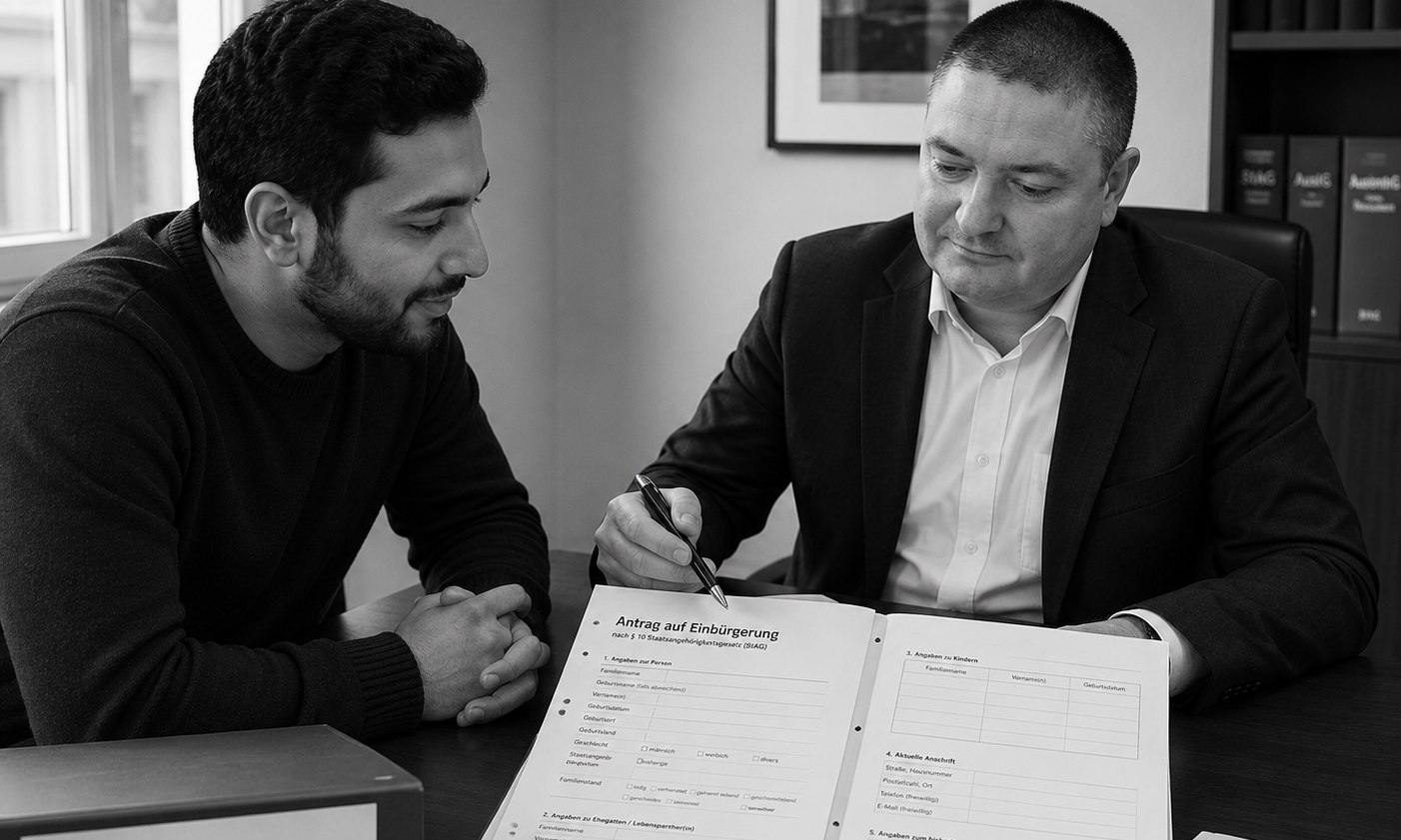
Since the 2024 StAG reform, the naturalization process in Munich has picked up pace: Those who are well-integrated can apply for a German passport after three years—and dual citizenship is no longer the exception, but the rule. Nevertheless, for many clients in Munich, the process stalls at the same points: during the appointment at the District Administrative Office (KVR), during identity verification, when substantiating the naturalization application, or when filing a lawsuit for failure to act against an agency that has not made a decision in 18 months. At KLAMERT & PARTNER, we have been providing legal counsel since 1987—as attorneys specializing in naturalization in Munich, we guide applicants through the entire process of citizenship law: from the initial consultation regarding the naturalization application, through the action for failure to act at the Munich Administrative Court, to the issuance of the naturalization certificate. With Denys Osypenko, our firm has a Ukrainian- and Russian-speaking attorney who can bridge cultural and linguistic gaps—while the licensed attorneys Markus Klamert, Marc Frey, and Johannes Goetz handle the legal aspects of your naturalization. Initial assessment is free of charge.
When do you need a lawyer specializing in naturalization in Munich?
The naturalization process in Munich is formally handled by the Munich District Administration Office (KVR), located at Ruppertstraße 19, 80466 Munich—the main office of the Munich naturalization authority. In theory, the procedure is standardized: submit an application, provide the required documents, take the naturalization test, wait, and pick up the certificate. In practice, as a naturalization attorney in Munich, we see that processing times at the KVR have increased dramatically since the 2024 StAG reform—waiting periods of 18 to 24 months between filing the application and receiving a decision are currently the rule, not the exception, in Munich. Those who apply without legal assistance not only lose patience during this time but often also lose track of the big picture: which document is missing, which language test was accepted, which gap in their resume was questioned.
A naturalization attorney in Munich typically becomes involved at three stages: First, before filing the application—reviewing the requirements under § 10 of the German Nationality Act (StAG), drafting a well-reasoned naturalization application with proper justification, and preparing the necessary documents. Second, during the ongoing proceedings—responding to additional requests from the KVR, clarifying the identity of clients without a valid passport from their country of origin, and filing a lawsuit for failure to act in cases of excessive procedural delays. Third, following a rejection—filing an appeal against the rejection notice and bringing a lawsuit before the Munich Administrative Court.
The naturalization process in Munich also has a few peculiarities that almost always catch clients without local experience by surprise: Certain identity documents are accepted only if they bear an apostille; some language certificates are scrutinized more closely by the KVR than elsewhere; and when it comes to proving sufficient means of support, the Munich KVR typically requires a continuous record of income spanning three years. We are familiar with these peculiarities—and tailor the application to them from the very beginning.
FROM OUR PRACTICE – OBSERVATION AT THE KVR IN MUNICH
At the Munich City Registry Office (KVR), Naturalization Division at Ruppertstraße 19, we have seen a significant increase in processing times since the 2024 StAG reform. Applications that used to be decided within six to nine months are now often stuck in the system for 18 months or longer. From our experience: Applicants in the Munich metropolitan area who submit a well-prepared application with complete documentation, a clear statement of reasons, and all supporting evidence noticeably speed up the process—because it eliminates the need for follow-up inquiries and requests for additional information, which typically cause delays of several weeks in the KVR’s processing. We had to anonymize the case—Section 6 of the BORA (in its current version) prohibits us from advertising with specific clients—but the logic behind it shows: The difference between six months and two years rarely lies with the KVR. It almost always lies in the preparation of the application.
Common issues that clients bring to us regarding naturalization in Munich:
- I’ve been living in Munich for five years, am well integrated, and have a stable job—can I apply for naturalization immediately after the 2024 StAG reform?
- I submitted my application for naturalization 14 months ago and haven't heard anything from the KVR for months—is it possible to file a lawsuit for failure to act?
- My application for naturalization was denied on the grounds that I cannot prove I have sufficient means to support myself—is there any chance of appealing the decision?
- I don't have a valid residence permit yet, and the KVR requires proof of identity—how can we resolve this?
- Dual citizenship: My home country allows me to retain it—what documentation do I need to provide for Germany?
- My husband is a German citizen—can I apply for naturalization as a spouse after just three years?
- I am an EU citizen and am registered in Germany—what special rules apply to me when applying for naturalization?
“In citizenship law, it’s rarely the first day that matters, but almost always the quality of the paperwork. Lawyers specializing in naturalization in Munich essentially have one task: to ensure that the KVR finds no reason to reject the application, request additional information, or leave it pending. We prepare applications so that they can be decided without further inquiries—and if the authorities still fail to make a decision, we file a lawsuit. That is precisely why we offer a free initial assessment: so that the first step does not fail due to cost concerns.”
— Markus Klamert, attorney and founder of KLAMERT & PARTNER
2024 StAG Reform — Naturalization After 3 Years and Dual Citizenship
The reform of the Nationality Act (StAG) on June 27, 2024, has transformed German naturalization law more fundamentally than any other amendment in the past twenty years. For clients seeking naturalization in Munich, this results in three key changes that we see in our daily practice: a shortened minimum residency requirement, general acceptance of dual citizenship, and a new entitlement to naturalization after three years for those who demonstrate exceptional integration efforts. As a result, the naturalization process in Munich has become faster overall—and more complex.
Naturalization after 3 years — the new special pathway
Section 10(3) of the German Nationality Act (StAG) provides that, as of 2024, the minimum residence period may be reduced to three years in cases of “exceptional integration achievements.” To qualify, applicants must cumulatively meet the following requirements: German language proficiency at least at the C1 level, the ability to independently support themselves, and exceptional integration achievements—such as volunteer work, outstanding academic or professional achievements, or a particularly strong professional background. The naturalization practice at the KVR in Munich is still in the process of consolidation; we observe that applications under the special track are reviewed much more critically than those under the standard five-year track. However, this application has a strong chance of success for clients in Munich who meet clear criteria—such as researchers with a Ph.D., tech employees at Munich-based corporations, or those involved in associations or volunteer organizations.
Minimum stay is now five years instead of eight
The standard path to naturalization has been shortened from a minimum residence period of eight years to five years (Section 10(1) of the German Nationality Act). Therefore, anyone who has been living legally in Germany for five years, holds a secure residence permit, can support themselves, and meets the other requirements may apply for naturalization in Munich. Previously, eight years was the standard, or seven years if an integration course was completed. This reduction alone has triggered a noticeable surge in applications in Munich—and is one of the reasons for the currently long processing times at the KVR.
Dual citizenship as the norm
Before the reform, most applicants for naturalization had to renounce their previous citizenship—exceptions applied to EU citizens, Swiss nationals, and a few other cases. Since 2024, dual citizenship has generally been permitted in Germany (Section 12 of the Naturalization Act, as amended). Thus, anyone who is Italian, Turkish, Brazilian, or American retains their home country passport and receives a German one in addition—provided that their home country itself permits multiple citizenship. The fact that the German reform cannot override foreign legal systems is a detail that many clients only come to understand during the course of their consultation.
What hasn't changed
Important to know: The reform has not abolished the naturalization test, lowered the language requirements (B1 for the standard path, C1 for the 3-year path), or relaxed the requirements for proof of sufficient means of support. On the contrary—since the reform, the ability to support oneself has been scrutinized more closely for many clients in Munich because the KVR (Municipal Citizenship Office) applies stricter criteria to the receipt of social benefits. Anyone receiving basic income support or who has received supplementary benefits in the last three years should seek legal advice before applying—the assessment of these circumstances under citizenship law is not a matter of mathematics, but rather a case-by-case evaluation.
Requirements for Naturalization — Overview of Section 10 of the German Nationality Act (StAG)
The requirements for naturalization in Munich are governed by Section 10 of the German Nationality Act (StAG). At first glance, the section appears straightforward, but its application at the Munich Regional Office for Migration and Refugees (KVR) involves a number of pitfalls that we, as naturalization attorneys, are familiar with. The following requirements for naturalization in Munich summarize the status following the 2024 StAG reform—we will clarify the legal classification in your specific case together during the free initial assessment.
Minimum stay
Five years of lawful and habitual residence in Germany (standard route); three years in cases of exceptional integration efforts (special route). For spouses of German citizens, shorter periods apply under § 9 of the German Residence Act (StAG) (three years of residence, including two years of marriage). Periods of residence under a residence permit or temporary stay do not generally count—what matters is lawful residence with a residence permit.
Securing a livelihood
The applicant must be able to support themselves and their dependents without relying on social benefits. Receipt of basic income or supplemental social benefits generally constitutes grounds for exclusion. Exceptions apply in cases of involuntary unemployment, illness, or child-rearing under special circumstances. In Munich practice, securing a livelihood is the most common point of discussion—we prepare documentation covering a three-year period that satisfies the KVR.
Language skills
B1 according to the Common European Framework of Reference for Languages (standard track), C1 for the 3-year special track. Certificates issued by the Goethe-Institut, telc, and ÖSD are particularly recognized. For school or university degrees obtained in Germany, the B1 level may be recognized without a certificate—but proof must be provided through transcripts.
Citizenship Test
The naturalization test consists of 33 questions on the German legal and social system; a score of 17 correct answers is required to pass. Applicants who hold a German high school or college degree in a field of law, social sciences, or humanities are exempt from the test. Passing the naturalization test is a prerequisite—not a hurdle that typically causes the application to fail, but one that must be completed before submitting the application.
Commitment to the free and democratic basic order
A written declaration of loyalty to the Basic Law and the free democratic basic order. Since the 2024 StAG reform, the declaration has been expanded to include a commitment to the protection of Jewish life and Israel’s right to exist. Applicants who have been politically active in the past or have been registered by authorities should seek legal counsel before submitting the declaration—the Munich KVR’s loyalty review can be very thorough in such cases.
impunity
Minor convictions (fines of up to 90 daily rates, prison sentences of up to three months suspended) are generally not a problem. More serious convictions will result in rejection—unless it can be demonstrated that there are exceptional circumstances or that integration-related factors clearly outweigh the conviction. We review criminal records before the application is submitted; a “minor offense” from 2018 does not necessarily have to derail the process today—if it is properly contextualized.
Clarification of identity
The applicant must verify their identity and nationality. In practice, this means providing a valid passport along with an apostille on the birth certificate and, if necessary, certified translations. For stateless applicants or those with unclear records from crisis-stricken regions, the identity verification process becomes a separate procedure in itself—we regularly assist with these cases, particularly for Ukrainian, Syrian, and Afghan clients in Munich.
Application for Naturalization — Documents, Statement of Reasons, Munich City Council
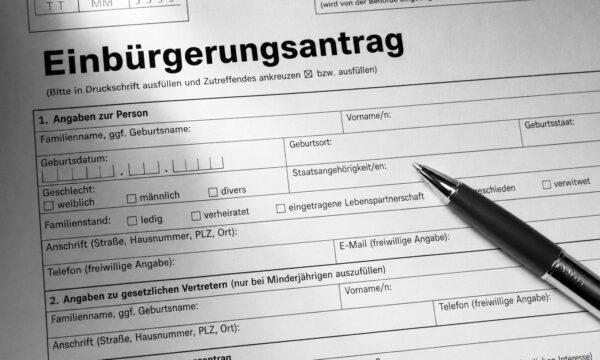
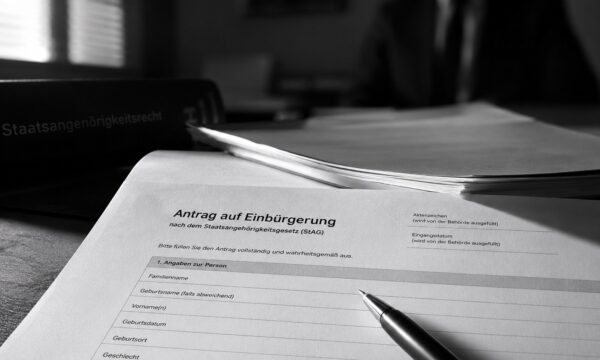
Applications for naturalization are submitted in Munich to the District Administration Office (KVR), Naturalization Division. Main address: Ruppertstraße 19, 80466 Munich. The application itself is not complicated in terms of formality—the naturalization application is a standard form issued by the Bavarian State Administration. What determines the outcome of the naturalization process in Munich are the accompanying documents and the justification provided in the naturalization application.
What documents are required?
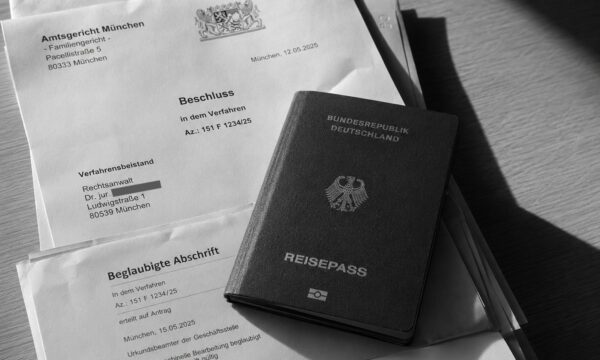
Required documents are: a valid passport and birth certificate from your country of origin (with an apostille and translation), residence permit, proof of registration, language certificate, naturalization test certificate, resume, proof of sufficient means of support (pay stubs from the last three months, tax assessment notices from the last three years, employment contract if applicable), police clearance certificate, declaration of loyalty. For married applicants, a marriage certificate and, if applicable, divorce certificates are also required. For applicants with children: the children’s birth certificates. In special cases—such as self-employed individuals, recipients of social benefits, or applicants with criminal records—the Munich KVR requires additional documentation, the specific requirements for which are not always clear.
Reasons for the application for naturalization
The justification for a naturalization application is not merely an administrative formality, but a reasoned argument. We structure it as a chronological resume highlighting key milestones of integration: periods of residence in Germany with supporting details, professional development, language proficiency, social and volunteer connections, and family structure. For applications under the 3-year special track, the justification becomes the central issue—here, the “special integration achievements” must be presented in a plausible and verifiable manner. In current practice at the Munich Regional Naturalization Office (KVR), a justification consisting of only half a page is rarely sufficient.
Applying for Naturalization — The Process at the Munich City Council
Applications must be submitted in writing. Upon receipt, the KVR reviews the documents for completeness, requests additional information if necessary, invites the applicant to an in-person interview, and makes a decision. For complete, well-prepared applications, the current processing time in Munich is approximately 12 to 18 months—for incomplete applications requiring multiple rounds of additional documentation, two years or longer. For this reason, the completeness of the application is the most important factor: Each request for additional information adds three to six months to the process, as the file must be “re-opened” in the KVR’s system.
Naturalization Ceremony and Presentation of the Certificate
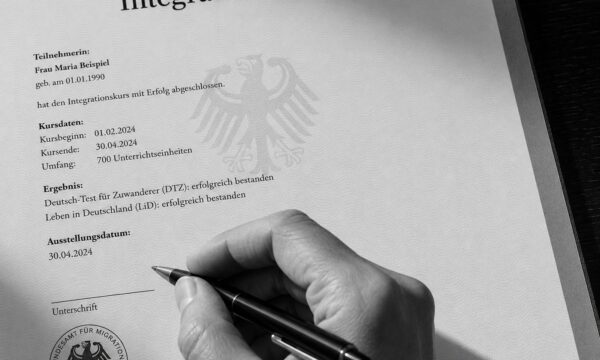
Once a positive decision has been made, the Munich Citizenship and Migration Office (KVR) invites the applicant to a naturalization ceremony. The naturalization certificate is presented at a public ceremony, along with the certificate of loyalty, and usually accompanied by a short speech. The applicant becomes a German citizen only upon receipt of the naturalization certificate—the decision alone is not sufficient. The German passport is then applied for at the relevant citizens’ office; the passport is the practical consequence of naturalization, not naturalization itself.
Request a free initial assessment
Tell us about your case—quickly and with no obligation. We’ll assess your chances of success and get back to you shortly.
or call us directly at: 089 540 239 0
Dual citizenship — what the rules will actually be starting in 2024
Under the 2024 reform of the German Nationality Act (StAG), dual citizenship is generally permitted in Germany (Section 12 StAG, as amended). However, what the reform does not address—and what often causes confusion among clients in Munich—is whether the respective home country itself permits multiple citizenship. German law permits the retention of foreign citizenship; whether the foreign legal system also permits this is a matter of the law of that country.
Which countries allow dual citizenship?
Most EU countries allow multiple citizenship—as do the United States, Canada, Brazil, Argentina, the United Kingdom, and many others. Countries such as Austria, Japan, China, and a few others are more restrictive, automatically revoking a person’s nationality upon the acquisition of foreign citizenship. Anyone coming from such a country who acquires German citizenship loses their home country citizenship by law—even if Germany would have accepted multiple citizenship. We review the foreign legal system on a case-by-case basis, in cooperation with lawyers in the home country if necessary.
What does this mean for the application in Munich?
The reform has simplified the naturalization application process itself: the requirement to provide proof of renunciation of previous citizenship has been eliminated. However, applicants must still submit their passport from their country of origin along with proof of identity. The Munich Naturalization Office does not verify multiple citizenship—that is the responsibility of the applicant’s country of origin.
Dual citizenship for children
Children born in Germany after June 27, 2024, who have at least one parent with a German passport or one parent who has been a long-term resident, will automatically receive a German passport—and will also retain the citizenship of the other parent. The former requirement to choose a nationality (by age 23) has been eliminated. For clients in Munich with internationally diverse families, this is one of the most practically relevant changes.
Naturalization for specific groups
Citizenship law includes a number of special provisions for specific groups of applicants. As naturalization attorneys in Munich, we most frequently encounter the following scenarios—in each case, the advice we provide deviates from the standard procedure. In these special cases, the naturalization process in Munich can often be completed more quickly than clients initially expect.
Naturalization for EU citizens
EU citizens enjoy freedom of movement and can live in Germany without a residence permit. The standard requirements of § 10 of the German Nationality Act (StAG) apply to naturalization—five years of residence, language proficiency, and proof of sufficient means of support. The advantage: Proof of residence is provided by the registration certificate; a residence permit is not required. Dual citizenship was already possible for EU citizens before the reform—the 2024 reform has changed little in this regard.
Naturalization of Spouses
Spouses of German citizens may be naturalized under Section 9 of the German Nationality Act (StAG) after three years of residence and at least two years of marriage. This expedited path is popular—but it requires a genuine marital relationship, which the Munich Regional Office for Migration and Refugees (KVR) thoroughly examines. In cases of separation shortly before the application is filed or in marriages involving significant geographical distance, the assessment becomes more critical. We are familiar with Munich’s practices and provide realistic advice on whether the Section 9 path or the regular Section 10 path makes more sense.
Naturalization for Refugees and Asylum Seekers
Individuals granted asylum and those granted subsidiary protection may—provided they are legally residing in the country—follow the standard naturalization process. In practice, establishing identity is the most common hurdle, as validly certified documents from their home country are often unavailable. In Munich, we regularly resolve identity verification issues through alternative means of proof—certified translations of existing documents, affidavits, and the presentation of an ID card from the home country. The process is lengthy but can usually be successfully completed.
Naturalization of Children
Minor children can be naturalized together with their parents, even if they have not yet met the five-year residency requirement. However, they must demonstrate their own language proficiency—generally in a manner appropriate to their age, meaning that for preschoolers this is done through an age-appropriate assessment, and for school-age children through their language proficiency level as determined by the school. The parents’ application includes the children; the Munich Citizenship Office (KVR) typically processes these applications as a family package.
Naturalization for Students and Doctoral Candidates
Students and doctoral candidates are an important group of applicants in Munich—TUM, LMU, and several other universities attract thousands of international academics to the city each year. Time spent as a student counts toward the minimum residency requirement; in some cases, the 3-year special pathway may also be considered—for example, for doctoral graduates with outstanding academic achievements. We regularly advise researchers from Max Planck Institutes and Helmholtz Centers in Munich who fall into this exact category.
Action for Failure to Act Regarding Naturalization — When the KVR Fails to Make a Decision
Since the 2024 StAG reform, the action for failure to act regarding naturalization has become one of the most important legal tools available—because processing times at the Munich Regional Office for Migration and Refugees (KVR) have become practically unacceptable for many applicants. Anyone who has applied for naturalization in Munich and has not received a response for well over a year should have their case reviewed for a lawsuit for failure to act. The legal basis is § 75 VwGO: Anyone who has submitted an application to an authority and has not received a decision after three months without sufficient cause may file a lawsuit for failure to act with the Administrative Court.
When is an action for failure to act permissible?
A three-month waiting period from the date of application is the formal minimum threshold. However, in Munich’s naturalization practice, we recommend filing an action for failure to act no sooner than twelve to 15 months after the application—before that, the Munich Administrative Court typically examines whether there was a “sufficient reason” for the delay and grants the KVR a reasonable processing period. Experience shows that if 18 months or more have passed without a decision and without any serious steps having been taken to process the application, the lawsuit has a very good chance of success.
How does an action for failure to act proceed?
Filing of the complaint with the Munich Administrative Court (Bayerstraße 30, 80335 Munich), service of process on the KVR, response to the complaint, oral hearing. In many cases, the KVR issues a decision after the complaint is filed—either granting naturalization or denying it. With this decision, the inaction is resolved; the complaint can be declared settled, and the KVR typically bears the costs of the proceedings. A decision by the Administrative Court on the inaction complaint is then rarely necessary—the pressure of filing the complaint itself is usually sufficient.
How much does an action for failure to act cost?
Court fees are based on the amount in dispute (typically €10,000 in naturalization proceedings), while attorney’s fees are calculated according to the RVG. If the case is successful, the KVR bears the costs. We discuss the cost risk openly before filing a lawsuit—and in practice, the lawsuit can be pursued with low risk in many situations because the Munich KVR can hardly defend itself with “sufficient cause” if the proceedings are clearly unduly prolonged.
FROM OUR PRACTICE – ACTION FOR FAILURE TO ACT AT THE MUNICH ADMINISTRATIVE COURT
Since the 2024 StAG reform, the Munich Administrative Court at Bayerstraße 30 has seen a significant increase in the number of actions for failure to act under citizenship law. Based on our practical experience: In cases where applications have been pending for more than 18 months without any substantive progress, the Munich Citizenship Office (KVR) often issues a decision within a few weeks of the complaint being served. The lawsuit thus often takes effect before a judgment is rendered—the pressure exerted by the formal filing of the lawsuit is generally sufficient. For applications that we revise with legal counsel before filing a lawsuit, the decisions following the filing are significantly more likely to be favorable than for applications that remain unchanged. We had to anonymize the case—§ 6 BORA (new version)—but practical logic shows: actions for failure to act and application optimization go hand in hand.
“My favorite line in naturalization cases: ‘I’ve been waiting 14 months, and the KVR just hasn’t gotten back to me.’ This is exactly where the leverage lies. Citizenship law is administrative law—and administrative law has deadlines. Three months is the formal minimum threshold for filing an action for failure to act; after twelve months without serious processing, it becomes the most effective tool of all. A naturalization attorney in Munich who only mentions the lawsuit after a three-year wait has left the most important tool unused for two years.”
— Marc Frey, Attorney at Law, specializing in contract and property law (with experience in administrative law, particularly in the area of citizenship law)
Naturalization Denied — Appeal and Lawsuit
If the Munich Citizenship Office (KVR) rejects the application for naturalization, the process is not over. In many cases, naturalization in Munich is still possible even after a rejection notice—through an appeal or an administrative lawsuit. An appeal may be filed against the rejection notice—though in Bavaria, this is only possible in limited circumstances, as the state has abolished the appeal process in many areas. In all other cases, an administrative lawsuit must be filed directly with the Munich Administrative Court.
Common reasons for rejection
Based on our experience, the most common grounds for rejection are: insufficient means of support (particularly in cases of short-term receipt of basic income or supplementary benefits), insufficient language skills, problematic criminal records, uncertainty regarding the identity of applicants from crisis regions, and doubts about loyalty to the free democratic basic order. For each of these reasons, the decision can be critically reviewed—and successfully challenged in many cases.
Action for annulment in the Munich Administrative Court
The deadline for filing a lawsuit is one month from the date the rejection notice is issued. We file an appeal with the Munich Administrative Court (Bayerstraße 30, 80335 Munich) and systematically challenge the grounds for the rejection notice. For issues related to means of support, we provide evidence of continuous employment history; for identity-related issues, we submit substitute evidence; and for cases of doubt regarding loyalty, we provide a legal assessment of the facts. The judicial aspect of citizenship law has increased significantly since 2024—in Munich, the Administrative Court’s practice is, in many respects, more applicant-friendly than the administrative practice at the KVR.
Don't miss the deadline for filing a lawsuit
Anyone who misses the one-month deadline will have the decision become final—and will be unable to do practically anything except file a new application, which will go through the processing cycle all over again. We recommend that any client who receives a rejection notice seek an initial legal assessment before discarding it. This costs nothing and, in a high percentage of cases, prevents the decision from becoming final.
Consultations in Ukrainian and Russian — Denys Osypenko
At KLAMERT & PARTNER, we have Denys Osypenko, a lawyer at our firm who assists clients in Ukrainian and Russian. Denys Osypenko is a trained lawyer with ties to Ukraine; he is not a licensed attorney under German law at our firm—the legal handling of Ukrainian- or Russian-language naturalization cases is handled by the licensed attorneys Markus Klamert, Marc Frey, and Johannes Goetz. Denys Osypenko serves as a linguistic and cultural bridge: he explains German citizenship law in the clients’ native language, translates official notices, clarifies questions, and prepares the statement of grounds for the naturalization application. In the Munich market, this combination—German bar admission plus a Ukrainian- and Russian-speaking legal professional under the same roof—is rare.
This offers a practical advantage in naturalization cases. Ukrainian applicants who have been in Germany since February 2022 typically face two issues simultaneously: their immigration status (initially under Section 24 of the Residence Act, later a settlement permit) and subsequent naturalization. We provide integrated advice on both aspects. Russian-speaking clients often come from several countries—Russia, Belarus, Kazakhstan, Uzbekistan, and Israel—and consequently present a variety of identity documents and issues related to their home countries’ laws. Here, too, the linguistic bridge is crucial, because nationality law is virtually impossible to navigate without precise translations of documents from their home countries.
Here’s how it works: You describe your case to us in Ukrainian or Russian—either by phone or during an initial consultation at Heimeranstraße 37. Denys Osypenko translates and handles the legal preparations. One of our licensed attorneys will take on responsibility for your case; for naturalization cases, this is typically Markus Klamert or Marc Frey. Letters to the Munich Naturalization Office (KVR), complaints filed with the Administrative Court, and all legal statements are signed by a licensed attorney. Language support doesn’t solve every individual case—but it ensures that nothing falls through due to translation issues and that you understand what your attorney is doing.
Request a free initial assessment
Tell us about your case—quickly and with no obligation. We’ll assess your chances of success and get back to you shortly.
or call us directly at: 089 540 239 0
FROM OUR PRACTICE – UKRAINIAN AND RUSSIAN NATURALIZATION CASES
A Ukrainian client who arrived in Munich in February 2022, now works at a Munich hospital, and holds a German language certificate at the C1 level—this is the scenario in which the 3-year special pathway may be considered following the 2024 StAG reform. The justification for the naturalization application had to clearly demonstrate “exceptional integration achievements”: professional work in the healthcare sector, language proficiency above the standard level, volunteer work, and a continuous employment history. From our practice: Without Ukrainian-speaking support during the preparation phase, the special pathway would have been virtually impossible to implement in this scenario—too many documents from her home country, too many follow-up questions regarding cultural context. We had to anonymize the case—§ 6 BORA (as amended)—but the logic behind it demonstrates what the combination of a lawyer and a Ukrainian/Russian-speaking legal professional can achieve in a client’s case.
How Your Naturalization Lawyer in Munich Works — Four Steps
1. Free initial assessment within 24 hours
Please describe your situation to us—via the contact form, by phone, or in person at Heimeranstraße 37. Languages: German, English, Ukrainian, Russian, Portuguese. We’ll get back to you within one business day with an initial assessment of your situation: Which path—the standard path, the 3-year special path, or spousal naturalization—is right for you, which requirements you’ve met, and which documents are still missing. There are no costs for you at this stage.
2. Application Preparation — Documents, Justification, Strategy
Once you’ve retained our services, we’ll work with you to gather the necessary documents: home country documents with an apostille, language proficiency certificate, naturalization test results, proof of sufficient funds, and a certificate of good conduct. We’ll structure the justification for your naturalization application chronologically and with a focus on integration—taking particular care with applications filed under the 3-year special pathway. Depending on the completeness of the documents, this phase takes two to eight weeks.
3. Application Process and Support at the KVR Munich
We submit the naturalization application to the Munich KVR at Ruppertstraße 19 and monitor the ongoing process—responding to requests for additional documentation, clarifying identity, and addressing inquiries regarding proof of sufficient means of support. If the processing takes an unreasonably long time, we will explore filing an action for failure to act with the Munich Administrative Court; if a rejection notice is issued, we will explore filing an action to challenge the decision. The process is concluded upon issuance of the naturalization certificate.
4. After Naturalization — Passport, Family, Follow-up Questions
After the naturalization ceremony, you should apply for a German passport at the Citizens’ Office. We can advise you on related matters, such as extending naturalization to your children, the implications for your foreign citizenship, and—where applicable—tax and name-related issues. For us, the naturalization process in Munich does not end with the official notification, but rather with the presentation of the certificate—and, if necessary, with the follow-up services that come afterward.
Frequently Asked Questions About Naturalization in Munich (including the German Passport)
How much does a naturalization lawyer cost in Munich?
KLAMERT & PARTNER provides an initial assessment of your case free of charge. Any further consultation regarding citizenship law is provided upon retention of our services—either based on RVG fees calculated according to the value of the matter (typically €10,000 in naturalization proceedings) or according to an individual fee agreement. Separate procedural fees apply for actions for failure to act or actions to set aside. If you have legal expense insurance that includes administrative law coverage, we will handle the coverage inquiry. Note: In naturalization proceedings without litigation, attorney’s fees typically fall in the low four-digit range.
How do I get a German passport?
A German passport is the practical result of naturalization—not naturalization itself. Anyone who wants a German passport must first be naturalized (apply for naturalization at the Munich KVR, receive a decision, and obtain a naturalization certificate) and then apply for the passport at the Citizens’ Office. As a foreigner, it is not possible to simply “apply for a German passport” without naturalization—exception: persons of German descent who are German citizens by birth under § 4 StAG. So if you ask the question “How do I get a German passport?”, the answer is almost always: Apply for naturalization—we’ll advise you free of charge as a first step.
When can I apply for naturalization in Munich?
After five years of lawful residence in Germany (standard pathway, § 10 StAG). After three years in cases of exceptional integration efforts (special pathway, § 10(3) StAG — new as of the 2024 StAG reform). After three years of residence and two years of marriage for spouses of German citizens (§ 9 StAG). Periods of residence with a residence permit or temporary suspension of deportation do not count; only lawful residence with a residence permit counts. Anyone who has lived in Munich for five years and meets all other requirements can immediately submit an application for naturalization to the KVR.
How long does the naturalization process currently take in Munich?
Current processing time at the KVR Munich: 12 to 24 months from the date of application; longer in some cases. The 2024 reform has led to a surge in applications that the KVR must process organizationally. Those who want a decision faster have two options: first, a fully prepared application with no additional requests for information; second—in the event of an excessively long wait—filing an action for failure to act with the Munich Administrative Court. We recommend filing the lawsuit no sooner than twelve to 15 months after the application has not been seriously processed.
What is an action for failure to act regarding naturalization?
A lawsuit filed with the Munich Administrative Court seeking to compel the KVR to issue a decision—or, if the matter is resolved by an interim decision, to impose the authority’s legal costs. Legal basis: § 75 VwGO. Minimum waiting period of three months; in Munich practice, filing is recommended after 12 to 15 months of inaction. In many cases, the KVR issues a decision within a few weeks of the lawsuit being filed—the pressure exerted by the lawsuit itself is often sufficient.
What are the requirements for naturalization after 3 years?
According to Section 10(3) of the German Nationality Act (StAG) (effective as of 2024): three years of lawful residence, German language proficiency at least at the C1 level, the ability to support oneself financially, and special contributions to integration—such as volunteer work, outstanding academic or professional achievements, or significant scholarly work. The assessment of “outstanding integration achievements” falls within the discretion of the KVR; we structure the justification for the naturalization application in such a way that the requirements are presented in a plausible and verifiable manner.
Will the 2024 StAG reform really allow dual citizenship?
Yes — Since June 27, 2024, Germany has generally permitted multiple citizenship (Section 12 of the Nationality Act, as amended). However, the reform does not address the question of whether the applicant’s country of origin permits multiple citizenship itself. In the case of countries of origin with automatic loss of citizenship (Austria, Japan, China, and a few others), the applicant automatically loses their citizenship of the country of origin upon acquiring German citizenship—even if Germany had accepted it. We review the applicable foreign law on a case-by-case basis.
As a Ukrainian citizen, can I become a naturalized citizen in Munich?
Yes, as soon as the requirements of Section 10 of the German Nationality Act (StAG) are met. Ukrainian citizens who arrived in Germany after February 24, 2022, typically initially held a residence permit under Category 2. Naturalization is possible upon transition to a settlement permit and fulfillment of the minimum period of residence. In individual cases, the 3-year special pathway may be considered—for applicants who are particularly well-integrated, have a C1 language proficiency level, and a work history. Dual citizenship with Ukraine is possible—Ukraine permits multiple citizenship in many circumstances, and the German reform in 2024 will allow it in any case. Consultation in Ukrainian by our attorney Denys Osypenko.
What documents do I need for my naturalization application?
Required documents: Passport, birth certificate with apostille and translation, residence permit, proof of registration, language certificate (B1 or C1), naturalization test certificate, resume, pay stubs (3 months), tax assessment notices (3 years), employment contract, police clearance certificate, declaration of loyalty. For married individuals, additionally a marriage certificate and, if applicable, divorce certificates. For children, birth certificates. Self-employed individuals must submit financial statements or simplified accounting records. In special cases—such as asylum seekers, past receipt of basic income support, or criminal record entries—additional documentation is required, the specific requirements of which we will clarify on a case-by-case basis.
Where can I find the Munich KVR for naturalization?
The Munich District Administration Office (KVR), Naturalization Division, is located at Ruppertstraße 19, 80466 Munich, in the Sendling district. It is accessible by subway (U3/U6 Implerstraße) and several bus lines. Applications must be submitted in writing—in-person visits are required only upon request. The KVR is easily accessible by subway from our law office at Heimeranstraße 37.
What is the naturalization test, and how do I pass it?
The naturalization test consists of 33 questions drawn from a pool of 310 possible questions on the German legal and social system. A score of 17 correct answers is required to pass. Registration is available through the Munich Adult Education Center (Volkshochschule München) or other testing centers. The exam fee is currently €25. Preparation materials are available for free online (BAMF practice questions). Applicants with a German high school or college degree in law, social sciences, or the humanities are exempt from the test. The test is generally not a major hurdle—those who fail it may retake it as many times as necessary.
I have an old criminal conviction—will that prevent me from becoming a naturalized citizen?
Minor convictions (fines of up to 90 daily rates, prison sentences of up to three months suspended) are generally not a problem. More serious convictions typically lead to rejection—unless exceptional hardship or a clear preponderance of integration-related factors justifies naturalization nonetheless. We review criminal records before filing the application and develop lines of argument for problematic situations. A conviction from 2018 that no longer has any effect today does not necessarily have to cost the applicant the application.
Free initial consultation with your naturalization attorney in Munich
Describe your situation to us in two or three sentences—we’ll review, with no obligation, which naturalization path is right for your situation, which requirements you meet, and what the next logical steps would be. Contact us online via our contact form, by phone at 089 540 239 0, or in person at Heimeranstraße 37 in Munich. Languages: German, English, Ukrainian, Russian, Portuguese. If the deadline for filing an action for failure to act is ongoing, you’ve recently received a rejection notice (the deadline for filing a lawsuit is only one month!), or you’re planning to submit an application, we’ll get back to you within one business day. At KLAMERT & PARTNER, naturalization services in Munich are integrated into our immigration law practice—partners responsible for naturalization: Markus Klamert, Marc Frey, and Johannes Goetz. Preliminary consultations in Ukrainian and Russian are provided by our legal advisor Denys Osypenko; legal representation is handled by our licensed attorneys.