§ 24 of the Residence Act (AufenthG)
and change of status
in Munich
Select your preferred language
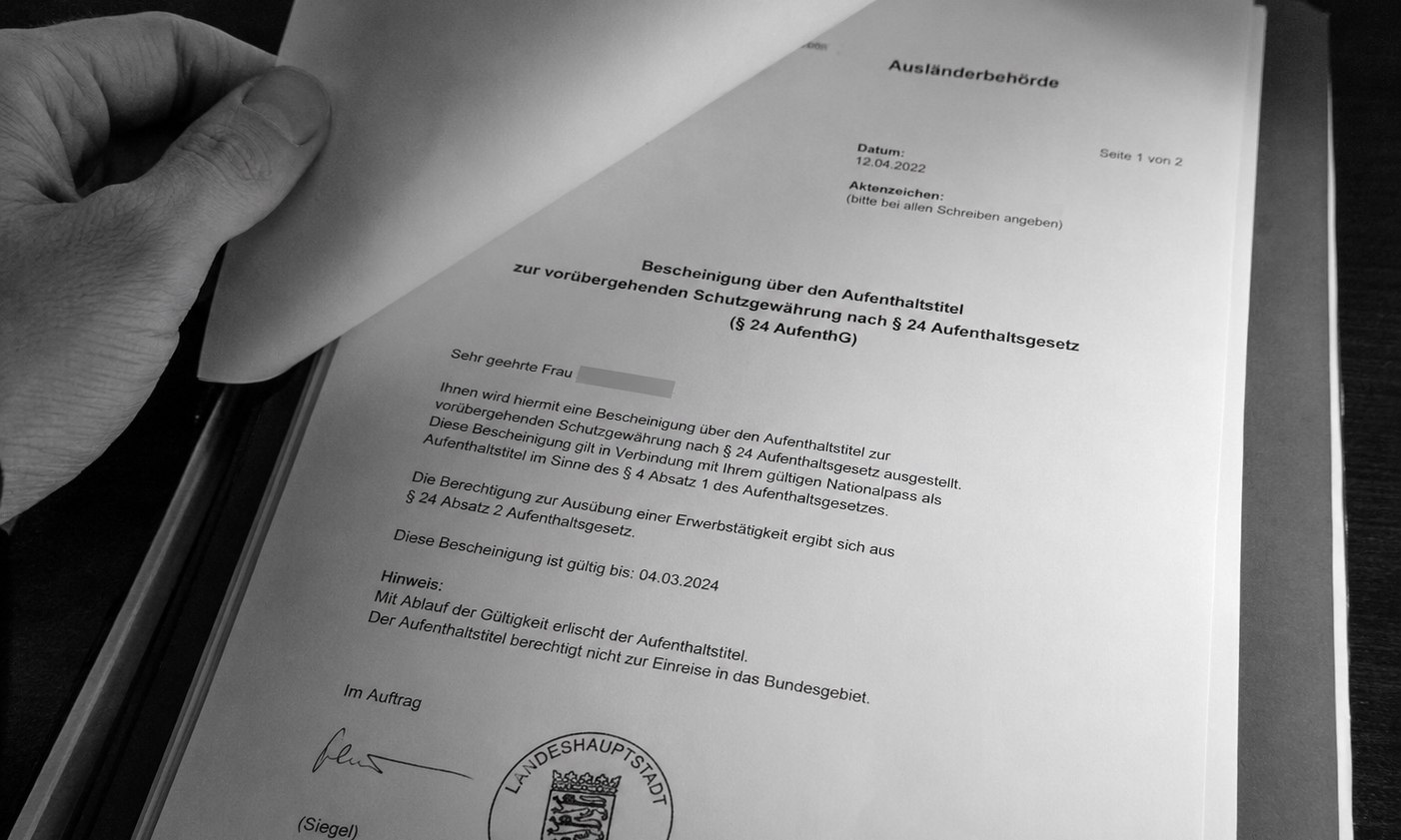
The Ukrainian IT architect in Munich who now has a job contract and wants to switch to the EU Blue Card. The Ukrainian nurse who has been working at a Munich hospital for three years and is having her professional qualifications recognized. The family from Kharkiv with two school-age children who no longer wants to wait to see if the EU will extend their protection status again in 2027. The architect from Kyiv who has been accepted into a master’s program at TUM. Over 1.1 million people in Germany hold residence permits under Section 24 of the Residence Act (AufenthG); these permits remain valid automatically until March 4, 2027—without the need for an individual application or a KVR appointment. What happens after that date remains unclear. That is precisely why 2026 is the year in which many clients are pursuing a change in status rather than waiting. At KLAMERT & PARTNER, we have been providing legal counsel since 1987—as attorneys specializing in § 24 of the Residence Act and status changes in Munich, we assist with the transition to the EU Blue Card, to § 18a / § 18b of the Residence Act (skilled workers), to § 16b of the Residence Act (studies), to § 17(1) of the Residence Act (search for training), and to the settlement permit. With three fixed consultation packages—Quick-Check, Complete Status Change, and Settlement Plan. Available in German, English, Ukrainian, Russian, and Portuguese—through our legal expert Denys Osypenko, we offer preliminary consultations in Ukrainian and Russian; the handling of legal cases is managed by licensed attorneys Markus Klamert, Marc Frey, and Johannes Goetz. Initial assessment is free of charge.
When do you need a lawyer specializing in Section 24 of the Residence Act (AufenthG) and changes in immigration status in Munich?
Since February 2022, Section 24 of the Residence Act (AufenthG) has granted more than 1.1 million people from Ukraine in Germany rapid, unbureaucratic protection status—thereby building a bridge that functions without asylum proceedings. The bridge will still be in place in 2026: Residence permits issued under Section 24 of the Residence Act that were valid as of February 1, 2026, will automatically remain valid until March 4, 2027, by virtue of a regulation (Federal Law Gazette 2025 I No. 252 of October 27, 2025, Second Regulation Amending the Regulation on the Continuation of Validity of Residence Permits for Ukrainians). What happens after March 4, 2027, remains to be seen—EU member states have so far extended temporary protection every year; another extension is possible but not guaranteed. It is precisely this uncertainty that is the reason why many clients are pursuing a change in status in 2026 rather than waiting to see whether the EU will decide to extend it again in the summer of 2026.
As attorneys specializing in Section 24 of the Residence Act (AufenthG) and status changes in Munich, we identify four typical areas of practice. First: A change of status to the EU Blue Card or to § 18a / § 18b of the Residence Act as soon as a concrete job offer is available—the ideal path for those with academic qualifications and a suitable salary, because the settlement permit takes effect after just 21 or 33 months with the EU Blue Card. Second: A change to § 16b of the Residence Act (studies) or to § 17(1) of the Residence Act (a “job search bridge” for up to nine months) when a student intends to begin a degree program or pursue a specific vocational training opportunity in Germany. Third: Family reunification—for Blue Card holders, this is even possible without an A1 language certificate for the spouse joining them. Fourth: Strategic multi-year planning—when is it worth making the switch now, when is it wiser to wait, and which residence permit is appropriate in which situation?
The process of changing residency status involves legal pitfalls that clients often fail to recognize without legal representation. The most important one: the restriction under Section 19f of the Residence Act (AufenthG). Certain residence permits—Section 16b (studies), Section 16e (study-related internship—EU), Section 17(2) (application for admission to a degree program), Section 18d (research), Section 18g (EU Blue Card), § 19e (European Voluntary Service)—may not, according to the Federal Ministry of the Interior (Guidance Notes dated August 11, 2025), be granted concurrently with a residence permit under § 24 of the Residence Act. However, they may be granted sequentially—the application under § 24 must be submitted first. Other categories—§ 18a of the Residence Act (skilled workers with vocational training) and § 18b of the Residence Act (skilled workers with academic training)—can, however, still be applied for concurrently without § 24 being revoked beforehand. Which approach is the safest in each individual case depends on the specific circumstances—we will review this in our free initial assessment.
Typical issues that clients bring to us in 2026:
- I worked as a software developer in Ukraine, have been living in Munich since 2022 under Section 24 of the Residence Act (AufenthG), and now have a job offer from a Munich-based corporation—how do I switch to the EU Blue Card?
- My college degree from Kyiv—is it listed in the Anabin database, and if not, how do I get it recognized?
- I am a nurse and work at a hospital in Munich—can I switch from Section 24 of the Residence Act (AufenthG) to Section 18a of the Residence Act without first giving up my status under Section 24?
- My son has been accepted to TUM—should we switch him to § 16b, or is that not an option because of § 19f?
- I would like to bring my mother over from Lviv—is family reunification possible under Section 24 of the Residence Act, or only after a change in status?
- What will happen to me on March 5, 2027, if the EU does not renew my protected status?
- I have two years under Section 24 of the Residence Act; when do I start counting the minimum period required for a settlement permit?
FROM OUR PRACTICE – STATUS CHANGE TO EU BLUE CARD AT THE MUNICH REGIONAL HEALTH INSURANCE BOARD (KVR)
From our practice: A Ukrainian IT architect who has been living in Munich since May 2022 under Section 24 of the Residence Act (AufenthG) received a job offer in the spring of 2026 from a Munich-based software company with an annual salary significantly above the EU Blue Card threshold for shortage occupations. Instead of waiting for the next automatic renewal of Section 24 of the Residence Act and hoping that the EU would extend it in 2027, we planned to change her status at the earliest possible date. We first verified the university’s Anabin entry (H+ status, degree automatically recognized), then prepared the application for the EU Blue Card under the expedited skilled worker procedure and submitted it to the Munich Regional Foreigners’ Office (KVR) — along with a declaration that the residence status under Section 24 of the Residence Act would be relinquished upon issuance of the Blue Card. The application was approved after seven weeks. Strategic advantage: The Blue Card leads to a settlement permit under Section 18c of the Residence Act (AufenthG) after just 33 months; with a B1 language certificate, this is possible after 21 months.
We had to anonymize the case—Section 6 of the BORA, as amended—and the logic behind this is clear: Anyone who qualifies for a status change to the EU Blue Card in 2026 will no longer be dependent on the EU’s renewal policy—and will have a fast track to a settlement permit. Consultations in Ukrainian and Russian are provided by our legal advisor Denys Osypenko; legal representation is handled by licensed attorneys.
“Section 24 of the Residence Act has served its purpose—providing rapid protection without an asylum proceeding. But it is, and remains, temporary protection. Anyone who still does nothing by 2026 and simply hopes that the EU will extend it again in the summer of 2026 is relinquishing control. That is exactly what we take off our clients’ hands: We work with them to develop a plan that makes them independent of the EU’s next decision. In nine out of ten cases, this involves a change in status—and in most cases, the situation is more favorable than the clients themselves realize.”
— Markus Klamert, attorney and founder of KLAMERT & PARTNER
Explanation of Section 24 of the Residence Act (AufenthG) — Protected Status, Continuation Until March 4, 2027, and What Comes Next
- Section 24 of the Residence Act (AufenthG) is the German implementation of the EU Mass Influx Directive 2001/55/EC. The directive was invoked by the Council of the European Union on March 4, 2022—shortly after the start of Russia’s war of aggression—for the first time since its creation in 2001. It enables the rapid, unbureaucratic admission of people seeking protection without an individual asylum procedure. In Germany, temporary protection is granted in the form of a residence permit under Section 24(1) of the Residence Act (AufenthG).
Who is covered under Section 24 of the Residence Act?
- Ukrainian nationals who had their habitual residence in Ukraine prior to February 24, 2022—and their family members.
- Third-country nationals and stateless persons who had international protection or an equivalent national protection status in Ukraine prior to February 24, 2022.
- Third-country nationals and stateless persons who were lawfully residing in Ukraine with a permanent residence permit prior to February 24, 2022—and who cannot safely return to their country of origin.
According to the Federal Ministry of the Interior’s (BMI) current interpretation, individuals who are not Ukrainian citizens and who only had temporary residence in Ukraine are no longer eligible for the extension—their residence permits generally expired on March 4, 2025. We are reviewing individual cases involving this group separately; the Düsseldorf Administrative Court ruled in a decision dated June 18, 2025 (24 K 7223/24) that the exclusion of “third-country nationals from third countries” was unlawful—the matter is still pending before a higher court.
What rights does Section 24 of the Residence Act grant?
- Immediate, unrestricted access to the German labor market—no priority review, no waiting period.
- Eligibility for benefits under SGB II or SGB XII (not under the Asylum Seekers Benefits Act).
- Access to health insurance, child benefits, BAföG, and housing assistance.
- Freedom of movement within the Schengen Area—and, until March 4, 2027, re-entry into Germany without the need for a new residence permit (Section 2(1) of the Ukrainian Residence Regulation (UkraineAufenthÜV)).
- Opportunity for family reunification —albeit in a limited form (see Section 7).
Valid through March 4, 2027 — who automatically qualifies?
Under the Second Ordinance Amending the Ordinance on the Continued Validity of Ukraine Residence Permits (Federal Law Gazette 2025 I No. 252, dated October 27, 2025) all residence permits under Section 24(1) of the Residence Act (AufenthG) that were valid as of February 1, 2026—including all conditions and ancillary provisions—are automatically extended until March 4, 2027, without the need to file an application for extension with the Foreigners’ Registration Office or to apply for a new electronic residence permit. Permission to work, entitlement to social benefits, health insurance, and freedom of travel will also remain unchanged during this period. This is the direct effect of EU Council Decision 2025/1460 of July 15, 2025 (effective August 13, 2025), which extended the Mass Influx Directive for another year.
What Comes After March 4, 2027 — The Unanswered Question
The EU Council is expected to decide in the summer of 2026 on the period following March 4, 2027. Three scenarios are realistic: First, temporary protection will be extended again (typically for another year)—in which case the § 24 residence permits will automatically remain valid. Second, the protection ends on March 4, 2027, and there will be a transitional arrangement allowing for a switch to other residence permits. Third, the protection ends without a blanket transitional arrangement; in that case, submitting an individual application would be the only way to remain in Germany. We won’t know which scenario will unfold until 2026. Those who seek a change in status are not dependent on the outcome.
Why Now Is the Right Time to Change Your Status
Looking ahead to 2026, we see four reasons why we should change our status now—rather than waiting any longer.
First: Independence from the EU's extension policy
Temporary protection under Section 24 of the Residence Act (AufenthG) is and remains a political stopgap. It can be extended—as it has been every year so far—but it does not have to be. Anyone who holds an independent residence permit (EU Blue Card, Section 18a, Section 18b, Section 16b of the Residence Act) is not dependent on the EU’s decision in the summer of 2026. This independence is the most important strategic asset.
Second: The clock is ticking on the residence permit
Under the EU Blue Card, the settlement permit pursuant to Section 18c of the Residence Act (AufenthG) becomes available after just 33 months—and even after 21 months for those with B1-level language proficiency. Under Sections 18a and 18b of the Residence Act, the settlement permit is typically granted after four years, though it may be granted earlier under certain conditions. The period of residence under Section 24 of the Residence Act generally counts as lawful residence—including for naturalization under Section 10 of the Nationality Act (StAG) (usually five years, or three years in cases of exceptional integration). Those who switch to the new system in 2026 can apply for a settlement permit in 2028 or 2029 and for naturalization in 2027 or 2028. Those who wait will have to postpone these dates.

Third: Access to the labor market is best today
In 2026, the German labor market will be seeking skilled workers in many sectors—IT, nursing, civil engineering, healthcare, and the skilled trades. Anyone with an employment contract in this context has a strong case for the EU Blue Card and for § 18a / § 18b of the Residence Act (AufenthG). The FEG 2.0 reform (phased in on November 18, 2023, March 1, 2024, and June 1, 2024) has lowered the salary thresholds and established an expedited procedure—both of which facilitate the change in status.
Fourth: Family reunification is often easier after a change in status
For § 24 residence permits, family reunification is legally possible but more complicated in practice. For EU Blue Card holders, the A1 language proficiency requirement does not apply to spouses seeking to join them; children under 18 are eligible for reunification; and the financial support requirement has been relaxed. Family reunification is often easier after a change in status than under § 24.
Change of Status to the EU Blue Card (Section 18g of the Residence Act) — The Ideal Path for Academic Professionals
The EU Blue Card under Section 18g of the Residence Act (AufenthG) will be the ideal solution in 2026 for Ukrainian clients with academic qualifications. It offers four advantages: a fast visa process at the Munich Foreigners’ Registration Office (KVR) (under the expedited skilled worker procedure), clear salary thresholds, simplified family reunification, and a faster path to a permanent residence permit.
§ 19f Lock and the Approach via the Logical Second
The EU Blue Card is one of the residence permits restricted under Section 19f of the Residence Act (AufenthG)—according to the Federal Ministry of the Interior’s (BMI) interpretation, it cannot be granted concurrently with a Section 24 residence permit. In practice, this means that the § 24 permit must be relinquished before or at the same time as the Blue Card is issued. Some immigration authorities—Berlin, for example—handle this using the “logical second” solution: They issue a non-restricted residence permit for a “logical second” and then switch to the Blue Card. In Munich, the standard practice at the KVR is to file the application directly, accompanied by a declaration of renunciation of the § 24 residence permit under the Residence Act. We prepare this application in such a way that no gap in residence status arises—this is legally crucial, as a gap in residence status can result in the loss of social benefits and problems under labor law.
Requirements for the EU Blue Card
- University degree from a third country — Ukrainian universities are primarily listed in ANABI with H+ or H+/– status; H+ degrees are automatically recognized.
- A specific job offer from a German employer that matches the applicant's college degree.
- Minimum gross salary under FEG 2.0 (as of 2026) — approximately two-thirds of the annual contribution assessment ceiling for general pension insurance. Significantly reduced for entry-level workers and in fields with labor shortages (IT, STEM, medicine).
Advantages over remaining under Section 24 of the Residence Act
- A settlement permit under Section 18c of the Residence Act (AufenthG) can be granted after just 33 months—and in the case of B1, even after 21 months.
- Family reunification without an A1 language proficiency certificate for the spouse.
- EU Mobility After 12 Months — Moving to Another EU Member State Without Having to Go Through the Visa Process Again.
- If you lose your job, the Blue Card generally remains valid—a grace period to look for a new job.
- Independence from the EU’s extension policy under Section 24 of the Residence Act.
Change of status under § 18a / § 18b of the Residence Act (AufenthG) — may be applied for concurrently (not barred by § 19f)
The residence permits under Section 18a of the Residence Act (skilled workers with vocational training) and Section 18b of the Residence Act (skilled workers with academic training) are the surest way to transition out of Section 24 of the Residence Act in 2026—and for a legal reason: They are not subject to the Section 19f restriction. They can be applied for alongside an existing § 24 residence permit without the latter having to be revoked first. Once the § 18a or § 18b residence permit is granted, the residence permit automatically transitions to independent status.
Section 18a of the Residence Act — Skilled Worker with Vocational Training
- Section 18a of the Residence Act (AufenthG) covers skilled workers with recognized vocational training—in particular nursing staff, tradespeople, professional drivers, and technical specialists with vocational training. Requirements: recognized vocational qualification (to be recognized under Section 16d of the Residence Act, if necessary), a concrete job offer, and approval from the Federal Employment Agency. Since the FEG 2.0 reform, there has been a legal entitlement provided the requirements are met—it is no longer a discretionary decision.
§ 18b of the Residence Act — Skilled Worker with an Academic Degree
Section 18b of the Residence Act (AufenthG) covers skilled workers with a college degree who do not meet the higher salary thresholds for the EU Blue Card—or for whom Section 18b is the more appropriate provision for other reasons. Requirements: college degree (Anabin H+ or recognized), a concrete job offer, and, if necessary, approval from the ZAV in Munich. Here, too, a legal entitlement has existed since FEG 2.0, provided the requirements are met.
FROM OUR PRACTICE – FILING A PARALLEL § 18B APPLICATION ALONGSIDE AN EXISTING § 24 RESIDENCE PERMIT
From our practice: A Ukrainian economist in Munich, who has been in the country under Section 24 of the Residence Act (AufenthG) since 2022 and has a job offer from a medium-sized company with a salary below the Blue Card threshold, came to us asking whether she risked a gap in her residence status when switching between Section 24 and the Blue Card. We changed course: We filed an application for a residence permit under Section 18b of the Residence Act in parallel with her existing Section 24 permit, without requiring her to give up the Section 24 permit first. This is the key advantage of Sections 18a and 18b over the EU Blue Card—no Section 19f waiting period, no gap in residence status, and no risk between the old and new residence permits. The Munich KVR granted the § 18b residence permit after eight weeks; the § 24 residence permit became a “dead letter” with the new title, but the client retained her social security and employment relationships without interruption.
We had to anonymize the case—§ 6 BORA (as amended)—and the logic behind this is clear: In 2026, § 18a and § 18b will be the legally safest route under § 24 of the Residence Act (AufenthG), because they are not barred by § 19f and can be applied for simultaneously. Consultations in Ukrainian and Russian are provided by our legal advisor Denys Osypenko; legal representation is handled by licensed attorneys.
“We have seen cases in which clients from Ukraine were left in a gap in their residency status for eight weeks because they had submitted the § 24 application themselves before the Blue Card was issued. This led to the suspension of social benefits, complications with their employment, and massive uncertainty. With § 18a or § 18b of the Residence Act (AufenthG), this is impossible because they can be granted at the same time as § 24. For those who do not meet the academic requirements for the Blue Card, applying under § 18b or § 18a is generally a safer and just as fast route to a settlement permit.”
— Marc Frey, attorney, specializing in administrative proceedings and client structures
Education and Training — Sections 16b, 17, and 18d of the Residence Act (restricted titles) and the “lane change” solution
Anyone who, pursuant to Section 24 of the Residence Act (AufenthG), wishes to begin a degree program at a German university or start vocational training in a regulated profession will encounter the aforementioned Section 19f restriction: Section 16b (Degree Programs), § 16e (EU Internship), § 17(2) (Application for Admission), § 18d (Research), and § 19e (Volunteer Service) cannot, according to the Federal Ministry of the Interior’s interpretation, be granted in conjunction with § 24 of the Residence Act—only sequentially.
§ 16b of the Residence Act — Residence for the Purpose of Studying
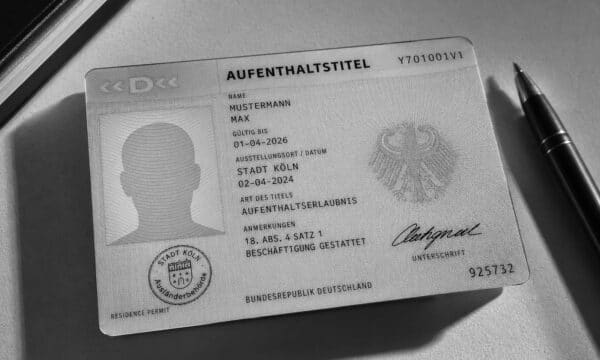
Once you have been admitted to a German university (TUM, LMU, Munich University of Applied Sciences, and other Munich-based institutions), the natural path is to transition to § 16b of the Residence Act (AufenthG). Requirements: Admission to a degree program; proof of sufficient funds to cover living expenses (typically via a blocked account; as of 2026, approximately 11,904 EUR per year / 12 times the BAföG needs-based rate; for recipients of § 24 social benefits, the issue of means of support is generally resolved through ongoing eligibility for benefits). Proof of health insurance.
§ 17(1) of the Residence Act — Searching for an apprenticeship as a temporary solution
Anyone who has not yet found a specific training program but is looking for one may, under Section 17(1) of the Residence Act (AufenthG), obtain a residence permit to seek training for up to nine months. During this time, the client may engage in trial employment in a skilled occupation—this opens a path whereby the client, who does not yet have a permanent apprenticeship position, can move beyond the § 24 bridge and build a bridge toward a regular residence permit.
§ 18d of the Residence Act — Research
For research stays at universities or research institutions in Munich (Max Planck, Helmholtz, Fraunhofer), § 18d of the Residence Act (AufenthG) governs the relevant residence permit. Requirements: an admission agreement with a recognized research institution and proof of sufficient financial means to cover living expenses. § 18d is precluded by § 19f—the transition between the two is only possible sequentially.
Lane-Change Solution — the “Logical Second”
Some immigration authorities in Germany have developed a pragmatic approach to the § 19f restriction: The authority issues a residence permit that is not subject to the restriction (such as § 17(1) of the Residence Act) for a brief moment and then immediately switches to the permit that is actually subject to the restriction (such as § 16b of the Residence Act). Berlin has documented its use of this solution (BAGFW guidance document, March 2025). In Munich, the standard practice at the KVR is more direct—we coordinate with the case officers to select the safest option for each individual case.
FROM OUR PRACTICE – SWITCH TO § 16B WITH A LANE-CHANGE SOLUTION IN MUNICH
From our practice: A young Ukrainian client who had been granted status under Section 24 of the Residence Act (AufenthG) since 2022 received admission in 2026 to a master’s program at TUM. The § 19f restriction required him to relinquish his § 24 residence status before § 16b residence status could be granted. However, the immediate loss of § 24 status would have jeopardized his entitlement to social benefits during the summer break and, if § 16b status had not been granted in a timely manner, would have resulted in a gap in his residence status. We coordinated with the Munich Foreigners’ Registration Office (KVR) to organize the application package so that, at the scheduled appointment, the declaration of waiver of § 24 of the Residence Act and the issuance of § 16b of the Residence Act would take place on the same day. In addition, as a preparatory measure, we applied for a provisional certificate pursuant to § 81(4) of the Residence Act for the transitional period until the electronic residence permit was issued.
We had to anonymize the case—§ 6 BORA (as amended)—and the logic behind this shows that, in cases involving suspended residence permits (§ 16b, § 16e, § 17(2), § 18d, § 18g, § 19e), the procedural approach taken by the Munich Regional Immigration Office (KVR) is decisive. Anyone who goes there without legal preparation risks a gap in their residence status, with consequences for social benefits and health insurance.
Family Reunification Under Section 24 of the Residence Act and Following a Change in Status
Family reunification for holders of a § 24 permit is legally possible, but it is subject to all the requirements of regular family reunification—means of support, housing, and, as a rule, proof of A1-level language proficiency for the spouse. This is precisely what changes after a status change to an EU Blue Card or § 18a / § 18b of the Residence Act (AufenthG).
Family Reunification Under Section 24 of the Residence Act
Section 29(4) of the Residence Act (AufenthG) provides for family reunification for holders of a permit under Section 24 if the family unit in the country of origin was torn apart by the mass influx of refugees. Requirements: an existing marriage or family relationship prior to the outbreak of the war (or joint minor children), verification of identity, and proof of sufficient means of support (eligibility for benefits under SGB II or SGB XII is generally sufficient). Visa application process at the relevant German diplomatic mission abroad—for Ukrainian clients, this is typically Kyiv, Warsaw, or Vienna. Wait times at diplomatic missions vary greatly.
Family Reunification Following a Change in Status — The Simplified Procedures
- For the EU Blue Card: No A1 language proficiency requirement for the accompanying spouse.
- The livelihood requirement has been relaxed—a primary beneficiary who is employed and earns a Blue Card salary generally meets the requirement much more clearly than under § 24.
- Children under the age of 18 are eligible for family reunification; proof of language proficiency is required only in specific circumstances.
- However, the rules for parents’ and grandparents’ family reunification with Blue Card holders remain as restrictive as those for standard family reunification—Section 36 of the Residence Act, subject to the exception for exceptional hardship.
For more details, see our Spoke page “FamilyReunification in Munich.”
“A common reason for seeking advice under the Section 24 mandate is not the change in status itself, but rather family-related issues. Anyone who fled Ukraine alone in 2022 and wants to bring their parents, spouse, or children to join them in 2026 will face greater hurdles under Section 24 than they would after changing their status to an EU Blue Card. We therefore routinely plan the change in status in conjunction with family reunification—as two steps of a single strategy.”
— Johannes Goetz, Attorney at Law, specializing in cases involving foreign professionals and their families
Our Fixed-Price Consulting Packages — Quick Check, Comprehensive Status Change, Branch Office Plan
We have developed three fixed-price consulting packages tailored to the three most common scenarios faced by our Ukrainian clients. Each package has clearly defined scope, a flat fee (or a fixed price agreed upon before retaining our services), and defined endpoints. This way, you know exactly what you’re getting—and how much it will cost—before retaining our services.
| Package | Contents | Flat rate | Suitable for |
| Quick Check: Section 24 | Fact-finding (Ukrainian/Russian). Status review. Written guidance with three realistic scenarios (remaining under § 24, change of status for academic purposes, change of status for professional purposes). Clear recommendation for action. | Starting at 480 € net | Clients who first want clarity regarding their own options without committing to a specific course of action. |
| Complete Status Change | Comprehensive application support: Anabin review of your college or vocational degree, review of your employment contract or job offer, submission of your application to the KVR in Munich (Ruppertstraße 11), correspondence with the processing office, and support through the entire process until your new residence permit is issued. | Flat fee depending on the circumstances; fixed price before retaining our services | Clients with a specific job offer or college acceptance who want to go through with the status change. |
| Branch Office Map | Change in status + medium-term consolidation strategy: Transition to an EU Blue Card or § 18a/§ 18b of the Residence Act (AufenthG), followed by a settlement permit under § 18c of the Residence Act (for Blue Card holders, this is possible after 21 or 33 months), and, if applicable, naturalization under § 10 of the Nationality Act (StAG). Includes family planning (family reunification without the A1 requirement for the Blue Card). | Flat fee depending on the circumstances; fixed price before retaining our services | Clients who not only want to change their immigration status but also plan to stay in Germany long-term and become naturalized citizens. |
If none of the packages are a perfect fit, we will work out a customized fee arrangement following the free initial assessment—either as a flat fee or based on RVG rates. For clients facing financial hardship, we will also explore the possibility of legal aid for court proceedings (such as a lawsuit filed with the Munich Administrative Court challenging a rejection notice from the KVR).
Request a free initial assessment
Tell us about your case—quickly and with no obligation. We’ll assess your chances of success and get back to you shortly.
or call us directly at: 089 540 239 0
Consultations in Ukrainian and Russian — Denys Osypenko
At KLAMERT & PARTNER, we have Denys Osypenko, a lawyer at our firm who assists Ukrainian- and Russian-speaking clients. Denys Osypenko is from Ukraine, is a trained lawyer with many years of experience in international law—and understands German immigration law from a client’s perspective. He is not admitted to practice law under German law at our firm—this clarification is legally important (in compliance with the RDG) and means, in practical terms, that the legal work—filing applications, drafting briefs, representing clients before government agencies, and filing lawsuits in the Munich Administrative Court—is handled by the admitted attorneys Markus Klamert, Marc Frey, and Johannes Goetz.
What Denys Osypenko does is build a linguistic and cultural bridge—and this bridge is crucial, especially in cases involving Section 24 mandates. He records the facts of the case in a structured manner in the client’s native language, translates Ukrainian and Russian documents from the client’s home country (college transcripts, marriage certificates, vocational training certificates), prepares correspondence with the Munich KVR and with the German diplomatic mission in Kyiv or Warsaw, and accompanies clients to appointments with the authorities. In a § 24 status change case, this means: The client explains their situation once—in Ukrainian or Russian—and then receives an application package from a Munich lawyer formulated in the official language of the German authorities.
FROM OUR PRACTICE – § 24 CASES FROM 24PARAGRAF.DE AND OTHER RESOURCES
In recent months, we have seen an increasing number of clients who first encountered the issue of status change through Russian- and Ukrainian-language online resources such as 24paragraf.de. These platforms provide useful initial information in the client’s native language; however, they are no substitute for a lawyer’s case-by-case review. We structure our initial consultation with such clients in a way that builds on the online information they have already gathered—and translates it into a practical strategy for their specific case. This saves consultation time and provides the client with more concrete guidance right from the start.
We had to anonymize the cases—§ 6 BORA (as amended)—and the reasoning behind this is that multilingual online information opens the door, while individual case reviews by attorneys ensure that the status change under § 24 actually takes place. The two complement each other.
“In my daily work, I see the same thing over and over again—Ukrainian clients who have waited four years to see if Section 24 would be extended and now finally want to have independent status. Every week, I hear the same phrase in Ukrainian and Russian: ‘I don’t want to wait any longer; I want clarity.’ That is exactly what we offer our clients—an initial consultation conducted in their native language, three fixed-price packages to choose from, and a clear plan for the next step at the Munich Regional Court.”
— Denys Osypenko, attorney (not admitted to practice in Germany), client services in Ukrainian and Russian
How Your Attorney Handles Section 24 of the Residence Act in Munich — Four Steps
1. Free initial assessment within 24 hours
Please describe your situation to us—by phone at 089 540 239 0, via the contact form, or in person at Heimeranstraße 37. Languages: German, English, Ukrainian, Russian, Portuguese. We’ll get back to you within one business day with an initial assessment: Which residence permit is appropriate for your situation (EU Blue Card, § 18a, § 18b, § 16b, § 17(1), § 18d), does the § 19f restriction apply, and which of the three packages (Quick Check, Complete Status Change, Settlement Plan) is right for you? There are no costs for you at this stage.
2. Anabin/accreditation review and contract review
Once we have been retained, we verify the applicant’s higher education or vocational training degree in Anabin (or initiate a recognition procedure, if necessary), review the employment contract with regard to the salary thresholds for the EU Blue Card or the requirements of § 18a / § 18b of the Residence Act (AufenthG), and gather the remaining application documents—certified translations, apostilles, proof of sufficient funds, and confirmation of health insurance. Depending on the specific circumstances, this phase takes two to six weeks.
3. Submitting an application to the KVR Munich
We submit the application to the Munich Foreigners’ Registration Office (KVR München, Ruppertstraße 11)—for the EU Blue Card under the expedited skilled worker procedure pursuant to § 81a of the Residence Act (AufenthG), and for § 18a / § 18b of the Residence Act (AufenthG), either under the expedited procedure or the regular application procedure in parallel with the existing § 24 residence permit. For suspended permits (Section 16b, Section 18d), we coordinate the declaration of surrender under Section 24 of the Residence Act with the issuance of the new permit to ensure there is no gap in residency. We respond to requests for additional documentation within a few days and utilize provisional certificates under Section 81(3) or (4) of the Residence Act where appropriate.
4. Issuance of the new residence permit and consolidation strategy
Once the new residence permit has been issued, we assist with the subsequent steps: family reunification (with simplified procedures for the EU Blue Card), renewal of the permit upon expiration, and, in the medium term, a settlement permit under Section 18c of the Residence Act (for the EU Blue Card, this is possible after 21 or 33 months; for Section 18a / § 18b), and, if applicable, naturalization under § 10 of the Nationality Act (StAG) after five years or, in cases of exceptional integration, after three years. With the Settlement Plan Package, this multi-year strategy is integrated from the very beginning.
Request a free initial assessment
Tell us about your case—quickly and with no obligation. We’ll assess your chances of success and get back to you shortly.
or call us directly at: 089 540 239 0
Frequently Asked Questions About Section 24 of the Residence Act and Change of Status
Does Section 24 of the Residence Act expire on March 4, 2027?
Section 24 of the Residence Act (the Act) itself does not expire—it remains part of the Residence Act. What ends on March 4, 2027, is the current period of validity of the EU Mass Influx Directive for refugees from Ukraine. Whether the Council of the European Union will extend the Mass Influx Directive beyond March 4, 2027, is expected to be decided in the summer of 2026. To date, the Council has extended it every year (most recently by Decision 2025/1460 of July 15, 2025); a further extension is possible but not guaranteed.
What will happen to me if Section 24 of the Residence Act expires on March 4, 2027, and I haven’t changed my status?
If the EU does not extend temporary protection again and you do not have any other residence permit at that time, you would generally be required to leave the country as of March 5, 2027. A blanket transitional arrangement would be legally conceivable, but is not guaranteed. Anyone who already has an independent residence permit in 2026 (EU Blue Card, Sections 18a, 18b, and 16b of the Residence Act) is not affected by this issue—and that is precisely the strategic value of the status change.
Do I need to submit an application to extend the validity until March 4, 2027?
No. Residence permits issued under Section 24 of the Residence Act (AufenthG) that were valid as of February 1, 2026, are automatically extended until March 4, 2027, pursuant to the Regulation on the Continued Validity of Ukrainian Residence Permits (Federal Law Gazette 2025 I No. 252 of October 27, 2025) — without the need to apply for an extension at the Foreigners’ Registration Office and without a new electronic residence permit. The permission to work, entitlement to social benefits, and freedom of travel also remain unchanged.
Can I apply for an EU Blue Card at the same time as my § 24 AufenthG?
According to the Federal Ministry of the Interior’s interpretation (Guidance Notes dated August 11, 2025), the simultaneous issuance of a § 24 permit and an EU Blue Card (§ 18g of the Residence Act) is not possible under § 19f of the Residence Act—they can only be issued one after the other. The § 24 permit must be surrendered before or at the same time as the EU Blue Card is issued. We coordinate this so that there is no gap in residency status.
Can I apply under Section 18a or Section 18b of the Residence Act in addition to my application under Section 24 of the Residence Act?
Yes. Section 18a of the Residence Act (skilled workers with vocational training) and Section 18b of the Residence Act (skilled workers with academic training) are not subject to the restriction under Section 19f and can be applied for in addition to an existing residence permit under Section 24—without the need to revoke the latter first. This is precisely what makes § 18a / § 18b 2026 the safest path for changing status.
What exactly does the Section 19f ban entail?
- Section 19f of the Residence Act contains an interpretation by the Federal Ministry of the Interior (BMI) according to which certain residence permits may not be issued in conjunction with Section 24 of the Residence Act. This applies to: § 16b (Study), § 16e (EU Internship), § 17(2) (Application for Study), § 18d (Research), § 18g (EU Blue Card), § 19e (European Voluntary Service). They may be issued after § 24 has been waived—the issuance must take place sequentially. The restriction expressly does not apply to § 18a and § 18b of the Residence Act.
What is a certificate of fiction—and when do I need one?
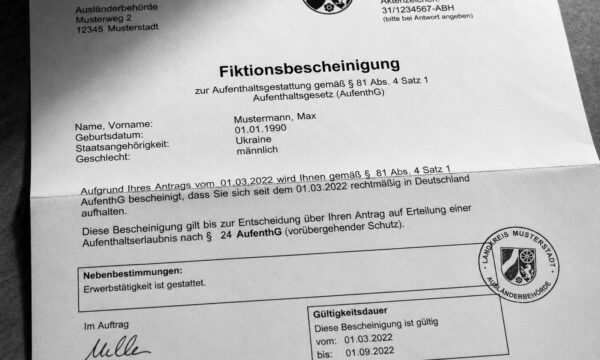
When an application for a new residence permit is submitted before the existing permit expires, the Foreigners’ Registration Office issues a provisional certificate pursuant to Section 81(4) of the Residence Act—this certifies that the existing residence status remains valid until a final decision is made on the new application. The right to work, entitlement to social benefits, and freedom of travel are maintained during this transitional period. For cases involving a change of status under Section 24, the provisional certificate is the most important safeguard against gaps in residence status.
Does my time count toward the residence permit and naturalization under Section 24 of the Residence Act?
Yes—the period of residence under Section 24 of the Residence Act (AufenthG) generally counts as lawful residence for the purposes of the regulations governing the settlement permit(Sections 9, 18c of the Residence Act) and naturalization (Section 10 of the Naturalization Act (StAG); typically five years, or three years in cases of exceptional integration efforts). This is precisely why changing one’s status is now strategically important: Those who change their status in 2026 will typically become eligible for a settlement permit in 2027 or 2028 and for naturalization in 2027.
How much do your consulting packages cost?
Quick Check § 24: starting at €480 net. Comprehensive Status Change and Branch Office Plan: Flat fee depending on the specific circumstances; fixed price provided before retaining our services. The free initial assessment is part of our standard service—you’ll know the total cost to expect before retaining our services.
Do you provide counseling in Ukrainian and Russian?
Yes. Through our legal advisor, Denys Osypenko, we offer client support in Ukrainian and Russian—including case intake, document translation, and assistance with appointments at government agencies. The legal work—such as filing applications, drafting pleadings, and representing clients before government agencies—is handled by the licensed attorneys Klamert, Frey, and Goetz.
Where can I find the Munich Foreigners' Registration Office?
The Munich Foreigners’ Registration Office is part of the District Administration Department (KVR) of the City of Munich, located at Ruppertstraße 11, 80337 Munich. It is accessible by subway (U3/U6 Implerstraße). The KVR is easily accessible by subway from our law office at Heimeranstraße 37.
Free Initial Consultation — Attorney Specializing in Section 24 of the Residence Act in Munich
Describe your situation to us in two or three sentences—we’ll review, with no obligation, which residence permit is right for your situation (EU Blue Card, § 18a, § 18b, § 16b, § 17(1), § 18d of the Residence Act (AufenthG)), whether you can circumvent the § 19f restriction, and which of the three packages (Quick Check, Complete Status Change, Settlement Plan) makes the most sense for you. Online via our contact form, by phone at 089 540 239 0, or in person at Heimeranstraße 37 in Munich. Languages: German, English, Ukrainian, Russian, Portuguese. § 24 status change cases at KLAMERT & PARTNER are handled through our Immigration Law Hub—responsible partners: Markus Klamert, Marc Frey, and Johannes Goetz. Preliminary consultations in Ukrainian and Russian are provided by our legal advisor Denys Osypenko; legal representation is handled by our licensed attorneys.