Germany Opportunity Map
(Section 20a of the Residence Act)
Select your preferred language

Opportunity Card (Section 20a of the Residence Act). Attorney representing skilled workers and employers—based in Munich and serving all of Germany. Get a free initial assessment via the contact form or call us directly at 089 540 239 0.
The Opportunity Card is the only German residence permit that allows entry without an employment contract—it gives holders one year to find a skilled job in Germany, with up to 20 hours of part-time work per week and two-week trial periods with potential employers. The price for this is a points-based system. A software developer from Bengaluru whose bachelor’s degree from Anabin is not recognized as equivalent. A nurse from Manila with five years of professional experience but no German certification. An engineer from Lagos whose points total hinges on a single language certificate. A human resources department in Leipzig that wants to hire a candidate with a “Chancenkarte” (opportunity card) but scheduled her first day of work too early. KLAMERT & PARTNER guides clients through the process—from reviewing the points total to submitting applications to diplomatic missions and the immigration office—and provides legal representation if an application is rejected or remains unprocessed. Residence law is governed by federal law: KLAMERT & PARTNER is your Munich-based law firm specializing in residence law and serves clients throughout Germany. Consultations are available in German, English, Ukrainian, Russian, Portuguese, and Hindi. The initial assessment is free of charge.
When do you need a lawyer for the Opportunity Card?
The Opportunity Card is governed by a relatively simple legal framework. The real challenge lies in the application process. Three agencies work together. The German diplomatic mission in the applicant’s country of origin handles the visa process for the Opportunity Card. The Central Office for Foreign Education evaluates degrees that are not listed in ANABIN. And the Foreigners’ Registration Office at the applicant’s future place of residence issues the title after entry into the country. Each agency conducts its review according to its own criteria; none corrects errors made by the previous agency.
KLAMERT & PARTNER's experience shows that there are three key moments when legal guidance makes the biggest difference.
- Before submitting the application: Choose between the Skilled Worker Track and the points-based system; check the ANABIN classification; calculate a realistic points total; and consider whether the “Opportunity Card” is even the right name for it, or whether the EU Blue Card might be the faster route.
- In progress: Responding to requests for additional documentation, submitting proof of language proficiency and work experience, coordinating with the ZAB.
- In the event of a denial or failure to render a decision: a formal protest, a lawsuit, or an action for failure to act pursuant to § 75 VwGO.
The most costly mistake with the Opportunity Card isn’t rejection, but rather an unspoken miscalculation. Someone adds up six points, moves to Germany, spends a year looking for work—and ultimately realizes that their degree would never have been sufficient for their desired profession, that they never applied for partial recognition, or that the salary of the job they found falls short of the threshold for the next qualification level. A year of their life, a fully funded blocked account, and in the end, an obligation to leave the country.
Typical issues that professionals and companies from all over Germany bring to KLAMERT & PARTNER:
- I have exactly six points; one of them is tied to a language certificate—which one does the diplomatic mission accept?
- My bachelor's degree from India isn't listed as equivalent in ANABIN—will the "Chance Card" help me at all?
- I have five years of professional experience in nursing, but my qualifications aren't recognized in Germany—should I apply for a "Chancenkarte" or start with Section 16d of the Residence Act (AufenthG)?
- I studied in Germany and then left the country—does my previous stay still count?
- I've been accepted to a program in Leipzig, but I still live in Lagos—which agency do I need to apply to, and in what order?
- My "Chance Card" expires in four months, and my new contract doesn't start until later—what should I do now?
- We have a candidate with an "opportunity card" in the hiring process—can we hire her before the job title is changed?
“The Opportunity Card is the first German residence permit that begins with a math problem. And you check your math problems before turning them in. KLAMERT & PARTNER regularly sees applications that hinge on a single point—a language certificate that could have been obtained three months earlier, or partial recognition that no one had applied for, even though it’s worth four points on its own. Those who have their point total calculated in advance aren’t buying certainty—they’re buying time.”
— Markus Klamert, attorney and founder of KLAMERT & PARTNER
What is the Opportunity Card (Section 20a of the Residence Act)?
The Opportunity Card under Section 20a of the Residence Act (AufenthG) has been in effect since June 1, 2024, and constitutes the third pillar of the Skilled Workers Immigration Act—the “Potential Pillar.” It is a residence permit issued for the purpose of seeking employment or pursuing measures to have a foreign professional qualification recognized. This makes it fundamentally different from all other employment-related residence permits: it does not require an employment contract. The purpose of the residence is the search itself.
The Opportunity Card is issued for a maximum of one year. During this time, the holder is permitted to work part-time for an average of no more than 20 hours per week, as well as to participate in a trial employment period of up to two weeks with each potential employer. In all cases, the requirement is that the holder’s livelihood must be secured for the entire duration—the second major hurdle, alongside obtaining the necessary qualifications.
In terms of legal structure, the Opportunity Card falls between two provisions. Section 20a of the Residence Act (AufenthG) governs the permit itself: duration, permitted employment, and renewal. Section 20b of the Residence Act governs the points-based system for all individuals who are not already considered skilled workers with fully recognized qualifications. Section 20a(7) of the Residence Act (AufenthG) also contains an authorization to issue regulations, which would allow the federal government to limit the number of Opportunity Cards issued annually to foreign nationals; KLAMERT & PARTNER reassesses whether this authorization is being exercised on a case-by-case basis for each client, as scheduling depends on this determination.
Important for managing expectations realistically: The Opportunity Card does not grant the right to a job, but rather the right to look for one in Germany. Anyone who does not find qualified employment within a year and cannot demonstrate another purpose for their stay must leave the country. The Opportunity Card is therefore not a substitute for a job-search strategy, but rather the legal framework for residency under that strategy.
Opportunity Map: Requirements—Qualifications, Language, Livelihood
The "Opportunity Map" requirements can be boiled down to a checklist that must be worked through before each scoring round.
First, the qualification: a foreign college degree or at least two years of vocational training, officially recognized in the country where the training took place—or, alternatively, a vocational degree awarded by a German Chamber of Commerce Abroad. If the qualification is fully recognized in Germany, the points system does not apply at all. Second, language proficiency: German at the A1 level or English at the B2 level. Without one of these, the points-based route is closed, regardless of how high the point total might otherwise be. Third, the points: at least six, as specified in the annex to Section 20b of the Residence Act (AufenthG). Fourth, proof of sufficient means of support for the entire duration of the stay, without recourse to public funds. In addition, proof of health insurance, a valid passport, and the formalities of the visa application process are required.
The eligibility requirements for the Opportunity Card are governed by federal law and apply identically to every application—regardless of the diplomatic mission and the applicant’s future place of residence in Germany. The only differences lie in procedural practices: processing time, scheduling, and the policy regarding requests for additional documentation. KLAMERT & PARTNER reviews the list point by point, because every single line on its own can lead to a rejection.
There are two factors that are not formally listed among the requirements but are, in practice, decisive for success: the ANABIN evaluation of your degree and whether the profession you are seeking to pursue is regulated in Germany. KLAMERT & PARTNER clarifies both of these issues before the application is submitted.
The Two Paths to the Opportunity Card — Skilled Worker or Points System
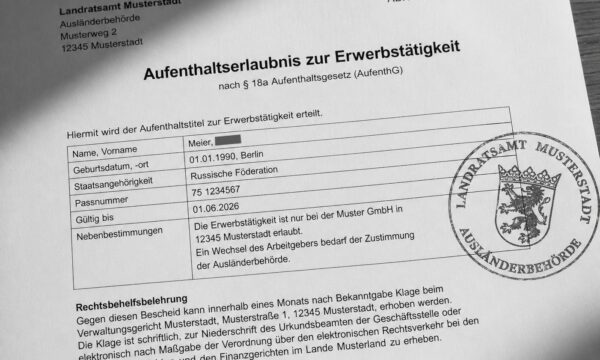
There isn't just one "opportunity card"; rather, there are two paths to access it, each requiring a completely different level of effort. This distinction is the single most important point of the consultation—and it is regularly glossed over in guidebooks and forums.
Path 1 — Opportunity Card for Skilled Workers under Section 20a(3)(1) of the Residence Act (AufenthG)
Anyone who meets the requirements for a skilled worker as defined by the Residence Act—that is, who holds a foreign college degree that is fully recognized in Germany or a fully recognized vocational training program lasting at least two years—receives the Opportunity Card without going through the points-based system. No point-counting, no debate over language certificates. The only requirement is proving the ability to support oneself. This is the fast track, and it’s rarely considered: Many applicants painstakingly tally up points, even though their degree has long been registered as equivalent.
Option 2 — Opportunity Card Based on the Point System Under Section 20b of the Residence Act (AufenthG)
Those who have not yet received full recognition are evaluated based on points. Points are only counted once the qualification and language proficiency requirements have been met—and even then, a minimum of six points must be earned. In many situations, it’s worth going through the recognition process first and then applying for the “Chance Card” as a skilled worker. Conversely, it may make sense to specifically apply for partial recognition, since it alone is worth four points in the point system. Because recognition agencies are under state jurisdiction, choosing the right authority is part of the strategy—one reason why a law firm operating nationwide has an advantage here.
Opportunity Card Points — The Point System Under Section 20b of the Residence Act (AufenthG)
The points on the Opportunity Card are determined in accordance with the annex to Section 20b of the Residence Act. A minimum of six points is required. Within the “Language” and “Work Experience” categories, only the highest score achieved in each category is counted—German B2 and German B1 are not combined.
- Partial recognition of a foreign professional qualification: 4 points
- Work experience: at least 5 years within the last 7 years: 3 points
- Work experience: at least 2 years within the last 5 years: 2 points
- German language proficiency at level B2 or higher: 3 points
- German language proficiency, Level B1: 2 points
- German language proficiency, Level A2: 1 point
- English proficiency at the C1 level or native speaker (bonus): 1 point
- Age under 35 at the time of application: 2 points
- Age between 35 and 40 at the time of application: 1 point
- Qualification in a high-demand occupation: 1 point
- Prior residence: at least 6 months of lawful and uninterrupted residence in Germany within the last 5 years: 1 point
- If the spouse or domestic partner also meets the requirements and applies jointly: 1 point
Opportunity Map Points — The Three Places Where Calculations Are Most Often Incorrect
First, partial recognition. Four points—the largest single category in the table. However, this requires a formal recognition procedure resulting in a determination of partial equivalence; those with only similar qualifications do not qualify for partial recognition under the regulation. Second, prior residence. One point for at least six months of lawful, uninterrupted residence within the last five years—a language course with a Schengen visa, several short visits, or a stay that took place longer ago do not count toward this; a completed semester abroad, on the other hand, certainly does. Third, age: two points for those under 35, one point for those between 35 and 40, based on the date of application.
FROM THE PRACTICE OF KLAMERT & PARTNER — WHY A SINGLE POINT CAN MAKE ALL THE DIFFERENCE OVER MONTHS.
For applicants nearing their 35th or 40th birthday, the date the application is submitted alone determines whether they receive a full point. This can be planned for and is often overlooked. The same applies to language certificates: Moving from B1 to B2 earns one point and takes just a few months, depending on prior knowledge—significantly less time than a formal recognition process, which, however, earns four points or makes the point-counting process entirely unnecessary. The procedure at KLAMERT & PARTNER is therefore always the same: first, go over the table with the client to calculate the points, then decide which missing point can be earned with the least amount of time, and finally, submit the application. This isn’t legal fine-tuning, but simply prioritization—yet hardly anyone does it before the application is submitted.
“With the Opportunity Card’s point system, it’s the order that matters, not just the total. We sit down with the client to review the table and see which missing point can be earned with the least effort and in the shortest amount of time. Anyone who simply submits the form and hopes for the best risks losing an entire year if things go wrong.”
— Marc Frey, attorney at KLAMERT & PARTNER, specializing in contract drafting and client structures
Germany Opportunity Map — Valid Throughout the Entire Country
People who search for the “Chancenkarte Deutschland” are usually looking for two things at once: confirmation that the permit is valid throughout Germany, and an answer to the question of who actually issues it. The two are related. The Chancenkarte Deutschland is a residence permit governed by federal law under Section 20a of the Residence Act (AufenthG) and entitles the holder to reside in the Federal Republic of Germany—not in a specific city or a specific federal state.
In practical terms, this means that anyone entering the country with an Opportunity Card may settle in any federal state, attend job interviews nationwide, and change their place of residence while searching for work. The job search is expressly not limited to a single metropolitan area—and this is important because, depending on the field, job market opportunities in Saxony, the Ruhr region, or Baden-Württemberg may be significantly better than in the most sought-after location, while the cost of living is considerably lower during the year of the job search.
KLAMERT & PARTNER serves Chancenkarte Deutschland under a nationwide retainer agreement. The attorneys’ license to practice applies throughout Germany; no local law firm is required to represent clients before immigration authorities in Bremen, Erfurt, or Kiel. The firm collaborates with immigration authorities in all sixteen federal states and with German diplomatic missions in the most important countries of origin. The firm is based in Munich, and its area of jurisdiction is Germany.
Request a free initial assessment
Tell us about your case—quickly and with no obligation. We’ll assess your chances of success and get back to you shortly.
or call us directly at: 089 540 239 0
Recognition of a degree: ANABIN, ZAB, and partial recognition
Recognition is the verification step that precedes every Opportunity Card—and the one that determines eligibility. The key reference is ANABIN, the database of the Central Office for Foreign Education. Two entries must match: the institution of higher education and the degree.
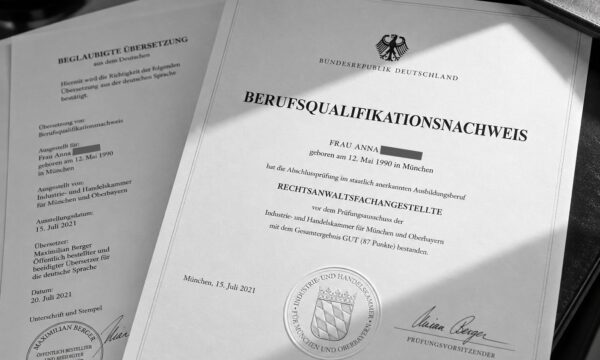
If the institution of higher education is listed with “H+” status and the degree is classified accordingly, recognition is generally unproblematic—and thus the Skilled Worker Pathway is open without a points system. If any of the entries are missing, an evaluation of the diploma by the Central Office for Foreign Education is required; processing typically takes about two months. For the points-based route, on the other hand, a degree recognized by the state in the country where the education was completed is sufficient—in this case, ANABIN is not the barrier to entry, but rather the means to obtain the four points for partial recognition.
The second explicitly stated purpose of the Opportunity Card is to seek measures for the recognition of professional qualifications. Those who enter the country with partial recognition can establish equivalence in Germany—through an adaptation course, a knowledge test, or an aptitude test administered by the relevant state office. For regulated professions, particularly in nursing and healthcare, this is the primary use case for the Opportunity Card.
FROM THE PRACTICE OF KLAMERT & PARTNER — THE CASE OF PARTIAL RECOGNITION.
The four points for partial recognition are the largest single category in the points system—and the one most often left unused. The reason is a misunderstanding: Many applicants believe that recognition is an issue that is only clarified once they arrive in Germany, and therefore calculate their points without including it. In fact, the formal procedure can be initiated from the country of origin. If the result is full equivalence, the points system is unnecessary; if it results in partial recognition, four points are guaranteed, and the adjustment measure becomes the second legitimate purpose of residence on the Opportunity Card. In both cases, the situation is better than before. At KLAMERT & PARTNER, therefore, when there is no ANABIN entry, the evaluation of the diploma proceeds in parallel with the preparation of the application—so that the two months do not end up adding to the timeline at the very end.
Applying for an Opportunity Card: Process, Documents, Processing Time
Anyone who wants to apply for the Opportunity Card must follow a different procedure—depending on where they are located. The standard procedure is to apply in the country of origin, not in Germany.
If you are applying from abroad, the process consists of four steps: online registration via VIDEX and scheduling an appointment at the relevant German diplomatic mission abroad or with the designated service provider. In-person appointment for biometric data collection; the fee for the national visa is 75 euros, payable in local currency. Entry into Germany with the visa. Application for a residence permit at the Foreigners’ Registration Office in your chosen place of residence. Applications are generally accepted at diplomatic missions up to three months before the planned date of entry.
Anyone already living in Germany under a different status may apply for the "Chancenkarte" without having to leave the country; the visa process is waived, and the application is submitted directly to the Foreigners' Registration Office.
To ensure a complete application package, KLAMERT & PARTNER typically compiles the following:
- Passport
- Educational credentials with an apostille or legalization and a certified translation
- Anabin extract or ZAB academic transcript evaluation
- Language certificates from accepted providers
- Proof of work experience that clearly links the job duties to the level of qualifications
- Proof of sufficient funds to support oneself, showing the monthly amount
- Health Insurance Confirmation
It is not possible to provide a reliable estimate of the processing time. The bottleneck for the Opportunity Card is almost never the substantive law, but rather the local scheduling situation: Waiting times for a visa appointment vary considerably depending on the diplomatic mission and are particularly long in India, Pakistan, and Nigeria. Anyone planning to start a job should work backward—first the start date, then the processing time at the agency, then the wait time for an appointment, and finally the deadline by which the documents must be ready. The key factor is ensuring the application is complete: every request for additional documentation results in another processing cycle.
One point that is frequently misunderstood: The choice of diplomatic mission is based on your habitual residence, not your nationality. An Indian professional working in the United Arab Emirates should submit their application there, not in New Delhi.
Ensuring a Livelihood: Restricted Account and Declaration of Obligations
The second major hurdle for the Opportunity Card has nothing to do with qualifications. You must be able to cover your living expenses for the entire duration of your stay without relying on public funds. According to the guidelines issued by German diplomatic missions abroad, the benchmark is approximately 1,091 euros net per month, or about 13,092 euros for one year. This amount is based on the BAföG needs-based rate, is adjusted accordingly, and applies uniformly throughout Germany—it does not vary depending on where in Germany you plan to live.
There are three ways to provide proof. A blocked account at a German bank or an authorized provider, whose confirmation must specify the total amount and the monthly available portion. A declaration of commitment from a person residing in Germany pursuant to Section 68 of the Residence Act (AufenthG), which constitutes a serious undertaking of liability and is reviewed by the authorities for financial viability. And, less commonly, an employment contract for permissible part-time work, provided the income demonstrably covers the applicant’s needs—at 20 hours per week, this is only possible in well-paid jobs.
FROM THE PRACTICE OF KLAMERT & PARTNER — WHEN THE BLOCKED ACCOUNT SHOWS THE WRONG BALANCE.
A recurring pattern with rejected applications has nothing to do with the amount, but rather with the form of the confirmation. What is required is a certificate that shows both the total amount deposited and the monthly available portion. Confirmations that list only the total amount are regularly rejected—the applicant has long since committed the funds and still loses a processing cycle. Conversely, KLAMERT & PARTNER sees letters of commitment from relatives that fail the financial review and delay the process by months, even though a blocked account would have been faster from the start. Both approaches are viable; which one is faster in a given case is decided before the payment is made, not after.
Working with the Opportunity Card — 20 Hours and a Trial Employment Period
What is and isn’t permitted with the Opportunity Card is more frequently misunderstood than any other question regarding this topic. A part-time job is permitted for an average of no more than 20 hours per week; the average refers to the duration of the stay, not to any single week, but it is up to the cardholder to document their working hours. A trial period of up to two weeks with a potential employer is also permitted; this is intended as a mutual suitability test and may be used with multiple employers.
Regular full-time employment is not permitted: Anyone who takes a qualified job while holding an Opportunity Card must obtain a different residence permit for that purpose. Self-employment is also not covered; in such cases, § 21 of the Residence Act (AufenthG) applies, which provides for a separate procedure.
The most important practical implication concerns the transition. As soon as a qualified position is found, an application must be filed to change to the appropriate status—before starting work, not after. For the skilled worker, this concerns their residency status; for the company, it concerns the verification obligations under Section 4a of the Residence Act (AufenthG) and the associated penalties.
Job Search Opportunity Card — One Year to Apply
The “Job Search Opportunity Card” means twelve months during which the purpose of your stay is to apply for jobs. That sounds like a lot of time, but it isn’t if you first have to establish your credentials, improve your language skills, and put together your application materials once you’re in Germany. Those who successfully use the Job Search Opportunity Card have clarified three things before entering the country: the ANABIN evaluation of their degree, whether their target profession is regulated, and a job application portfolio in the German format.
The second factor is the choice of region. In many shortage occupations—nursing, IT, engineering, and academic health professions—competition is significantly lower outside major metropolitan areas, while the cost of living places less of a burden on the job-search year. Because the Opportunity Card is valid throughout Germany, this choice is unrestricted. KLAMERT & PARTNER openly addresses this point in the initial assessment because it influences the decision between the Opportunity Card and the direct EU Blue Card.
And third: The two-week trial period is not a minor detail, but rather the most powerful tool in the job-search toolkit. For positions where a video interview does not allow for a reliable assessment of professional qualifications, it replaces the leap of faith an employer would otherwise have to take.
Opportunity Card Renewal and Follow-up Opportunity Card
The Opportunity Card for job seekers is issued for a maximum of one year. An extension of the Opportunity Card is possible as a follow-up Opportunity Card under Section 20a(5) of the Residence Act (AufenthG) for up to two additional years—provided that qualified employment has been found but a regular residence permit cannot yet be issued, for example because a recognition process or an adaptation measure is still ongoing. An employment contract and the approval of the Federal Employment Agency are required.
The stumbling block is the timing. An application to extend an Opportunity Card must be submitted well in advance of its expiration date—not on the very last day of validity. Those who wait risk a gap in their residency status, which can subsequently be closed only with considerable effort. Employers should therefore keep track of the expiration date of an Opportunity Card in a deadline calendar; KLAMERT & PARTNER will handle this deadline monitoring upon request, throughout Germany.
Request a free initial assessment
Tell us about your case—quickly and with no obligation. We’ll assess your chances of success and get back to you shortly.
or call us directly at: 089 540 239 0
From the Opportunity Card to the EU Blue Card — the Change in Status
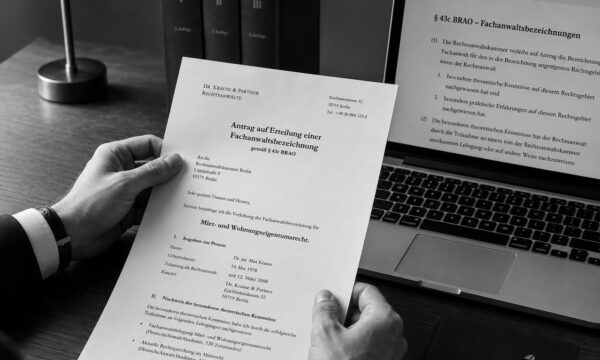
The Opportunity Card is a transitional permit. Its value depends on what comes next—and the intended next step is to transition to an employment-based residence permit. Depending on qualifications and salary, this leads to an EU Blue Card under Section 18g of the Residence Act (AufenthG), a residence permit for skilled workers with academic training under Section 18b of the Residence Act, for skilled workers with vocational training under Section 18a of the Residence Act, or a permit under Section 19c of the Residence Act for those with non-academic professional experience.
The switch can be made from within Germany, without having to leave the country and without going through a new visa application process. Which option is most advantageous depends on your salary, the status of your professional qualification recognition, and how quickly you wish to obtain a settlement permit: For the EU Blue Card, pursuant to Section 18c(2) of the Residence Act (AufenthG), 27 months are sufficient for basic German language skills and 21 months for sufficient German language skills; for other work-based permits, the process takes significantly longer. KLAMERT & PARTNER therefore plans the change in status from the very beginning, because the order in which applications are filed plays a key role in meeting this deadline.
For employers, this means that if they hire a candidate through the Opportunity Card program, they should factor in the eventual transition when making the job offer. A base salary just below the Blue Card threshold will set the skilled worker back six to twelve months on the path to permanent residency—and this is a matter of contract terms, not a procedural issue.
Opportunity Card or EU Blue Card — A Comparison
The Opportunity Card and the EU Blue Card are often treated as alternatives. They are not—they are two stops along the same journey, and the only question is where you get on.
The EU Blue Card under Section 18g of the Residence Act requires a specific employment contract that meets the threshold requirements. In 2026, the salary thresholds will be 50,700 euros gross per year, equivalent to 4,225 euros per month; for occupations facing labor shortages and entry-level positions, a reduced threshold of 45,934.20 euros per year or 3,827.85 euros per month applies, subject to approval by the Federal Employment Agency. The thresholds are dynamically linked to the contribution assessment ceiling of the general pension insurance system and increase annually; the current value must be verified before each application. They apply uniformly across Germany—an offer of 46,000 euros meets the shortage-occupation threshold in Rostock just as it does in Frankfurt.
The rule of thumb: If you have a job offer ready to be signed and the salary is sufficient, the EU Blue Card is almost always the better option—longer validity period, preferential family reunification, EU mobility, a faster path to a permanent residence permit, and no restricted account requirement. If the job search is still open, the best route is the Opportunity Card. It is also the better option if in-person job interviews are required, if the applicant’s degree has not yet been fully recognized and the process is to take place in Germany, or if the applicant does not want to commit to a specific employer or federal state in advance.
If the salary is below the Blue Card threshold but the qualification is recognized, the path to entry is via a German work visa under Sections 18a or 18b of the Residence Act (AufenthG). All three pathways fall under the topic of skilled worker immigration and are distinguished from one another in the Skilled Worker Immigration Hub.
Family Reunification and the Opportunity Card
When it comes to family reunification, the eligibility criteria for the Chancenkarte are significantly stricter than those for the EU Blue Card—a point that should be clarified early in the planning process because it helps determine the order in which applications are filed. Family reunification depends on the type of residence permit held, and a residence permit based on dependency carries less weight than one based on employment.
However, the point system does offer an incentive for couples: A spouse or domestic partner who applies jointly and also meets the requirements earns an additional point. For couples in which both partners are eligible, applying jointly may therefore be the more advantageous option.
After switching to an EU Blue Card, the situation changes fundamentally: For spouses joining their partner, the A1 language proficiency requirement under Section 30(1), sentence 3, no. 5 of the Residence Act (AufenthG) no longer applies; the housing requirement under Section 29(5) of the Residence Act no longer applies; and the spouse joining their partner has unrestricted access to the labor market under Section 27(5) of the Residence Act. Anyone planning family reunification should therefore not delay the change in status.
Which immigration office is responsible for your Opportunity Card
After entry into the country, the Foreigners’ Registration Office at the place of habitual residence is responsible for issuing the “Chance Card” residence permit; thus, after a move, the office at the new place of residence takes over. While the substantive law is the same nationwide, the practical implementation is not: processing times, appointment scheduling, online procedures, and fee amounts vary considerably from municipality to municipality. Those who do not yet have a permanent place of residence thus have real flexibility—one of the most underestimated aspects of the Opportunity Card.
The Munich Opportunity Map as an Example — Specific Figures from a Large Immigration Office
The extent to which the process depends on one’s place of residence is illustrated by the example of the state capital, Munich. There, the Immigration and Naturalization Service Office within the District Administration Department, located at Ruppertstraße 19, 80337 Munich, is responsible. The residence permit for the Opportunity Card costs 100 euros for adults and 50 euros for minors. The city currently estimates that processing a complete application takes 10 to 12 weeks and explicitly notes that the application cannot be finalized until all required documents have been submitted. Other agencies may take less or significantly more time—the only certainty is that incomplete applications take the longest to process everywhere.
Request a free initial assessment
Tell us about your case—quickly and with no obligation. We’ll assess your chances of success and get back to you shortly.
or call us directly at: 089 540 239 0
Opportunity Card Rejected or Application Unprocessed
A rejection isn't the end of the road. With the Opportunity Card, it's usually a calculation or documentation issue—and both can be corrected. The key thing to determine first is exactly what was rejected and by whom.
The most common issues encountered in practice tend to recur: a points total that the authorities calculate differently than the applicant does—usually in cases of partial recognition, prior residence, or work experience; proof of sufficient funds that does not show the monthly amount available; language certificates from providers that are not accepted; And proof of work experience that does not clearly link the job to the applicant’s level of qualification.
If a visa is denied by a diplomatic mission abroad, filing a formal protest is the usual first step; if this is unsuccessful, a lawsuit may be filed with the Berlin Administrative Court, which has nationwide jurisdiction over lawsuits against German diplomatic missions abroad. If the denial is issued by the Foreigners’ Registration Office, the administrative court at the applicant’s place of residence has jurisdiction. The deadline for filing a lawsuit is generally one month from the date of notification, pursuant to § 74 VwGO. If no decision is issued at all, § 75 VwGO applies: An action for failure to act is generally admissible no earlier than three months after the application is filed; the court may stay the proceedings and set a deadline for the agency. Whether an appeal has a chance of success can only be assessed after reviewing the decision and the case file.
One side effect of the rules governing jurisdiction is revealing when it comes to choosing a lawyer: If a visa application is denied, it doesn’t matter at all where the law firm is based—the proceedings take place centrally in Berlin anyway.
FROM THE PRACTICE OF KLAMERT & PARTNER — WHEN THE APPLICATION IS PUT ON HOLD.
Not every delay is unlawful, and not every action for failure to act is the right course of action. A common observation: At some diplomatic missions abroad, the bottleneck is not the processing of applications but the scheduling of appointments to file them—particularly in India, Pakistan, and Nigeria, where demand for the Opportunity Card is highest. In those cases, filing a lawsuit against the agency is of little help because no application has yet been filed. Conversely, there are cases where all required documents have been submitted for months, and in which a well-reasoned inquiry into the status of the case—with a deadline set—achieves more than any further submission of supporting documents. The first step is therefore always to reliably determine the status of the proceedings: which agency has the file, what is missing, and since when.
Opportunity Map for Employers: Trial Employment, Section 4a of the Residence Act, Compliance
For companies, the Opportunity Card is good news—with a caveat. The good news: Applicants can be interviewed in Germany, assessed for their professional skills during a trial period of up to two weeks, and then hired—without having to prepay for the entire visa process and without bearing the application risk alone. As a Munich-based law firm specializing in immigration law, KLAMERT & PARTNER advises employers at all locations throughout Germany.
The footnote refers to Section 4a of the Residence Act (AufenthG). An employer may only hire someone who holds a residence permit that authorizes that specific employment. The Opportunity Card permits part-time work of up to 20 hours and a two-week trial period—but not a regular full-time position. Therefore, the first day of work in the target position may not occur before the appropriate permit has been issued. The employer is responsible for verifying compliance, and violations are subject to fines.
What KLAMERT & PARTNER does for employers and HR departments:
- Verification of Qualifications: Verification of the submitted qualifications and eligibility for employment pursuant to Section 4a of the Residence Act (AufenthG), with a documented assessment for the personnel file.
- Contract Drafting: Draft the employment contract so that the salary structure clearly meets the threshold for the desired next-level title—variable components are typically the main stumbling block here.
- Application for the follow-up document: at the appropriate immigration office, scheduled to coincide with the onboarding appointment, at any location nationwide.
- Expedited Skilled Worker Procedure under Section 81a of the Residence Act: An Exam as a Predictable Alternative for Applicants Who Are Still Abroad.
- Deadline Management: A workflow and deadline schedule that includes a follow-up reminder before the opportunity card expires.
For companies with locations in multiple federal states, there is an additional layer to consider: The same situation is handled at different speeds and, at times, with varying degrees of strictness by different immigration authorities. Companies that can assign a skilled worker with an Opportunity Card to one of five plants also have some flexibility in this regard.
FROM THE PRACTICE OF KLAMERT & PARTNER — THE FIRST DAY OF WORK BEFORE THE DEGREE IS AWARDED.
The most common compliance violation related to the Opportunity Card isn’t due to bad faith, but rather a scheduling issue. The hiring process is underway, the candidate has a valid Opportunity Card in hand, and both parties assume that employment is permitted. But it isn’t: The Opportunity Card covers 20 hours of part-time work and a two-week trial period, not the full-time position for which the candidate is being hired. This usually only becomes apparent when applying for the follow-up permit—by which time the first day of work is already weeks in the past. That’s why KLAMERT & PARTNER, when representing employers, always establishes the timeline first and then drafts the contract. This reminder takes just one sentence in the onboarding process and prevents administrative proceedings.
“In employer-led initiatives, the benefit of the Opportunity Card is almost always the pre-screening process, and the risk is almost always the calendar entry. A company that hires a female candidate with an Opportunity Card and schedules her first day of work before the title is officially granted does not have a personnel problem, but rather faces the risk of an administrative offense. This is easy to avoid—and costly if you don’t.”
— Johannes Goetz, attorney at KLAMERT & PARTNER, specializing in representing employers and HR departments
Opportunity Card: Costs, Fees, and Legal Protection
The "Opportunity Map: Costs" consists of three sections that must be clearly separated.
The official fee for the national visa associated with the Opportunity Card is 75 euros. The fee for the residence permit is collected by the local immigration office and varies by municipality; in Munich, it is 100 euros for adults and 50 euros for minors. In addition, depending on the case, there may be costs for an apostille, certified translations, and the ZAB’s evaluation of academic credentials.
The largest expense is not the application fee, but the proof of sufficient funds for living expenses: approximately 1,091 euros per month, or about 13,092 euros per year, which must be held in a restricted account—unless a letter of commitment or sufficient additional income is provided. Provider fees for the restricted account are added to this amount.
KLAMERT & PARTNER’s fees are based on the Attorney’s Fees Act or on an individual fee agreement. For employer clients, a fee agreement is the norm, often in the form of a flat fee per application proceeding. The specific cost of a case is discussed before the retainer is signed—not afterward. Fees are regulated uniformly throughout Germany and are not higher for clients from abroad. If legal expense insurance is in place, the firm will handle the coverage inquiry.
The initial assessment is free of charge regardless of the circumstances. As part of the free initial assessment, KLAMERT & PARTNER will review the facts of the case on a non-binding basis to determine whether there is a reasonable chance of success. Any legal advice beyond this will be provided only after you have retained our services and we have reached an agreement on fees.
Opportunity Map: Attorney in Munich — Serving Clients Nationwide · Your Free Initial Assessment
Are you unsure whether your points balance is sufficient, whether your degree will be recognized, or whether it’s worth filing an appeal? That’s exactly what the free initial assessment is for. As part of the free initial assessment, KLAMERT & PARTNER will review your case—with no obligation—to determine its apparent prospects for success and identify the appropriate legal proceeding. Any legal advice beyond this will be provided only after you retain our services and we reach an agreement on fees.
Please use the contact form for this purpose: There, you can directly upload your academic transcripts, language certificates, proof of work experience, and—if available—the official notification from the authorities. You can reach us by phone at 089 540 239 0. Employers and HR departments receive the same free initial assessment for planned hires, including guidance on whether the “Chancenkarte” or the expedited skilled worker procedure is the better option. For cases with upcoming deadlines, appointments are scheduled on short notice, including video appointments across time zones.
The law firm’s offices are located at Heimeranstraße 37 in Munich’s Westend district, just a few minutes’ walk from the Schwanthalerhöhe and Heimeranplatz subway stations (U4/U5); it is two stops from Munich Central Station. For clients in Munich, the Kreisverwaltungsreferat on Ruppertstraße is the competent immigration authority. The firm is based in Munich, and its area of jurisdiction is Germany. Immigration law is governed by federal law: As a Munich-based law firm specializing in immigration law, KLAMERT & PARTNER represents skilled workers and employers before immigration authorities and administrative courts throughout Germany—from Kiel to Konstanz, from Aachen to Dresden. The skilled worker is based in Bengaluru, the diplomatic mission is in New Delhi, and the future immigration office is in a district in Saxony: The firm handles such cases entirely digitally, using encrypted communication and digital access to case files.
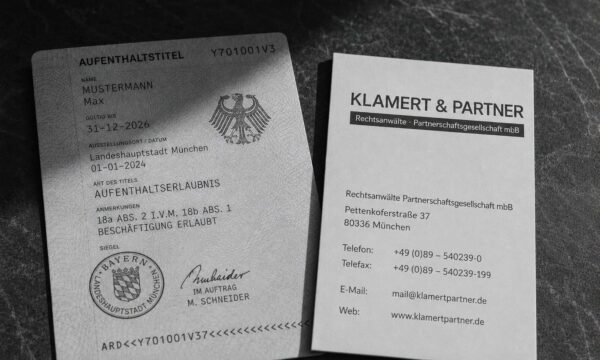
Languages: Consultations are available in German, English, Ukrainian, Russian, Portuguese, and Hindi. The team includes a lawyer from India who provides consultations in Hindi. Indian professionals account for the majority of demand for the Opportunity Card—inquiries from India are expressly welcome at KLAMERT & PARTNER, and preliminary consultations are conducted in Hindi rather than through a third language. We welcome professionals from IndiaFor Ukrainian- and Russian-speaking clients, the point of contact is attorney Denys Osypenko. In both cases, the initial consultation is conducted by the team’s attorneys; the legal representation is handled by the licensed attorneys Markus Klamert, Marc Frey, and Johannes Goetz.
“When it comes to the Opportunity Card, a great deal depends on documents from the country of origin—educational credentials, employment records, and language certificates. Clients often consider documents that carry weight in the points system to be worthless: for example, an employment record with continuous entries that proves they have two or five years of professional experience in the first place. That is why KLAMERT & PARTNER conducts the initial consultation in the client’s native language—in Hindi, Ukrainian, and Russian. Licensed attorneys then handle the legal processing. This is not a mere formality, but a prerequisite for ensuring that a viable application is ultimately submitted.”
— Markus Klamert, attorney and founder of KLAMERT & PARTNER
Frequently Asked Questions About the Opportunity Card
What is the Opportunity Card?
This is a residence permit issued under Section 20a of the Residence Act (AufenthG) for the purpose of seeking employment or undergoing recognition procedures. It has been in effect since June 1, 2024, is granted for a maximum of one year, and does not require an employment contract. It permits part-time work for an average of no more than 20 hours per week and trial employment for up to two weeks per employer.
Germany's Opportunity Map — Does the title apply throughout the entire country?
Yes. The German Opportunity Card is a residence permit governed by federal law under Section 20a of the Residence Act (AufenthG) and entitles the holder to reside in the Federal Republic of Germany, not in a specific city. You may settle in any federal state, attend job interviews nationwide, and change your place of residence. Only the competent immigration office is determined by your current place of residence.
Who is eligible to apply for the Opportunity Card?
Two groups. Skilled workers with a college degree fully recognized in Germany or a fully recognized vocational training program lasting at least two years—the points system does not apply to them. And individuals with a qualification recognized by the government of the country where they received their training who also demonstrate proficiency in German at the A1 level or in English at the B2 level and achieve at least six points under Section 20b of the Residence Act (AufenthG).
Opportunity Card Eligibility Requirements: What Criteria Do I Need to Meet?
The requirements for the “Chancenkarte” are: a foreign college degree or at least two years of vocational training; German at the A1 level or English at the B2 level; at least six points under Section 20b of the Residence Act (AufenthG)—unless the qualification is fully recognized, in which case the point system does not apply—; sufficient financial means to support oneself for the entire duration of the stay; and proof of health insurance.
Opportunity Card Points: How many do I need, and what are they for?
You need at least six Opportunity Card points. Points are awarded for partial recognition of a qualification (4), 5 years of work experience within the last 7 years (3) or 2 years within the last 5 years (2), German B2 or higher (3), B1 (2), A2 (1), English C1 or native speaker (1), age under 35 (2) or 35 to 40 (1), a shortage occupation (1), a previous stay in Germany (1), and a spouse applying jointly (1).
How can I apply for the Opportunity Card?
From abroad: Gather the necessary documents, submit the application via VIDEX, schedule an appointment at the German diplomatic mission abroad, provide biometric data, and pay the 75-euro visa fee. After entering Germany, apply for a residence permit at the Foreigners’ Registration Office in your place of residence. Anyone already living in Germany who holds a qualifying degree can apply for the “Chancenkarte” without having to leave the country.
How much money do you need for the Opportunity Card?
According to the guidelines issued by German diplomatic missions abroad, applicants must demonstrate that they have approximately 1,091 euros net per month, or about 13,092 euros for one year. Proof of funds can be provided through a blocked account, a declaration of financial commitment pursuant to Section 68 of the Residence Act (AufenthG), or sufficient additional income. The blocked account confirmation must specify the total amount and the monthly available portion.
Opportunity Map Costs: How much should I budget for in total?
The costs associated with the Opportunity Card consist of a 75-euro visa fee, the residence permit fee (which varies by municipality—in Munich, 100 euros for adults and 50 euros for minors), translations, certifications, and apostilles, as well as the largest expense: approximately 1,091 euros per month to demonstrate sufficient means of support. Attorney fees are based on the RVG (German Lawyers’ Fee Act) or a fee agreement.
How long does it take to process the Opportunity Card?
That depends on two factors. In the visa application process, diplomatic missions generally accept applications up to three months before the planned date of entry; the wait time for an appointment varies considerably and is particularly long in India, Pakistan, and Nigeria. For a residence permit, the City of Munich, for example, estimates 10 to 12 weeks from the date the application is complete.
Job Search Roadmap: How Can I Find a Job in a Year?
The Job Search Opportunity Card is valid for twelve months, during which part-time work of up to 20 hours per week and two-week trial placements are permitted. Preparation is key: application materials in the German format, a clarified Anabin classification, and a realistic choice of region. In many occupations facing labor shortages, competition is significantly lower outside of metropolitan areas.
How long is the Opportunity Card valid?
The Opportunity Card for job seekers is issued for a maximum of one year. If a qualified job is found but a regular residence permit cannot yet be issued, Section 20a(5) of the Residence Act provides for an extension in the form of a follow-up Opportunity Card for up to two additional years.
Opportunity Card Extension: Is an extension possible?
An extension of an Opportunity Card is possible as a follow-up Opportunity Card under Section 20a(5) of the Residence Act (AufenthG) for up to two additional years—provided that qualified employment has been found but a regular residence permit cannot yet be issued, for example because a recognition process or an adjustment measure is still pending. An employment contract and the approval of the Federal Employment Agency are required.
Is it permissible to use the Opportunity Card?
Yes, but with restrictions. You are permitted to engage in secondary employment for an average of no more than 20 hours per week and to participate in trial employment with a potential employer for up to two weeks. A regular full-time position is not covered by the Opportunity Card—to work in such a position, you must first apply to switch to a work-related residence permit. Self-employment is not covered.
Do I need to know German to get the Opportunity Card?
For the points-based route, you need either German at the A1 level or English at the B2 level as an entry requirement—without one of these, your application cannot be approved. In addition, German language proficiency earns you points: A2 earns one point, B1 earns two, and B2 or higher earns three. English at the C1 level or as a native language earns you one bonus point.
Does my degree have to be entered into Anabin to qualify for the Opportunity Card?
For the “Specialist Pathway,” yes—full recognition is a prerequisite there, and the standard verification process is handled through anabin. For the “Points Pathway,” a degree recognized by the government of the country where the education was completed is sufficient. If the institution or degree is not listed, a credential evaluation by the ZAB may be considered—processing typically takes about two months.
Do credits from a previous degree program in Germany count toward the total?
One point is awarded for at least six months of lawful, uninterrupted residence in Germany within the last five years. A completed semester abroad or a longer period of study during this time frame therefore counts toward this point. Multiple short visits, a language course lasting only a few weeks, or studies that took place some time ago do not count toward this point.
What is the difference between an Opportunity Card and an EU Blue Card?
The EU Blue Card under Section 18g of the Residence Act requires a specific employment contract with a salary above the threshold—in 2026, this amounts to 50,700 euros per year, or 45,934.20 euros for occupations facing labor shortages and for entry-level workers. The Opportunity Card does not require an employment contract but allows the holder to look for work. Anyone who has a job offer that meets the salary threshold is better off with the EU Blue Card.
Can I switch from the Opportunity Card to the EU Blue Card?
Yes, and that is the standard procedure. As soon as an employment contract is in place that meets the requirements of Section 18g of the Residence Act—in particular, the salary threshold and alignment with qualifications—it is possible to change jobs within Germany without having to leave the country or go through a new visa application process. Depending on qualifications and salary, § 18a, § 18b, or § 19c of the Residence Act (AufenthG) may also be applicable.
What happens if I can't find a job with the Opportunity Card?
In that case, the purpose of stay ends when the Opportunity Card expires, and the holder is required to leave the country unless another purpose of stay can be established. Renewal as a follow-up Opportunity Card specifically requires that the holder has found qualified employment. Therefore, counseling prior to submitting an application should include a realistic assessment of the labor market situation—nationwide, not just in a single region.
Can I bring my family with me using the Opportunity Card?
Family reunification depends on the specific residence permit and is subject to much stricter requirements under the Opportunity Card than under the EU Blue Card. However, a spouse who applies jointly and also meets the requirements earns one point. After switching to an EU Blue Card, the A1 language proficiency requirement is waived for spouses joining the family, there is no housing requirement, and access to the labor market is unrestricted.
Can an employer hire someone with an Opportunity Card?
You may not work full-time in the target position as long as you only hold an Opportunity Card. Part-time work of up to 20 hours per week and a two-week trial period are permitted. For the regular position, the appropriate residence permit must be granted beforehand. Under Section 4a of the Residence Act (AufenthG), the employer is responsible for verifying this, and failure to do so is subject to a fine.
Is the Opportunity Card Worth It for Businesses?
For positions where a video interview does not allow for a reliable assessment of professional qualifications, yes: the two-week trial period is a genuine aptitude test. For positions with a fixed start date, the expedited skilled worker procedure under Section 81a of the Residence Act (AufenthG) is easier to plan. As a Munich-based law firm, KLAMERT & PARTNER assists employers at locations throughout Germany.
Which immigration office is responsible for my Opportunity Card?
The immigration office responsible is the one in the location of your habitual residence in Germany—so, if you move, it will be the office in your new place of residence. While the substantive law is the same nationwide, processing times, scheduling of appointments, and fee amounts vary considerably from one municipality to another. As a Munich-based law firm, KLAMERT & PARTNER represents clients before immigration offices throughout Germany.
My Opportunity Card was denied—what can I do?
If a visa application is denied by a diplomatic mission abroad, filing a formal objection is typically the first step; after that, a lawsuit may be filed with the Berlin Administrative Court, which has jurisdiction over diplomatic missions nationwide. If the application is denied by the Foreigners’ Registration Office, the administrative court in the applicant’s place of residence has jurisdiction. The deadline for filing a lawsuit is generally one month from the date of notification (Section 74 of the Administrative Court Rules [VwGO]).
My application isn't being processed—what can I do?
Under § 75 of the Administrative Court Rules (VwGO), an action for failure to act is generally admissible no earlier than three months after the application is filed. It makes sense only if an application is actually pending; if the bottleneck lies in the scheduling of appointments at the diplomatic mission abroad, other remedies must be sought. The first step is always to determine with certainty which agency has the file and what is missing.
Can I switch from § 24 of the Residence Act to the Opportunity Card?
For those living in Germany with a residence permit under Section 24 of the Residence Act (AufenthG), the “Opportunity Card” is generally a less favorable option than transitioning directly to an employment-based permit—the Opportunity Card would involve a detour via a “substitute” permit, even though access to the labor market already exists. It may make sense, however, if the primary goal is to obtain professional recognition.
How much does a lawyer in Munich charge for the Chancenkarte?
The initial assessment is free of charge. Thereafter, the fee is based on the Attorney’s Fees Act or an individual fee agreement; for employer-mandated cases, a flat fee per application procedure is customary. The specific terms will be specified before the retainer is signed. The firm will check with existing legal expense insurance providers to determine coverage.
Do I need a lawyer in Munich, or do you provide legal advice nationwide?
Both are possible. The firm is headquartered in Munich, and its jurisdiction covers all of Germany: Immigration law is federal law, and KLAMERT & PARTNER represents skilled workers and employers before immigration authorities and administrative courts throughout Germany—entirely digitally, with encrypted communication and digital access to case files.
Do I even need a lawyer for the "Chance Card"?
Not legally. In practice, success depends on points, supporting documentation, and order—and these three factors can be optimized before submitting the application but are difficult to correct after a rejection. It makes sense to seek guidance especially when your point total is close to the threshold, your recognition status is unclear, you’re in a regulated profession, you have an employer mandate, or after a rejection.
Does KLAMERT & PARTNER advise Indian professionals in Hindi?
Yes. India is the most important source market for the Opportunity Card, and our team includes a lawyer from India who provides legal advice in Hindi—initial assessment of the facts, classification of Indian college degrees and their Anabin evaluation, and explanation of the point system in the client’s native language. Inquiries from India are expressly welcome; licensed attorneys handle the legal work.
In which languages does KLAMERT & PARTNER provide consulting services regarding the Opportunity Map?
In German, English, Ukrainian, Russian, Portuguese, and Hindi. For Indian professionals, a lawyer on the team who is originally from India provides consultation in Hindi; Denys Osypenko is the point of contact for Ukrainian- and Russian-speaking clients. Initial consultations are conducted in the respective language, and legal services are provided by the firm’s licensed attorneys.