Family Reunification
in Munich —
KLAMERT & PARTNER
Select your preferred language
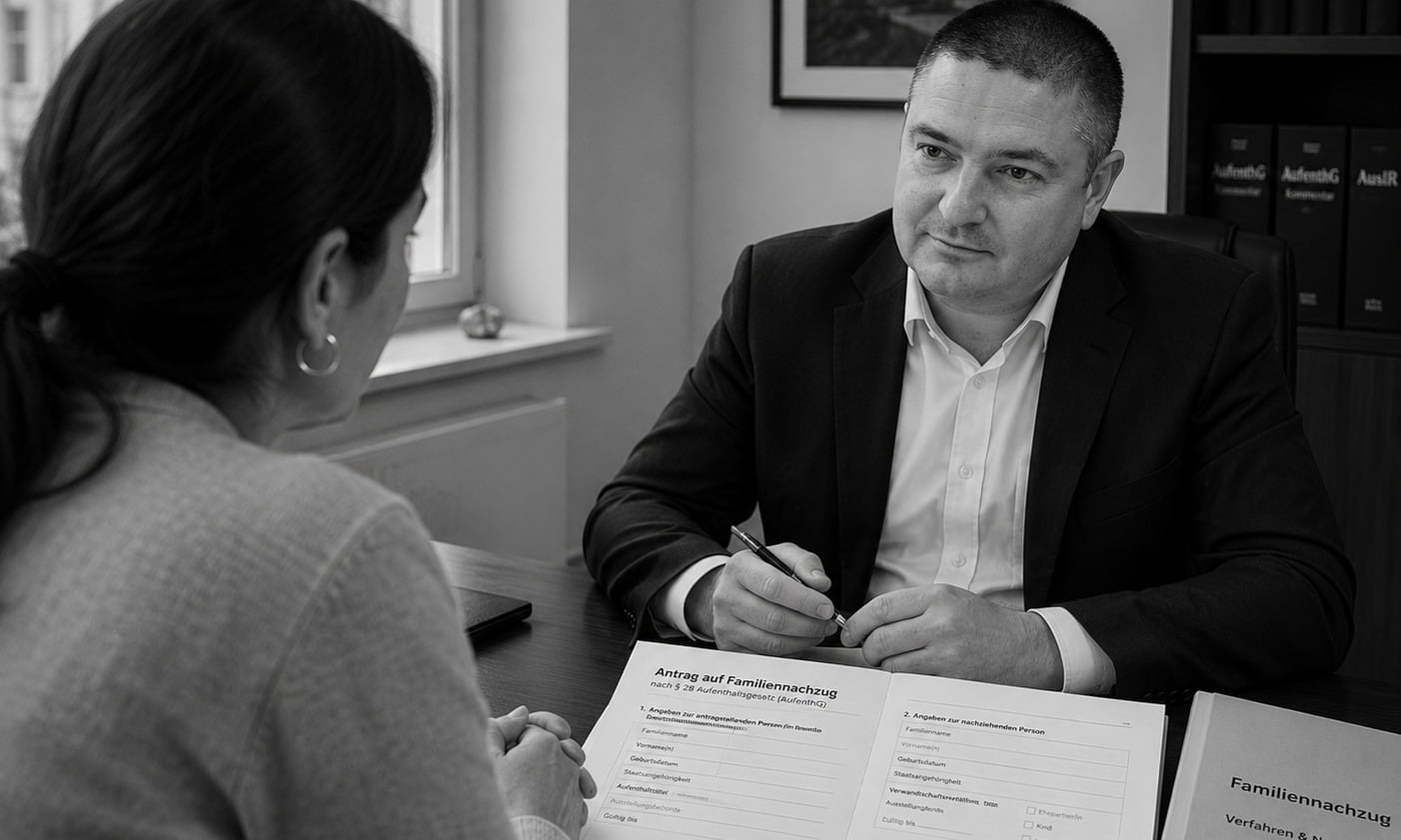
Family reunification means keeping a family together when members are separated across borders under German residency law. The husband lives in Munich with a residence permit, while the wife and children wait in Istanbul, Damascus, Kyiv, or São Paulo for their appointment at the diplomatic mission abroad. The son has been studying at TUM for three years and wants to bring his mother over from Algeria because she is in need of care. The Ukrainian client has a German passport—and her sister has been waiting 18 months for a family reunification visa. At KLAMERT & PARTNER, we have been providing legal advice since 1987—as attorneys specializing in family reunification in Munich, we assist with spousal reunification, parental and child reunification, family reunification with German citizens and third-country nationals, the visa application process at German diplomatic missions abroad, and the submission of applications to the Munich Foreigners’ Registration Office. Languages: German, English, Ukrainian, Russian, Portuguese—through our attorney Denys Osypenko, we offer preliminary consultations in Ukrainian and Russian; the legal representation is handled by the licensed attorneys Markus Klamert, Marc Frey, and Johannes Goetz. Initial assessment is free of charge.
When do you need a lawyer specializing in family reunification in Munich?
The family reunification process in Munich is handled in parallel by two agencies: The German diplomatic mission in the home country of the family member seeking to join their relatives handles the visa application, while the Munich Foreigners’ Registration Office (KVR, Ruppertstraße 19) decides on the residence permit in consultation with the diplomatic mission. Family reunification is therefore, legally speaking, a two-part process—and this is precisely where it most often fails. A missing apostille on the Turkish marriage certificate, an unrecognized A1 language certificate from Beirut, or insufficient proof of financial means—each of these details delays family reunification by months, sometimes years.
As attorneys specializing in family reunification in Munich, we see three typical areas where we can assist: First, before filing the application—strategy, documentation, proof of financial support, and integration with the current residence permit of the family member already living in Germany. Second, during the ongoing proceedings—responding to additional requests from the diplomatic mission, obtaining prior approval from the Munich Foreigners’ Registration Office, and filing a lawsuit for inaction in cases of excessive processing times. Third, after a rejection—filing a formal complaint with the diplomatic mission, filing a lawsuit in the Berlin Administrative Court (which has local jurisdiction over visa-related lawsuits against diplomatic missions) or in the Munich Administrative Court against the Munich Foreigners’ Registration Office.
Family reunification in Munich also has a few local peculiarities that often take clients by surprise when they proceed without legal representation. The Munich Foreigners’ Registration Office strictly reviews financial means—given that rent in Munich is significantly higher than the national average, disposable income after rent is often assessed as lower than in other cities. When it comes to proof of language proficiency, certain certificates are consistently required, while others are rejected. We are familiar with these peculiarities and tailor the application accordingly from the very beginning.
FROM OUR PRACTICE – OBSERVATIONS AT THE MUNICH IMMIGRATION OFFICE
At the Munich Foreigners’ Registration Office (KVR, Ruppertstraße 19), we see a recurring pattern when it comes to family reunification: The Foreigners’ Registration Office grants preliminary approval to the German diplomatic mission in the home country—and this preliminary approval hinges precisely on proof of sufficient means of support. For clients in Munich with standard salaried incomes (nurses, tech workers, restaurant staff), the funds available for family reunification are often just barely insufficient after deducting their Munich rent. From our experience: Those who document their ability to support themselves over a 12-month period using guarantees, a housing eligibility certificate, supplemental health insurance, and a clear trail of supporting documents receive preliminary approval significantly more often and more quickly. We had to anonymize the case—§ 6 BORA, as amended—but the logic behind it is still clear: Family reunification in Munich stands or falls on the ability to support oneself.
Typical issues that clients bring to us regarding family reunification in Munich:
- My husband has been living in Munich for three years with a settlement permit —when can I come to join him under the family reunification program?
- We got married in Istanbul, and the German consulate requires an apostille—how do I go about getting one?
- My spouse visa application was denied due to the lack of an A1 certificate—is there any chance of appealing the decision?
- My child from my first marriage lives in São Paulo and is 16 years old—can I bring him or her to Germany under the family reunification program?
- My mother is 72, lives in Kharkiv, and is increasingly in need of care—is it possible to bring her to Germany under Section 36 of the Residence Act?
- My application for family reunification has been pending at the German consulate for 14 months—can I file a lawsuit for failure to act?
- I have subsidiary protection and would like to bring my wife here—do I qualify for the simplified family reunification process?
“In family reunification cases, it’s rarely substantive law that determines the outcome—it’s almost always the paperwork. Anyone who files an application for family reunification has to deal with two agencies at the same time—the German diplomatic mission in their home country and the Munich Foreigners’ Registration Office. Both operate independently, both have their own processing procedures, and both send documents back and forth that clients often don’t even know exist. This is exactly where the family reunification attorney comes in—we know the chain of authorities and make sure nothing gets lost.”
— Markus Klamert, attorney and founder of KLAMERT & PARTNER
Requirements for Family Reunification — Overview of Sections 27 et seq. of the Residence Act (AufenthG)
The requirements for family reunification are governed by Sections 27 et seq. of the Residence Act (AufenthG). The law distinguishes based on the type of family member (spouse, child, parent), the type of residence permit held by the person already living in Germany (settlement permit, residence permit, asylum status, German citizenship), and the need for protection. The combination of these three factors results in a range of very different pathways—as attorneys specializing in family reunification in Munich, we determine which pathway is appropriate for each individual case during a free initial consultation.
General Requirements (Section 27 of the Residence Act)
Three requirements apply to every family reunification case in Munich: First, the ability to support oneself without relying on public funds—the family member living in Germany must be able to support his or her family on his or her own. Second, adequate living space in accordance with the standards of Munich’s Minimum Living Space Ordinance. Third, there must be no grounds for deportation and no threat to the free democratic basic order. These requirements form the basis—special circumstances may modify them.
Securing a livelihood
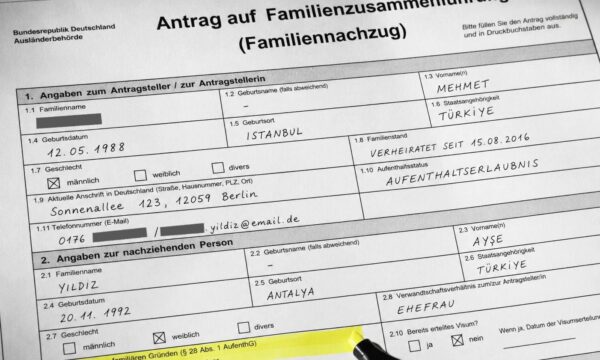
The family’s livelihood must be secured for the entire family, including the family member joining them. In practical terms, this means that the net income of the person living in Germany—after deducting rent, health insurance, and debt obligations—must exceed the basic income rate for all family members. With rent in Munich ranging from €1,400 to €2,000 (including utilities) for a three-bedroom apartment, this will be a tight fit for many families. We compile the proof of means using pay stubs from the last twelve months, tax assessment notices, the lease agreement, and health insurance confirmation—for self-employed individuals, we use business income statements and tax assessment notices from the last three years.
Adequate living space
In Munich, the standard requirement is 12 square meters of living space per family member over the age of six, and 6 square meters per child under the age of six. A three-room apartment measuring 75 m² is usually sufficient for a family of four. We will have the landlord or property management company provide a certificate of living space if the visa application process requires it.
A1 Language Proficiency Certificate for Spouses
In the case of spousal reunification, the spouse seeking to join their partner must generally demonstrate basic German language proficiency at the A1 level—through a certificate from the Goethe-Institut or other recognized testing centers. Exceptions apply to spouses of highly qualified individuals (Blue Card holders), Canadian, U.S., Israeli, Japanese, and certain other nationals, as well as in cases where language acquisition is unreasonable due to illness or age. We assess on a case-by-case basis whether the language requirement applies or whether an exception is warranted.
Request a free initial assessment
Tell us about your case—quickly and with no obligation. We’ll assess your chances of success and get back to you shortly.
or call us directly at: 089 540 239 0
Spousal Reunification — The Most Common Scenario
Spousal reunification is the most common reason for seeking legal advice regarding family reunification in Munich. Lawyers specializing in family reunification in Munich handle these cases practically every week. The situation is almost always the same: one spouse lives in Germany with a residence permit or a settlement permit; the other is waiting in their home country for a family reunification visa. Processing times at German diplomatic missions abroad have varied significantly for years—ranging from a few months at some locations to as long as two years at heavily trafficked missions.
Spousal Reunification for Third-Country Nationals with a Residence Permit (Section 30 of the Residence Act)
Standard Path: A third-country national living in Germany holds a residence permit (temporary status). The requirements are the general criteria set forth in § 27 of the Residence Act (AufenthG)—means of support, housing, and no interest in deportation—plus proof of A1 language proficiency and, as a rule, a minimum two-year period of residence in Germany by the principal applicant. For highly qualified individuals (Blue Card), the waiting period and, in some cases, the language requirement are waived—this is relevant for many tech employees at corporations in Munich.
Spousal Reunification for Holders of Permanent Residence Permits
If the principal applicant holds a settlement permit (indefinite), spousal reunification applies without a waiting period. The A1 language requirement remains in effect—with the exceptions mentioned. In practice, this offers a significant time advantage for family reunification in Munich; we recommend that clients who frequently use our services have their own residence permit converted to a settlement permit before applying for spousal reunification, provided the requirements are met.
Spousal Reunification with German Citizens (Section 28 of the Residence Act)
Spouses of German citizens are eligible for a simplified family reunification process. The waiting period is waived entirely, though proof of A1-level language proficiency remains required in principle. After three years of residence and two years of marriage, the reunited spouse may apply for naturalization (Section 9 of the German Nationality Act [StAG])—a path that we plan for from the outset for many binational families in Munich as part of the family reunification process.
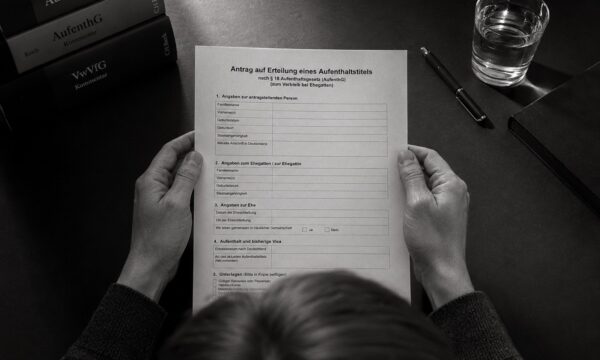
Spousal Reunification with EU Citizens
For spouses of EU citizens, the Residence Act (AufenthG) does not apply; instead, the Freedom of Movement Act (FreizügG/EU) applies. The requirements are more lenient: no A1 language proficiency certificate is required, no proof of sufficient means of support in the strict sense is required, and the procedures are streamlined. We frequently handle these cases for clients in Munich who are married to Italian, Spanish, French, or Polish spouses.
FROM OUR PRACTICE – THE A1 CERTIFICATE FOR SPOUSAL RELOCATION
The A1 language proficiency requirement is the most common stumbling block we encounter during consultations regarding spousal reunification. The German consulate accepts Goethe Institute certificates, telc certificates, and ÖSD certificates—but other providers are generally not accepted. For clients from countries where there is no Goethe Institute, the A1 requirement becomes a logistical challenge. In such situations, we provide early guidance: Which testing center is recognized, which test dates are available, and whether an exception clause (illness, age, Canadian/U.S./Israeli/Japanese citizenship) applies. Those who have their A1 certificate reviewed by an attorney—without obligation—before filing an application typically save at least three months in processing time.
Family Reunification — Minor and Adult Children
The reunification of children with their parents is governed by Section 32 of the Residence Act (AufenthG) and is a very common scenario in family reunification cases in Munich. Unlike in the case of spousal reunification, the following applies here: Both parents must either already be living in Germany, or the parent with sole custody must be living in Germany—or it must be unreasonable, for humanitarian reasons, to leave the child with the other parent in the home country.
Minors up to age 16
For minor children up to the age of 16, family reunification is the norm, provided that both parents (or the sole custodial parent) live in Germany. Proof of language proficiency is not required. Important: The residence permit for the child joining the family is generally granted for the duration of the parents’ residence permit—if the parents’ permit is extended, the child’s permit is also extended.
Minors between the ages of 16 and 18
For children between the ages of 16 and 18, an additional assessment is conducted to determine whether the child is proficient in German or has a positive integration prognosis—otherwise, family reunification is only possible if it is warranted on humanitarian grounds. This scenario is often the most challenging path in Munich’s family reunification process—in such cases, we prepare a justification supported by school transcripts, language certificates, and an integration prognosis.
Adult Children — The Narrow Exception
As a rule, adult children cannot be brought to Germany under the family reunification program. An exception applies only if family reunification is indispensable due to exceptional hardship (Section 36(2) of the Residence Act). In practice, very strict criteria are applied here—the need for care with no other means of support, serious illness, or social isolation. We assess the merits of the case during the initial evaluation; there is no one-size-fits-all assessment here.
Adopted Children and Stepchildren
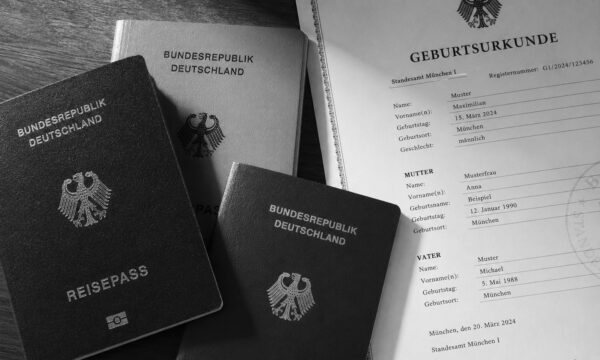
Adopted children are generally treated the same as biological children—provided the adoption is recognized in Germany. In the case of stepchildren (children of a spouse from a previous relationship), family reunification is possible if both parents consent or if German custody arrangements are structured accordingly. We regularly assist with these situations in blended families resulting from German-international marriages in Munich.
Request a free initial assessment
Tell us about your case—quickly and with no obligation. We’ll assess your chances of success and get back to you shortly.
or call us directly at: 089 540 239 0
Parental Reunification — The Strict Requirements of Section 36 of the Residence Act
For parents seeking to join their children in Germany, this is by far the most difficult route to take under the family reunification program in Munich. Section 36 of the Residence Act (AufenthG) permits it only if family reunification is “necessary to avoid exceptional hardship.” In practice, this means that parents are generally allowed to join their children in Germany only if they require long-term care and adequate care is no longer available in their home country.
When does a situation constitute exceptional hardship?
Case law requires a serious need for care, a lack of care options in the home country (no other relatives, no reasonable care facilities), and, as a rule, social isolation. A general longing for family is not sufficient—nor is the desire of a child living in Germany to have their parents nearby. We prepare applications using medical certificates, care assessments, social assessments, and, if necessary, reports from social services in the home country.
Parents from EU countries
The situation is different if the parents themselves are EU citizens. In this case, the Freedom of Movement Act applies: Parents may join EU citizens who are working or studying in Munich if their livelihood is secured by the child. We regularly assist with family reunification for Italian, Polish, Romanian, and other EU parents—the process is significantly less restrictive than the third-country route under Section 36 of the Residence Act (AufenthG).
Parents of minor children with German passports
An important special case: If a minor child holds German citizenship and the non-German parent lives abroad, parental reunification may be possible under Section 28(1)(3) of the Residence Act (AufenthG) for the purpose of exercising parental custody. This scenario is commonly relevant in Munich in cases of family reunification involving German-foreign parents who have separated—we prepare the application with proof of custody and, if applicable, visitation agreements.
Family Reunification Visa — Procedures at German Diplomatic Missions Abroad
The family reunification visa is applied for at the German diplomatic mission in the home country of the family member seeking to join the family—either the embassy or the consulate general. The process consists of four phases: scheduling an appointment online, submitting documents in person, obtaining preliminary approval from the Munich Foreigners’ Registration Office (KVR Munich, Ruppertstraße 19), and visa issuance. Each phase has its own challenges—as attorneys specializing in family reunification in Munich, we guide you through every single step.
Online Appointment Scheduling — The First Bottleneck
At many German diplomatic missions abroad, scheduling appointments has been the real bottleneck for years. Appointments at the Embassy in Beirut, the Consulate General in Istanbul, and the consulates in India, Egypt, and Morocco are often booked up for twelve months in advance. Our recommendation: Book an appointment immediately as soon as the person living in Germany has their residence permit—even if the requirement to demonstrate sufficient means of support has not yet been fully met. You won’t get that waiting time back, but you can continue to build up your means of support in the meantime.
In-person appointment and documents
When applying in person, the applicant submits the complete set of documents: passport, birth certificate, marriage certificate (with apostille and translation), language certificate, proof of the principal applicant’s financial means in Germany, lease agreement, and health insurance confirmation. The diplomatic mission scans the documents, performs a formal review, and forwards them via the Federal Foreign Office to the Munich Foreigners’ Registration Office for preliminary approval.
Prior Approval from the Munich Foreigners' Registration Office
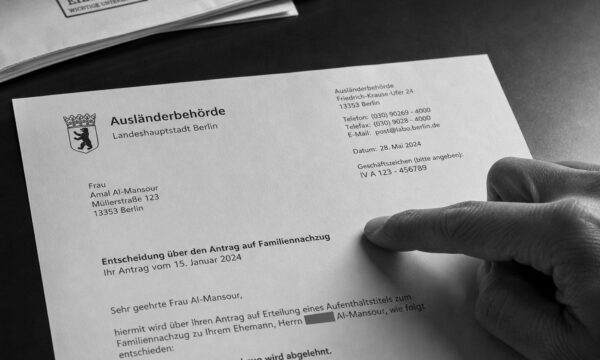
The KVR Munich (Ruppertstraße 19) reviews the German requirements—means of support, housing, and grounds for deportation. This phase typically takes two to four months. If the applicant’s means of support are insufficient, an interim inquiry is sent; if the application is denied, a notice of denial is sent to the diplomatic mission abroad. During this phase, we can communicate directly with the KVR Munich and respond to requests for additional information immediately—without a lawyer, all communication must go through the diplomatic mission, which takes significantly longer.
Visa Issuance and Entry
After receiving preliminary approval, the diplomatic mission issues a national visa (D visa) valid for 90 days for entry into the country. After entering the country, the family member joining the family must apply for a residence permit at the KVR in Munich within 90 days. We prepare the appointment in Munich and assist with the application process—precisely because many clients are overwhelmed by the language, bureaucracy, and their new living situation immediately after arrival.
FROM OUR PRACTICE – GERMAN DIPLOMATIC MISSIONS ABROAD IN FAMILY REUNIFICATION CASES
We correspond regularly with German diplomatic missions abroad—the processing times at embassies and consulates vary greatly. Applications in Latin America are often decided within three to six months; applications in Turkey, Lebanon, and North Africa frequently take twelve to 24 months. From our experience: Sending a letter from an attorney to the diplomatic mission that outlines the specific facts of the case and sets a deadline often speeds up the process in many situations—not because the mission works faster, but because inquiries are formally and clearly resolved and do not get lost in the system. We had to anonymize the case—§ 6 BORA (as amended)—but the logic behind it shows that correspondence with German diplomatic missions abroad is a craft in its own right when it comes to family reunification.
“My favorite line in the family reunification case: ‘But we already had that appointment six months ago.’ That’s exactly where the problem lies. The appointments at the diplomatic mission are just the beginning—after that, the process goes through the German immigration office, the Federal Foreign Office, and back again. Family reunification in Munich isn’t just that one appointment at the embassy; it’s a chain of four to six administrative steps. Anyone unfamiliar with this chain loses time at every step. That’s exactly what we make transparent—step by step.”
— Marc Frey, Attorney at Law, specializing in contract and property law (with experience in administrative law, particularly immigration law)
Family Reunification for Refugees and Persons Entitled to Protection
Family reunification for refugees is governed by its own rules. Persons entitled to asylum (Art. 16a of the Basic Law), recognized refugees (Section 3 of the Asylum Act), and resettlement refugees have a preferential right to family reunification—Section 29(2) of the Residence Act. In contrast, persons entitled to subsidiary protection (Section 4 of the Asylum Act) long had a limited right to family reunification; since the legislative changes of recent years, family reunification has also been possible in these cases, but it is subject to a quota.
Priority Family Reunification for Those Granted Asylum or Recognized as Refugees
For individuals entitled to asylum and recognized refugees, proof of language proficiency and proof of sufficient means of support are not required. The following are required: a marriage that existed prior to the recognition of protection status (or the birth of their children together), and submission of the application within three months of recognition. This three-month deadline is strict—anyone who misses it loses this preferential treatment and reverts to the standard family reunification process with all its requirements. We actively remind clients of this deadline in every case involving asylum.
Subsidiary Protection and Quota
Persons entitled to subsidiary protection may apply for family reunification under Section 36a of the Residence Act (AufenthG) based on a monthly quota of 1,000 visas. Selection is based on humanitarian criteria—severe physical or mental illness, danger to life or limb in the home country, or a long period of separation. We prepare applications that include medical reports and situation assessments regarding the home country; the prospects for approval depend heavily on the documented hardship.
Family Reunification from Ukraine
Ukrainian beneficiaries of protection with residence status under Section 24 of the Residence Act (AufenthG) have special status. Family reunification does not follow the asylum process but rather the regular right of residence—with all associated requirements, including means of support and housing. For clients who have been living in Munich since February 2022, we are reviewing the transition to a settlement permit and, in parallel, the process for family reunification. Ukrainian- and Russian-language consultations are provided by our legal advisor Denys Osypenko, and legal representation is handled by our licensed attorneys.
Request a free initial assessment
Tell us about your case—quickly and with no obligation. We’ll assess your chances of success and get back to you shortly.
or call us directly at: 089 540 239 0
Costs of Family Reunification — Attorney's Fees, Court Fees, Living Expenses
The costs of family reunification in Munich consist of three components: attorney fees (if an attorney is retained), government fees, and the recurring cost of proving the ability to support oneself. Anyone who Googles “family reunification attorney fees” is usually looking for the first figure—and we provide that transparently.
Attorney Fees for Family Reunification
Attorney fees are based on the RVG fee schedule, calculated according to the value in dispute (typically €5,000 to €10,000 for family reunification cases), or on an individual fee agreement. In practice, legal fees for a standard family reunification case without litigation typically fall in the low four-digit range, broken down into the initial consultation, preparation of the application, and correspondence with the diplomatic mission abroad and the Munich Foreigners’ Registration Office. If a visa appeal or lawsuit is filed with the Administrative Court, additional court fees apply. A free initial assessment at KLAMERT & PARTNER is standard—you’ll know what total costs to expect before retaining our services.
Government fees
Visa fee at a German diplomatic mission abroad: currently €75 for adults, €37.50 for children. Residence permit from the Munich Foreigners’ Registration Office after entry: between €80 and €110, depending on the purpose and duration of stay. Translation and apostille fees vary widely depending on the country of origin—from €50 to several hundred euros per document.
Who Pays for Family Reunification? Declaration of Financial Responsibility
One of the most common questions clients ask is: “Who pays for family reunification?” The legal answer is clear: the principal applicant living in Germany. He or she submits a declaration of financial responsibility to cover living expenses—which includes medical treatment, living expenses, and, if necessary, repatriation costs. If the principal applicant’s own income is insufficient, declarations of financial responsibility from third parties (family members in Germany with higher incomes) may be submitted. For beneficiaries of subsidiary protection and those granted asylum, the declaration of financial responsibility is not required—the state assumes the obligation to provide for their livelihood.
Consultations in Ukrainian and Russian — Denys Osypenko
At KLAMERT & PARTNER, we have Denys Osypenko, a lawyer at our firm who assists clients in Ukrainian and Russian. Denys Osypenko is a trained lawyer with ties to Ukraine; he is not a licensed attorney under German law at our firm—the legal handling of Ukrainian- or Russian-language family reunification cases is handled by the licensed attorneys Markus Klamert, Marc Frey, and Johannes Goetz. Denys Osypenko serves as a linguistic and cultural bridge: he explains German residency law in the clients’ native languages, translates documents from their home countries and official correspondence, clarifies any questions, and prepares correspondence with the German diplomatic missions in Kyiv or Moscow.
This results in a practical advantage for family reunification cases in Munich. Ukrainian clients who have been living in Germany since February 2022 with a residence permit under Section 24 of the Residence Act (AufenthG) frequently seek family reunification with parents, siblings, or in-laws. In these cases, the need to navigate both German residence law and Ukrainian national law is crucial. Russian-speaking clients often come from several countries—Russia, Belarus, Kazakhstan, Uzbekistan, and Israel—and consequently have different home-country documents and family circumstances. Here, too, the linguistic bridge is crucial, because the family reunification process cannot proceed without precise translations of the home-country documents.
Here’s how it works: You describe your case to us in Ukrainian or Russian—either by phone or during an initial consultation at Heimeranstraße 37. Denys Osypenko translates and handles the initial legal preparations. One of our licensed attorneys takes over responsibility for your case; for family reunification cases, this is typically Markus Klamert or Marc Frey. Letters to the German diplomatic mission abroad, the Munich Foreigners’ Registration Office, and all legal documents are signed by a licensed attorney. Language support doesn’t solve every individual case—but it ensures that nothing falls through due to translation issues and that you understand what your attorney is doing.
Request a free initial assessment
Tell us about your case—quickly and with no obligation. We’ll assess your chances of success and get back to you shortly.
or call us directly at: 089 540 239 0
How Your Family Reunification Attorney in Munich Works—Four Steps
1. Free initial assessment within 24 hours
Please describe your situation to us—via the contact form, by phone, or in person at Heimeranstraße 37. Languages: German, English, Ukrainian, Russian, Portuguese. We’ll get back to you within one business day with an initial assessment of your situation: Which route—spousal reunification, child reunification, parental reunification, or EU family reunification—is right for your situation, which requirements are met, and what documents are needed. There are no costs for you at this stage.
2. Strategy and Application Preparation
Once you’ve retained our services, we’ll work together to gather the documents needed for family reunification in Munich: documents from your home country with an apostille, a marriage certificate with a translation, an A1 language certificate, proof of the primary applicant’s ability to support the family, a lease agreement, and proof of health insurance. We carefully draft the declaration of support, verify the income limits for proof of sufficient means, and—if necessary—prepare third-party guarantees. This phase takes two to eight weeks, depending on how complete the documents are.
3. Correspondence with the diplomatic mission and the Munich Foreigners' Registration Office
We assist you with your appointment at the German diplomatic mission abroad—preparing you for what to do during the interview and then corresponding directly with the Munich Foreigners’ Registration Office afterward. If additional documentation is requested, we respond within a few days; if the process takes too long, we consider filing an action for failure to act with the Berlin Administrative Court (for diplomatic missions abroad) or the Munich Administrative Court (for the Munich Foreigners’ Registration Office). If a visa is denied, we file an appeal or a lawsuit.
4. Arrival in Munich and Residence Permit
Once the visa has been issued and the applicant has entered the country, we assist with the appointment at the KVR in Munich to apply for a residence permit. As attorneys specializing in family reunification in Munich, we prepare the following subsequent cases: family reunification for additional family members, a settlement permit after three or five years, and, if applicable, naturalization under § 9 or § 10 of the German Nationality Act (StAG). For us, family reunification in Munich does not end with the visa, but rather with the residence permit and the long-term family reunification in the city.
Frequently Asked Questions About Family Reunification in Munich
How much does a family reunification lawyer cost in Munich?
The initial assessment at KLAMERT & PARTNER is free of charge. Any further consultation takes place after you retain our services—either based on RVG fees calculated according to the value of the matter (typically €5,000 to €10,000 for family reunification cases) or according to an individual fee agreement. Separate procedural fees apply in the event of a visa appeal or lawsuit. If you have legal expense insurance that includes administrative law coverage, we will handle the coverage inquiry for you. Good to know: For a standard family reunification case without litigation, attorney’s fees are typically in the low four-digit range.
What is family reunification?
Family reunification refers to the immigration process whereby a family member of a foreign national or German citizen living in Germany enters Germany from abroad and receives a residence permit for the purpose of family reunification. Family reunification is governed by Sections 27 et seq. of the Residence Act (AufenthG). In practice, it encompasses the reunification of spouses, children, and parents, as well as the reunification of other family members in cases of hardship.
Who is eligible to come to Germany under the family reunification program?
Spouses and registered domestic partners, minor children, and—in very limited exceptional cases—parents of minor German children or parents from abroad who require long-term care (exceptional hardship pursuant to Section 36 of the Residence Act). Adult children, siblings, and other relatives generally cannot be brought to Germany through family reunification—unless exceptional hardship justifies their reunification.
Who pays for family reunification?
The principal applicant residing in Germany. He or she submits a declaration of financial responsibility covering living expenses, medical treatment, and repatriation costs. If the applicant’s income is insufficient, third-party guarantees (from family members in Germany with higher incomes) may be provided. For individuals granted asylum and resettled refugees, the declaration of financial responsibility is not required—the state assumes the obligation to provide for their living expenses.
How long does it currently take for family members to join a relative in Munich?
This depends heavily on the home country and its diplomatic mission abroad. At German diplomatic missions in Latin America and Western Europe, the wait is typically three to six months from the appointment date. At heavily trafficked missions—Turkey, Lebanon, India, Egypt, and North Africa—the wait is twelve to 24 months. Added to this is the processing time at the Munich Foreigners’ Registration Office for preliminary approval, which takes two to four months. Those who wish to expedite their family reunification process in Munich have two options: first, preparing a complete application with no requests for additional documentation; second, filing a lawsuit for failure to act in cases of clearly excessive processing times.
What are the requirements for spousal reunification?
General requirements: secure means of support, adequate living space, no grounds for deportation (Section 27 of the Residence Act). Specifically for spousal reunification: A1 language proficiency certificate; generally, a minimum two-year period of residence in Germany by the principal applicant (waived for holders of a settlement permit and for highly qualified individuals/Blue Card holders); valid marriage with a recognized marriage certificate. For spouses of German citizens, the simplified family reunification process applies without a waiting period (Section 28 of the Residence Act).
What documents do I need for family reunification?
Passport and birth certificate of the family member seeking to join the sponsor (with an apostille and translation), marriage certificate (for spousal reunification), A1 language certificate (for spousal reunification), proof of financial means for the principal applicant in Germany (12 months of pay stubs, tax assessment notice, employment contract), lease agreement with confirmation of living space, health insurance confirmation, police clearance certificate from the home country, and, if applicable, medical certificates or proof of custody. Free consultation during the initial assessment—we’ll determine what’s required in each individual case.
How can I bring my mother (or father) to Germany?
Parental reunification under Section 36 of the Residence Act (AufenthG) is strictly limited—it is permitted only in cases of exceptional hardship (in particular, a severe need for care that cannot be met in the home country). The situation is different for EU parents (Freedom of Movement Act, which is significantly more generous) and for parents of minor German children (Section 28(1)(3) of the Residence Act, duty of care). We assess the merits of the case in our initial evaluation—there is no blanket assessment for parental reunification.
My visa application for family reunification was denied—what can I do?
Two options: First, file a formal objection with the German diplomatic mission abroad—an informal appeal within one month that substantively challenges the grounds for the denial. Second, file a lawsuit with the Berlin Administrative Court, which has local jurisdiction over visa-related lawsuits against German diplomatic missions abroad. The deadline for filing a lawsuit is one month from the date the denial was notified. We will review the decision and develop a strategy—in many cases, the grounds for rejection can be challenged on procedural or substantive grounds.
Where is the Munich Foreigners' Registration Office for family reunification located?
The Munich Foreigners’ Registration Office is part of the District Administrative Office—KVR Munich for short—and is located at Ruppertstraße 19, 80466 Munich. It is accessible by subway (U3/U6 Implerstraße). Applications for a residence permit after entry into the country must be submitted by appointment. The KVR Munich is easily accessible by subway from our law office at Heimeranstraße 37.
Family Reunification and Residence Permit — What Does That Mean?
If the principal applicant holds a settlement permit (permanent residence permit) in Germany, the waiting period for spousal reunification does not apply. The settlement permit is therefore the fastest route to family reunification. Third-country nationals who still hold a residence permit should check, before applying for family reunification, whether the requirements for converting it to a settlement permit have already been met—we regularly handle this review in parallel at the Immigration Law Hub.
Is there a special provision for Ukrainian families?
Ukrainians with protected status under Section 24 of the Residence Act (AufenthG) are subject to the regular family reunification process—with all the requirements, including proof of financial means and housing. Special privileges, such as those granted to asylum seekers, do not apply. In practice, we recommend that our Ukrainian clients in Munich simultaneously pursue the transition to a settlement permit and prepare for family reunification. Ukrainian- and Russian-language consultations are provided by our legal advisor Denys Osypenko, and legal representation is handled by our licensed attorneys.
Free Initial Consultation with Your Family Reunification Attorney
Describe your situation to us in two to three sentences—we’ll review, with no obligation, which path to family reunification is right for you, which requirements are met, and what the next logical steps would be. Contact us online via our contact form, by phone at 089 540 239 0, or in person at Heimeranstraße 37 in Munich. Languages: German, English, Ukrainian, Russian, Portuguese. If you’re subject to the ongoing three-month deadline in the context of asylum, have had a visa application denied with a deadline for filing an appeal (only one month!), or have an urgent spousal reunification deadline, we’ll get back to you within one business day. At KLAMERT & PARTNER, family reunification in Munich is part of our Immigration Law Hub—the partners responsible for family reunification are Markus Klamert, Marc Frey, and Johannes Goetz. Initial consultations in Ukrainian and Russian are provided by our legal advisor Denys Osypenko; legal representation is handled by our licensed attorneys.