Fachkräfte-einwanderung (FEG 2.0)
in München
Select your preferred language

Fachkräfteeinwanderung bedeutet, internationale Talente nach Deutschland zu holen — und die Hürden des deutschen Aufenthaltsrechts so zu organisieren, dass aus einem Job-Angebot in München kein zwölfmonatiges Visumsverfahren wird. Die indische Software-Entwicklerin, die ab Herbst bei einem Münchner DAX-Konzern anfangen soll. Der brasilianische Maschinenbauer mit Job-Angebot in Garching. Die ukrainische Krankenpflegerin, die unter §24 AufenthG in München lebt und nun in einen regulären Aufenthaltstitel zur Erwerbstätigkeit wechseln will. Die Personalabteilung, die ihren neuen Senior Manager binnen acht Wochen einreisefertig haben muss. Bei KLAMERT & PARTNER beraten wir seit 1987 — als Anwalt für Fachkräfteeinwanderung in München begleiten wir die Blue Card EU, die Chancenkarte nach § 20a AufenthG, das beschleunigte Fachkräfteverfahren am KVR München, die Anerkennung ausländischer Berufsqualifikationen, den Statuswechsel und die Niederlassungserlaubnis nach § 18c AufenthG. Sprachzugang Deutsch, Englisch, Ukrainisch, Russisch, Portugiesisch — über unseren Juristen Denys Osypenko bieten wir die ukrainisch- und russischsprachige Vorberatung; die juristische Mandatsbearbeitung übernehmen die zugelassenen Rechtsanwälte Markus Klamert, Marc Frey und Johannes Goetz. Erste Einschätzung kostenfrei.
When do you need a lawyer specializing in skilled worker immigration in Munich?
The skilled worker immigration process in Munich is handled in parallel by three agencies: The German diplomatic mission in the home country of the skilled worker applicant reviews the visa application; the Munich Foreigners’ Registration Office (KVR, Ruppertstraße 11) issues the residence permit after entry; and the Central Foreign Placement Office of the Federal Employment Agency (ZAV Munich, Kapuzinerstraße 26) provides approval under labor market law behind the scenes. This is precisely where skilled worker immigration most often fails: not because of the law, but because of the procedure. A missing apostille on an Indian college transcript, a degree program not registered in the Anabin system, an employment contract whose salary structure does not clearly meet the EU Blue Card threshold—each of these details delays skilled worker immigration by months.
As attorneys specializing in skilled worker immigration in Munich, we see three typical areas of focus: First, prior to filing the application—choosing between the EU Blue Card, Sections 18a, 18b, and 19c of the Residence Act (AufenthG), or the Opportunity Card; conducting an Anabin check; and drafting contracts with an eye toward salary thresholds. Second, during the ongoing proceedings—applying for preliminary approval in the expedited skilled worker procedure with the Munich Regional Foreigners’ Office (KVR), responding to additional requests, and coordinating with the Central Employment Agency (ZAV). Third, following a rejection—filing a protest with the diplomatic mission, filing a lawsuit at the Berlin Administrative Court (which has local jurisdiction over visa lawsuits against diplomatic missions) or at the Munich Administrative Court against the Foreigners’ Office.
The skilled worker immigration process in Munich also has certain peculiarities that often catch clients off guard if they do not have legal representation. The Munich KVR generally processes applications under the expedited procedure more quickly than smaller immigration authorities—provided the documentation is complete. The ZAV applies its own assessment criteria for work permit approval, which differ, for example, for entry-level professionals and in shortage occupations. We are familiar with these peculiarities and tailor the application accordingly from the very beginning.
FROM OUR PRACTICE – OBSERVATIONS AT THE MUNICH REGIONAL HEALTH AUTHORITY (KVR) REGARDING THE ACCELERATED PROCEDURE FOR QUALIFIED PROFESSIONALS
At the Munich District Administrative Office (KVR, Ruppertstraße 11), we observe a recurring pattern regarding skilled worker immigration: Applications filed under the expedited procedure pursuant to Section 81a of the Residence Act (AufenthG) are processed within six to ten weeks—provided the documentation is complete upon receipt. If the documentation is incomplete, an interim request for additional information is issued, and the process is extended by six to twelve weeks for each request for additional documentation. From our practice: In a recent case involving an Indian software developer who was set to start at a Munich-based corporation, we saved approximately eight weeks compared to the originally planned standard procedure by thoroughly preparing the application package—including an Anabin transcript, an apostille on the diploma, certified translations, and detailed proof of salary. The corporation was able to meet the onboarding date.
We had to anonymize the case—§ 6 BORA (as amended)—but the logic behind it is still clear: The success of skilled worker immigration in Munich depends entirely on how well the application package is prepared.
Common issues that clients bring to us at Skilled Worker Immigration Munich:
- My new employee from Bangalore is scheduled to start in 90 days—how do I go about the expedited skilled worker procedure at the Munich Regional Foreigners’ Office?
- My college degree from São Paulo isn't listed in Anabin—can I still apply for an EU Blue Card?
- I have a job offer with an annual salary of 52,000 euros as an entry-level IT professional—is that enough to qualify for the EU Blue Card?
- We would like to transfer our senior manager from New York to Munich on an ICT visa for 18 months—what is the fastest way to do this?
- Ich lebe seit Februar 2022 mit § 24 AufenthG in München, habe gerade einen Arbeitsvertrag bekommen — wie wechsle ich in Blue Card EU oder § 18b AufenthG?
- Mein Antrag wartet seit fünf Monaten an der deutschen Botschaft in Manila — kann ich Untätigkeitsklage erheben?
- I have three years of professional experience as a nurse in Ukraine, but my qualifications aren't recognized in Germany—is the Chancenkarte right for me?
“In skilled worker immigration, it is rarely the substantive law that matters, but almost always the preparation of the documents. Those who submit an application under the expedited procedure have a clear advantage—provided the documents are complete upon receipt. Every week, we see corporate HR departments and individuals who have lost eight or twelve weeks because an apostille was missing or an Anabin entry was misunderstood. This is exactly where we come in as the immigration attorneys for skilled workers in Munich.”
— Markus Klamert, attorney and founder of KLAMERT & PARTNER
The Skilled Worker Immigration Act (FEG 2.0) — An Overview of the 2023/2024 Reform
The Skilled Immigration Act 2.0 (FEG 2.0) is the most significant labor market policy reform of the past two decades. It came into effect in three phases: the first phase on November 18, 2023, the second phase on March 1, 2024, and the third phase—the Opportunity Card—on June 1, 2024. The reform implements EU Directive 2021/1883 on the Blue Card and significantly expands national pathways beyond its scope. Anyone working on a residency application in 2026 that was initiated before 2023 must distinguish between the old and new laws—transitional provisions and grandfathering clauses play a significant role in practice.

The Three Pillars of the FEG Reform
First Pillar — Qualification Pillar: Recognized professional qualifications as a prerequisite for a residence permit for employment purposes. The recognition procedures have been simplified; a residence permit for the purpose of recognition can now be issued even from abroad (Section 16d of the Residence Act). In practice, this means that anyone with a foreign qualification can come to Germany to have it formally recognized here—and work at the same time.
Second Pillar — Experience-Based Pillar: For the first time, two years of relevant professional experience is sufficient as an entry requirement for many professions (vocational training in the home country plus experience), even without formal German recognition—provided that the residence permit is granted under Section 19c of the Residence Act. This is the route for nursing staff, IT specialists, and professional drivers who were trained in their home country but do not have a job profile that is directly recognized in Germany.
Third Pillar — Potential Pillar: The Opportunity Card (Section 20a of the Residence Act) allows, for the first time, a points-based residence permit for the purpose of job seeking—based on language skills, work experience, age, ties to Germany, and partner integration. The threshold is six points, granting a one-year residence permit without the requirement of a concrete job offer in the home country.
What made the reform even easier
- The salary threshold for the EU Blue Card has been significantly lowered—and further reduced for entry-level professionals and occupations facing labor shortages (IT, natural sciences, mathematics, engineering, and medicine).
- Familiennachzug für Schutzberechtigte und Fachkräfte vereinfacht — die Lebensunterhaltsklausel wurde gelockert. Bei Blue-Card-EU-Inhabern entfällt der A1-Sprachnachweis für nachziehende Ehepartner.
- Expedited Skilled Worker Procedure (Section 81a of the Residence Act) by the Munich Regional Immigration Office — Preliminary approval replaces a lengthy preliminary review.
- The recognition process may be conducted concurrently with the stay (Section 16d of the Residence Act).
- Specific pathways for nursing staff, IT professionals without formal qualifications, and professional drivers.
Important for counseling practice: The FEG Reform 2.0 has been implemented in phases—and transitional cases (applications filed under the old law that had not yet been decided upon when the reform took effect) are reviewed on a case-by-case basis. Before submitting any application, we assess whether the old or new rules are more favorable and choose the most advantageous option.
Request a free initial assessment
Tell us about your case—quickly and with no obligation. We’ll assess your chances of success and get back to you shortly.
or call us directly at: 089 540 239 0
EU Blue Card — the ideal solution for highly skilled professionals
The EU Blue Card (Blaue Karte EU) under Section 18g of the Residence Act is the most important residence permit for highly skilled professionals from third countries. It combines four advantages in a single document: a streamlined visa process, clear salary thresholds, simplified family reunification, and a faster path to a settlement permit under Section 18c of the Residence Act. Anyone coming to Munich as a software developer, engineer, doctor, or economist almost always arrives with an EU Blue Card. We handle the EU Blue Card as a central element of Munich’s skilled worker immigration process—from drafting the contract with the employer to the appointment at the KVR.
Requirements for the EU Blue Card
A university degree from a third country—either recognized or classified as equivalent in the Anabin database. A concrete job offer from a German employer that corresponds to the applicant’s university qualification. Minimum gross salary according to FEG 2.0 (as of 2026)—approximately two-thirds of the annual contribution assessment ceiling for general pension insurance. Specific thresholds are adjusted annually and should be verified before each application. For recent graduates (university degree obtained within the last three years) and in shortage occupations—IT, STEM fields, medicine—a significantly lower salary threshold applies.
Advantages of the EU Blue Card over other residence permits
- Niederlassungserlaubnis nach § 18c AufenthG bereits nach 33 Monaten möglich — bei B1-Sprachkenntnissen sogar nach 21 Monaten. Klassische Aufenthaltstitel zur Erwerbstätigkeit verlangen vier oder fünf Jahre.
- Familiennachzug ohne Sprachnachweis A1 für den nachziehenden Ehegatten — eine erhebliche Erleichterung gegenüber dem Standard-Familiennachzug.
- Mobility within the EU: After 12 months in Germany, you can move to another EU member state without having to go through the visa process again—a particular advantage for those pursuing a career within a corporate group.
- If you lose your job (“Blue Card holder unemployed,” “Blue Card holder lost job”), your Blue Card generally remains valid—you must notify the immigration authorities immediately and may look for a new job during the remaining validity period without your residence permit automatically expiring.
FROM OUR PRACTICE – EU BLUE CARD AT THE MUNICH REGIONAL HEALTH INSURANCE FUND — WHAT WE CONSISTENTLY ENFORCE
When applying for an EU Blue Card, it is worth working with your employer to calculate the salary structure of your employment contract before submitting your application. Variable salary components, bonus schemes, and non-cash benefits are factored into the salary threshold in different ways. From our experience: In three out of four cases where clients come to us with a rejected Blue Card, the rejection was due to a calculation issue regarding the salary threshold that could have been resolved in advance with just three sentences of contract amendments. A concrete example: A Brazilian mechanical engineer with a job offer in Garching, whose base salary was just below the shortage occupation threshold but included a guaranteed bonus of 15 percent—we converted the bonus into a fixed component of the contract, thereby clearly exceeding the salary threshold. The application was approved via the expedited procedure after eight weeks.
We had to anonymize the case—§ 6 BORA (as amended)—and the logic behind this shows that the EU Blue Card is a matter of drafting a sound contract at the outset, not of a denial notice at the end.
“The three most common mistakes with the EU Blue Card are: First, the salary threshold is based solely on the base salary—variable components are not included. Second, the Anabin entry is not verified before the employer signs the contract—and a degree program that is not listed in Anabin can only be clarified retroactively through the ZAB, which causes delays. Third, the application is submitted without using the expedited procedure—and then you lose eight to twelve weeks, which are critical for any HR planning. We check all these points before submitting the application.”
— Marc Frey, attorney, specializing in contract law and client structures
Opportunity Card (Section 20a of the Residence Act) — points-based residence permit for job seekers
The Opportunity Card under Section 20a of the Residence Act has been perhaps the most important new tool in German immigration law since June 1, 2024. It allows third-country nationals to stay in Germany for one year for the purpose of seeking employment—without the need for a concrete job offer from their home country. The requirements are a points total of at least six points and proof of sufficient means to support oneself during the stay. The Opportunity Card is not a guarantee of a job—it is a guarantee of the right to look for a job in Germany.
The Opportunity Card's Point System
- A recognized professional qualification or college degree is a basic requirement—without this basic qualification, you won’t stand a chance.
- Points for language proficiency — German (A1 to C1) and English (B2). German is weighted more heavily than English. C1 German is worth three points, while B2 English is worth one point.
- Points for work experience — based on the number of years spent in the relevant field. Five years of experience in a profession earns two points; two years earns one point.
- Points for age — Applicants under 35 receive two points, those between 35 and 40 receive one point, and those over 40 receive no age bonus.
- Points for ties to Germany—previous stays, studies, or language courses taken there. A spouse’s residence in Germany also counts.
- Points for spousal integration — if the spouse also meets the point requirements or has language skills, an additional point is awarded.
- Bonus points for in-demand occupations — nursing, IT, and STEM fields receive one or more bonus points, depending on the specific occupation.
What the Opportunity Map Is — and What It Isn't
The Opportunity Card is a temporary residence permit issued for the purpose of seeking employment—it allows for trial employment of up to ten hours per week during the stay, but not for regular full-time employment during the job search period. If the job search is successful, the permit is converted into a regular residence permit for employment (EU Blue Card, § 18a, § 18b, or § 19c of the Residence Act). If the holder does not find a job within one year, they must leave the country—an extension is possible only in very limited exceptions.
Strategic consulting prior to submitting an application
Anyone applying for an Opportunity Card should do the math beforehand—not just once the application is with the German diplomatic mission. We review your points total, identify ways to improve your score (such as taking a German language course before applying to boost your language certificate), and advise on the strategic question: Is the Opportunity Card worth it, or is applying directly for an EU Blue Card the faster route? If you have a job offer, the EU Blue Card is almost always the better option. If you’re actively looking for work, the Opportunity Card is unbeatable—especially for in-demand professions and for clients under 35 with good language skills.

Expedited Skilled Worker Procedure (Section 81a of the Residence Act) at the Munich Regional Immigration Office
The expedited skilled worker procedure under Section 81a of the Residence Act (AufenthG) is the most significant procedural simplification introduced by the FEG. The employer submits an application for preliminary approval to the Munich Regional Foreigners’ Office (KVR) — and once preliminary approval is granted, the visa process at the German diplomatic mission in the applicant’s home country is significantly expedited. The target timeframe communicated by the authorities is four weeks for preliminary approval; in practice in 2026, six to ten weeks at the Munich Regional Foreigners’ Office is more realistic. Nevertheless, compared to the standard procedure, the accelerated procedure saves between two and six months in total processing time.
Who is eligible for the expedited procedure?
- Employers who wish to hire a skilled worker from a third country — EU Blue Card, Sections 18a, 18b, and 19c of the Residence Act.
- Research institutions eligible for residence permits for research purposes under Section 18d of the Residence Act — relevant for Munich’s universities, Max Planck Institutes, and Fraunhofer Institutes.
- Groups for ICT cards (intra-group transfers) pursuant to § 19 of the Residence Act.
- This also applies to vocational training completed in a third country that is subject to a recognition procedure in Germany (Section 16d of the Residence Act).
What we handle under the expedited procedure
- Preliminary review of formal requirements — from the employment contract to the entry in the Anabin registry.
- Submit your application to the KVR Munich with all required documents—thereby preventing avoidable requests for additional information that can delay the process by six to twelve weeks.
- Monitoring the process, communicating with the administrative staff, and addressing any questions.
- Forwarding the preliminary approval to the diplomatic mission abroad — and preparing the visa application documents for the skilled worker.
- Coordination with the employer's HR department and, if necessary, relocation service providers.
FROM OUR PRACTICE – APPOINTMENTS AT GERMAN EMBASSIES AND CONSULATES ABROAD
We correspond regularly with German diplomatic missions abroad—and have observed significant variations in processing times. Applications submitted to missions in Latin America are often decided within three to six weeks; at missions in India, the Philippines, Nigeria, or Turkey, appointments frequently take 12 to 24 weeks just to schedule an in-person interview. From our experience: Preliminary approval under the expedited skilled worker procedure at the Munich Regional Foreigners’ Office (KVR) significantly shortens the processing time after the in-person interview—the diplomatic mission then no longer needs to review the content but simply issues the visa based on the preliminary approval.
From our experience: For an Indian IT specialist who was scheduled to start at a Munich-based software company in November, the next available visa appointment in Mumbai was seven months away. With the preliminary approval from the expedited procedure, we were able to request a special appointment for skilled workers—resulting in the visa being issued within four weeks. We had to anonymize the case—§ 6 BORA (as amended)—but the effect is evident in nearly every ICT and Blue Card case.
Request a free initial assessment
Tell us about your case—quickly and with no obligation. We’ll assess your chances of success and get back to you shortly.
or call us directly at: 089 540 239 0
Recognition of Foreign Professional Qualifications — ANABIN and Section 16d of the Residence Act
The recognition of foreign professional qualifications is the second most common obstacle in the skilled worker immigration process—right after the salary thresholds for the EU Blue Card. The Anabin database of the Central Office for Foreign Education (ZAB) lists universities worldwide according to their H+/H-/H+/-status. For H+ universities, the degree is automatically recognized in Germany; for H+/- universities, it depends on the specific degree program; for H- universities, the degree is not automatically recognized. For professional qualifications below the university level (nursing, skilled trades, IT vocational training), the recognition process is handled by the respective competent authority—the Chamber of Industry and Commerce (IHK), the Chamber of Skilled Trades, or the Ministry of Social Affairs.
Section 16d of the Residence Act — Residence for the Purpose of Recognition of Professional Qualifications
Anyone wishing to have a foreign professional qualification recognized in Germany may enter the country with a residence permit under Section 16d of the Residence Act—even if the recognition process has not yet been completed. Part-time employment is permitted during the recognition process, often in combination with adaptation training or language courses. As soon as recognition is complete, the status is converted to a full-fledged residence permit for gainful employment (EU Blue Card or Section 18a/Section 18b of the Residence Act) — without having to leave the country and without a new visa application. Since the FEG 2.0 reform, this has been the standard procedure for many nursing staff and regulated professions.
What we handle during the recognition process
- Preliminary review of the client’s university or vocational training institution’s entry in the Anabin database.
- For non-accredited universities: Submit a request to the ZAB along with all relevant documents—study plan, course catalog, and transcript.
- For regulated professions (nursing, medicine, teaching): Submit an application to the relevant recognition authority in Bavaria.
- Advice on adjustment courses, knowledge tests, or aptitude tests—if full recognition is granted only after supplementary measures have been completed.
- Simultaneous application for a residence permit under Section 16d of the Residence Act, so that the recognition process takes place in Germany rather than in the home country.
Change of Status and Permanent Residence — Settlement Permit under Section 18c of the Residence Act
Wer erstmal mit einem Aufenthaltstitel zur Erwerbstätigkeit oder mit einer Chancenkarte in Deutschland angekommen ist, wird über kurz oder lang über die nächsten Stufen nachdenken: Verlängerung, Statuswechsel innerhalb der Aufenthaltstitel, Niederlassungserlaubnis nach § 18c AufenthG, Daueraufenthalt-EU, Einbürgerung. Diese Verfestigungsstrecke ist anwaltlich gut planbar — und sie hat seit der FEG-Reform und der Reform des Staatsangehörigkeitsgesetzes (27.06.2024) deutlich kürzere Wege als noch vor wenigen Jahren.

Residence permit under Section 18c of the Residence Act for skilled workers
Skilled workers with a college degree or recognized professional qualification and a residence permit for employment purposes may obtain a settlement permit under Section 18c of the Residence Act (AufenthG)—after just 33 months for EU Blue Card holders, and after as little as 21 months for those with B1-level language proficiency. Requirements: proof of sufficient means of support, adequate housing, minimum contribution periods to the pension insurance scheme, and sufficient language proficiency. This is a remarkably short path—for traditional residence permits for employment, a minimum residence period of four or five years applies.
Change in Status — When Life Circumstances Change
Mit der Reform der Aufenthaltsmöglichkeiten ist auch der Wechsel zwischen Aufenthaltstiteln einfacher geworden. Typische Konstellationen aus unserem Mandantenstamm: Wechsel von § 16b AufenthG (Studium) in einen Aufenthaltstitel zur Erwerbstätigkeit (Blue Card EU oder § 18a/§ 18b AufenthG). Wechsel von § 16d AufenthG (Anerkennung) in § 18a AufenthG nach abgeschlossener Anerkennung. Wechsel von Chancenkarte (§ 20a AufenthG) in Blue Card EU oder § 18a/§ 18b AufenthG nach erfolgreicher Arbeitsplatzsuche. Wechsel von § 24 AufenthG (Ukraine-Schutz) in einen erwerbsbezogenen Aufenthaltstitel, wenn der Mandant einen festen Arbeitsplatz gefunden hat — gerade für unsere ukrainischen Mandanten ist das 2026 ein zentraler Schritt.
FROM OUR PRACTICE – TRANSITION FROM A § 24 RESIDENCE PERMIT TO AN EU BLUE CARD — THE PATH FOR MANY UKRAINIAN CLIENTS IN 2026
Aus unserer Praxis: Eine ukrainische IT-Architektin, die seit Mai 2022 mit § 24 AufenthG in München lebt, erhielt im Frühjahr 2026 ein Job-Angebot eines Münchner Software-Konzerns mit einem Jahresgehalt deutlich über der Mangelberuf-Schwelle der Blue Card EU. Statt die Verlängerung des § 24 AufenthG abzuwarten, wechselten wir frühzeitig in die Blue Card EU — mit dem strategischen Vorteil, dass der Verfestigungsweg über § 18c AufenthG bereits 33 Monate nach Erteilung der Blue Card greift. Antrag beim KVR München bewilligt nach sieben Wochen, parallel Familienzusammenführung der minderjährigen Tochter ohne A1-Sprachnachweis.
Wir mussten den Fall anonymisieren — § 6 BORA n.F. — der Effekt steht trotzdem klar: Der Statuswechsel von § 24 AufenthG in einen erwerbsbezogenen Aufenthaltstitel ist 2026 für viele unserer ukrainischen Mandanten der naturgemäße nächste Schritt. Beratung ukrainisch-/russischsprachig durch unseren Juristen Denys Osypenko, juristische Mandatsbearbeitung durch die zugelassenen Anwälte.
Naturalization — the next step after obtaining a settlement permit
With the reform of the Nationality Act on June 27, 2024, naturalization in Germany is now possible in many cases after five years, and after just three years for those who have demonstrated exceptional integration. Dual citizenship has been permitted in principle since then—a major turning point for many international professionals who did not wish to renounce their original nationality. We work with our clients to determine when the right time for naturalization has arrived—and what preparatory steps (language certificate, naturalization test, documentation of integration efforts) need to be taken in advance. For details, see our“Naturalization and NationalityLaw” page.
Multilingual consulting — DE / EN / UK / RU / PT in one team
In immigration law, multilingualism is not just a “nice-to-have”—it determines the quality of client service. Anyone who cannot describe a situation in their native language implicitly translates it into a second language, thereby losing details, connotations, and sometimes crucial facts. At KLAMERT & PARTNER, our team covers the five most important languages for skilled worker immigration cases in Munich—without external interpreters and without any gaps in translation.
German and English — Markus Klamert, Marc Frey, Johannes Goetz
All three partners handle cases in both German and English. English is the standard language for client communications with international professionals, HR departments of multinational corporations, and non-European partner law firms. Correspondence with German authorities, legal briefs, and representation in court are conducted in German—while communications between the attorneys and the client may take place in either language.
Portuguese — Markus Klamert
Markus Klamert also provides consulting services in Portuguese—which is particularly relevant for Brazilian and Portuguese professionals arriving in Munich. For years, Brazil has been one of the main sources of IT and engineering professionals for the Munich job market; many Munich-based companies actively recruit in São Paulo, Curitiba, and Rio specifically for their Munich locations.
Ukrainian and Russian — Denys Osypenko
Denys Osypenko is a trained lawyer with ties to Ukraine; he is not a licensed attorney under German law at the firm—the legal handling of Ukrainian- or Russian-speaking skilled worker immigration cases is handled by the licensed attorneys Markus Klamert, Marc Frey, and Johannes Goetz. Denys Osypenko serves as a linguistic and cultural bridge: he takes the initial intake of the case in the client’s native language, translates documents from the home country, prepares correspondence with German diplomatic missions in Kyiv or Moscow, and accompanies clients to appointments with the Munich Foreigners’ Registration Office (KVR).
Consultations in Ukrainian and Russian — Denys Osypenko
At KLAMERT & PARTNER, we have a lawyer on staff, Denys Osypenko, who assists clients in Ukrainian and Russian. Denys Osypenko is from Ukraine and is a trained lawyer with many years of experience in international law. He is not admitted to practice as an attorney under German law—this clarification is legally important (RDG-compliant) and means, in practical terms, that the legal handling of Ukrainian- or Russian-speaking skilled worker immigration cases is handled by the admitted attorneys Markus Klamert, Marc Frey, and Johannes Goetz.

Im Fachkräftemandat ergibt sich daraus ein praktischer Vorteil. Ukrainische Mandantinnen und Mandanten, die seit Februar 2022 mit Aufenthalt nach § 24 AufenthG in München leben, möchten 2026 regelmäßig in einen erwerbsbezogenen Aufenthaltstitel wechseln — Blue Card EU bei akademischer Qualifikation, § 19c AufenthG bei nicht-akademischer Berufserfahrung. Hier ist die Doppelarbeit am deutschen Aufenthaltsrecht und am ukrainischen Heimatrecht entscheidend: Welche Berufsausbildung lag im Heimatland vor, welche Dokumente lassen sich aus der Ukraine besorgen, welche Zertifikate sind in Anabin eingetragen. Russischsprachige Mandanten kommen häufig aus mehreren Staaten — Russland, Belarus, Kasachstan, Usbekistan, Israel — und bringen dementsprechend unterschiedliche Heimatdokumente und Familienverhältnisse mit. Auch hier ist die sprachliche Brücke entscheidend, weil das Fachkräfteverfahren ohne präzise Übersetzung der Heimatdokumente nicht führbar ist.
Konkret läuft es so: Sie schildern uns Ihren Fall auf Ukrainisch oder Russisch — telefonisch oder im Erstgespräch in der Pettenkoferstraße 37. Denys Osypenko übersetzt und ordnet rechtlich vor. Die Mandatsverantwortung übernimmt einer der zugelassenen Rechtsanwälte; bei Fachkräftemandaten typischerweise Markus Klamert oder Johannes Goetz. Schreiben an die deutsche Auslandsvertretung, an die Ausländerbehörde München und alle juristischen Erklärungen werden von einem zugelassenen Anwalt unterzeichnet. Sprachzugang löst keinen einzelnen Fall — er sorgt aber dafür, dass nichts an der Übersetzung scheitert und dass Sie verstehen, was Ihr Anwalt tut.
“Anyone coming to Munich from Ukraine, Russia, Kazakhstan, or Belarus who needs to resolve an issue related to skilled labor has often already spent weeks trying to understand German forms written in a foreign language. My job is to first conduct the conversation in their native language—and, together with the licensed attorneys Klamert, Frey, and Goetz, to define the next concrete step. In 2026, for nearly every Ukrainian client, this involves transitioning from Section 24 of the Residence Act to an employment-based residence permit or applying directly for an EU Blue Card.”
— Denys Osypenko, attorney (not admitted to practice in Germany), client services in Ukrainian and Russian
Costs of Skilled Worker Immigration — Legal Fees, Visa Fees, Escrow Account
The costs associated with skilled worker immigration in Munich consist of three components: attorney fees (if retained), government fees, and, in some cases, escrow account deposits for students. If you’d like to see a transparent breakdown of costs before retaining our services, we’ll provide it.
Legal fees for skilled worker immigration
Attorney fees are based on RVG rates calculated according to the value of the matter (typically €5,000 to €15,000 for skilled worker cases) or on an individual fee agreement. For employer cases, a fee agreement is the norm—employers often prefer flat fees per application process plus hourly rates for complex individual issues. In practice, legal fees for a standard Blue Card case without litigation typically fall in the low four-digit range, divided among the initial consultation, application preparation, and correspondence with the KVR and foreign missions. If a visa appeal or lawsuit is filed in administrative court, procedural fees are added.
Government fees
Visumgebühr an der deutschen Auslandsvertretung: aktuell 75 € für Erwachsene, 37,50 € für Kinder. Aufenthaltstitel-Erstausgabe am KVR München: zwischen 100 € und 110 €. Verlängerung des Aufenthaltstitels: zwischen 96 € und 98 €. Niederlassungserlaubnis nach § 18c AufenthG: 113 €. Beschleunigtes Fachkräfteverfahren: 411 € — vom Arbeitgeber zu tragen, im Standard-Onboarding-Paket der meisten HR-Abteilungen vorgesehen. Übersetzungen und Apostillen variieren stark nach Heimatland — von 50 € bis mehrere hundert Euro pro Dokument.
Blocked account for international students
International students from non-EU countries must demonstrate that they have sufficient funds to cover their living expenses by opening a blocked account at a German bank in order to apply for a visa—currently (as of 2026) approximately €11,904 per year (12 times the BAföG needs-based rate). Only one-twelfth of the funds in the blocked account may be withdrawn each month. We provide advice on choosing a bank, submitting the application, and alternatives such as a declaration of support from relatives living in Germany. For skilled worker cases, the blocked account is generally not relevant—but for clients who initially enter the country under Section 16b of the Residence Act (studies) and later switch to a residence permit for employment, it is an important first step.
“In employer-driven projects, speed is almost always the key factor. A skilled worker who waits twelve weeks for a visa instead of six costs the hiring company a mid-five-figure sum—due to salary claims against the next employer, an unused onboarding slot, and project delays. We know the levers of influence at the Munich Foreigners’ Registration Office (KVR) and the most important diplomatic missions abroad—and we use them consistently. Fee agreements with employers are generally more transparent than any hourly billing.”
— Johannes Goetz, attorney, specializing in representing employers and HR departments
Request a free initial assessment
Tell us about your case—quickly and with no obligation. We’ll assess your chances of success and get back to you shortly.
or call us directly at: 089 540 239 0
How Your Skilled Worker Immigration Lawyer in Munich Works — Four Steps
1. Free initial assessment within 24 hours
Please describe your situation to us—via the contact form, by phone, or in person at Pettenkoferstraße 37. Languages: German, English, Ukrainian, Russian, Portuguese. We will get back to you within one business day with an initial assessment of your situation: Which path—EU Blue Card, Opportunity Card, § 18a/§ 18b of the Residence Act, § 19c of the Residence Act, ICT Card—is right for your situation, which requirements are met, and what documents are needed. There are no costs for you during this phase.
2. Strategy and Application Preparation
Once you’ve retained our services, we’ll work with you to gather the necessary documents for the Skilled Worker Immigration Program in Munich: university degree or professional qualification with an apostille, certified translation, Anabin transcript or ZAB inquiry, employment contract with a detailed salary structure, resume with proof of work experience, and health insurance confirmation. We compile the complete application package—giving you a head start over a standard application that inevitably leads to requests for additional documentation. Depending on the completeness of the documents, this phase takes two to six weeks.
3. Application under the expedited procedure at the Munich City Council
Antrag auf Vorabzustimmung im beschleunigten Fachkräfteverfahren beim Kreisverwaltungsreferat München. Wir reichen vollständig ein — und reduzieren damit Nachforderungen, die Verfahren um vier bis acht Wochen verzögern können. Bei Nachforderungen reagieren wir innerhalb weniger Tage; bei überlanger Verfahrensdauer prüfen wir die Untätigkeitsklage am Verwaltungsgericht München. Bei Visumablehnung erheben wir Remonstration bei der Auslandsvertretung oder Klage am Verwaltungsgericht Berlin.
4. Arrival in Munich and Settlement
Nach Visumerteilung und Einreise begleiten wir den Termin beim KVR München zur Ausgabe des Aufenthaltstitels. Als Anwalt für Fachkräfteeinwanderung in München bereiten wir Folgemandate vor: Familiennachzug bei Blue-Card-EU-Inhabern (ohne A1-Sprachnachweis für Ehepartner), Verlängerung der Aufenthaltserlaubnis, Niederlassungserlaubnis nach § 18c AufenthG (bei Blue Card EU bereits nach 33 Monaten möglich), gegebenenfalls Einbürgerung nach § 9 oder § 10 StAG. Fachkräfteeinwanderung München ist für uns nicht mit dem Visum zu Ende, sondern mit dem nachhaltigen beruflichen und privaten Ankommen in der Stadt.
Frequently Asked Questions About Skilled Worker Immigration in Munich
How much does a lawyer specializing in skilled worker immigration cost in Munich?
The initial assessment at KLAMERT & PARTNER is free of charge. Any further consultation takes place after the client has retained our services—either based on RVG fees calculated according to the value of the matter (typically €5,000 to €15,000 for skilled worker cases) or according to an individual fee agreement. For employer mandates, a fee agreement is the norm—employers prefer flat fees per application procedure plus hourly rates for complex individual issues. In practice: For a standard Blue Card mandate without litigation, attorney fees typically fall in the low four-digit range.
What is an EU Blue Card?
Die Blue Card EU (Blaue Karte EU) nach § 18g AufenthG ist der Aufenthaltstitel zur Erwerbstätigkeit für akademische Fachkräfte aus Drittstaaten. Voraussetzungen: Hochschulabschluss, konkretes Job-Angebot eines deutschen Arbeitgebers entsprechend der Qualifikation, Mindestbruttogehalt nach FEG 2.0 (circa zwei Drittel der Beitragsbemessungsgrenze, abgesenkt für Berufseinsteiger und Mangelberufe). Die Blue Card EU bietet vereinfachten Familiennachzug, schnellen Zugang zur Niederlassungserlaubnis nach § 18c AufenthG und EU-Mobilität nach 12 Monaten.
What is the Opportunity Card?
The Opportunity Card under Section 20a of the Residence Act has been, since June 1, 2024, a one-year residence permit for job seekers in Germany—without the requirement of having a specific job offer from their home country. Requirements: a recognized professional qualification or university degree plus at least six points in the assessment system (language skills, work experience, age, ties to Germany, partner integration, bonus for occupations with labor shortages). While holding the Opportunity Card, trial employment of up to ten hours per week is permitted; upon successful job placement, the holder transitions to a regular employment-based residence permit.
What is the difference between the Opportunity Card and the EU Blue Card?
The EU Blue Card requires a concrete job offer and a university degree—and immediately grants a residence permit for employment for the duration of the contract. The Opportunity Card is a residence permit for job seeking—without the need for a concrete job offer from the home country. It is valid for twelve months. If you have a job offer, the EU Blue Card is almost always the better option; if you’re still looking for work, the Opportunity Card is unbeatable.
How long does the visa application process take with the EU Blue Card?
The official target timeframe is six to eight weeks from the date of application under the expedited procedure. In practice, however, eight to twelve weeks at the KVR Munich is more realistic—plus two to six weeks for visa issuance at the diplomatic mission. At some diplomatic missions (India, the Philippines, Nigeria), waiting times for the visa application appointment itself are the bottleneck—here, preliminary approvals from the expedited procedure help significantly, because skilled workers often receive special appointments.
Which university degrees are recognized in Germany?
The Anabin database maintained by the Central Office for Foreign Education is the authoritative source. Higher education institutions are listed there according to their H+/H-/H+/-status. Institutions with H+ status have automatically recognized degrees; for H+/-institutions, it depends on the specific degree program. We check the Anabin entry before submitting the application—if there is no entry or a negative entry, the recognition procedure takes place concurrently with the stay pursuant to Section 16d of the Residence Act.
What happens to the EU Blue Card if you lose your job?
Unlike traditional work permits, the EU Blue Card does not expire automatically (“blue card while unemployed,” “blue card after losing a job”). The holder must notify the Foreigners’ Registration Office immediately—and is then given a period of time to find a new job. Clear communication with the Munich Foreigners’ Registration Office is essential. We assist clients in this situation and ensure that no gap in their residence status arises.
How do I switch from a residence permit under Section 24 of the Residence Act (Ukraine Protection) to a skilled worker residence permit?
Ukrainische Mandantinnen und Mandanten mit Aufenthalt nach § 24 AufenthG können in einen erwerbsbezogenen Aufenthaltstitel wechseln, sobald ein konkretes Arbeitsangebot vorliegt. Bei akademischer Qualifikation und passendem Gehalt ist die Blue Card EU der Königsweg — mit dem strategischen Vorteil, dass die Niederlassungserlaubnis nach § 18c AufenthG bereits nach 33 Monaten greift. Bei nicht-akademischer Qualifikation kommt § 19c AufenthG (Erfahrungssäule) oder § 18a/§ 18b AufenthG in Betracht. Beratung ukrainisch-/russischsprachig durch unseren Juristen Denys Osypenko, juristische Mandatsbearbeitung durch die zugelassenen Anwälte.
What is the Fast-Track Skilled Worker Procedure?
The expedited skilled worker procedure under Section 81a of the Residence Act (AufenthG) allows employers to apply to the Munich Regional Foreigners’ Registration Office (KVR) for preliminary approval for a skilled worker. Once preliminary approval is granted, the visa process at the diplomatic mission is significantly expedited. Official target timeframe: four weeks for preliminary approval. In practice in 2026: six to ten weeks at the Munich Regional Foreigners’ Office (KVR). Processing fee: €411, to be paid by the employer.
Does the company cover the specialist's legal fees?
In most cases, yes—for engagements initiated by the employer, the fee agreement is typically concluded between the employer and the law firm. For engagements initiated by the professional themselves, they bear the costs. In mixed scenarios—such as when an international corporation recruits for a senior position and offers relocation packages—we advise on clearly separating the employer and client roles in the contract.
Where is the Munich Foreigners' Registration Office for skilled worker immigration located?
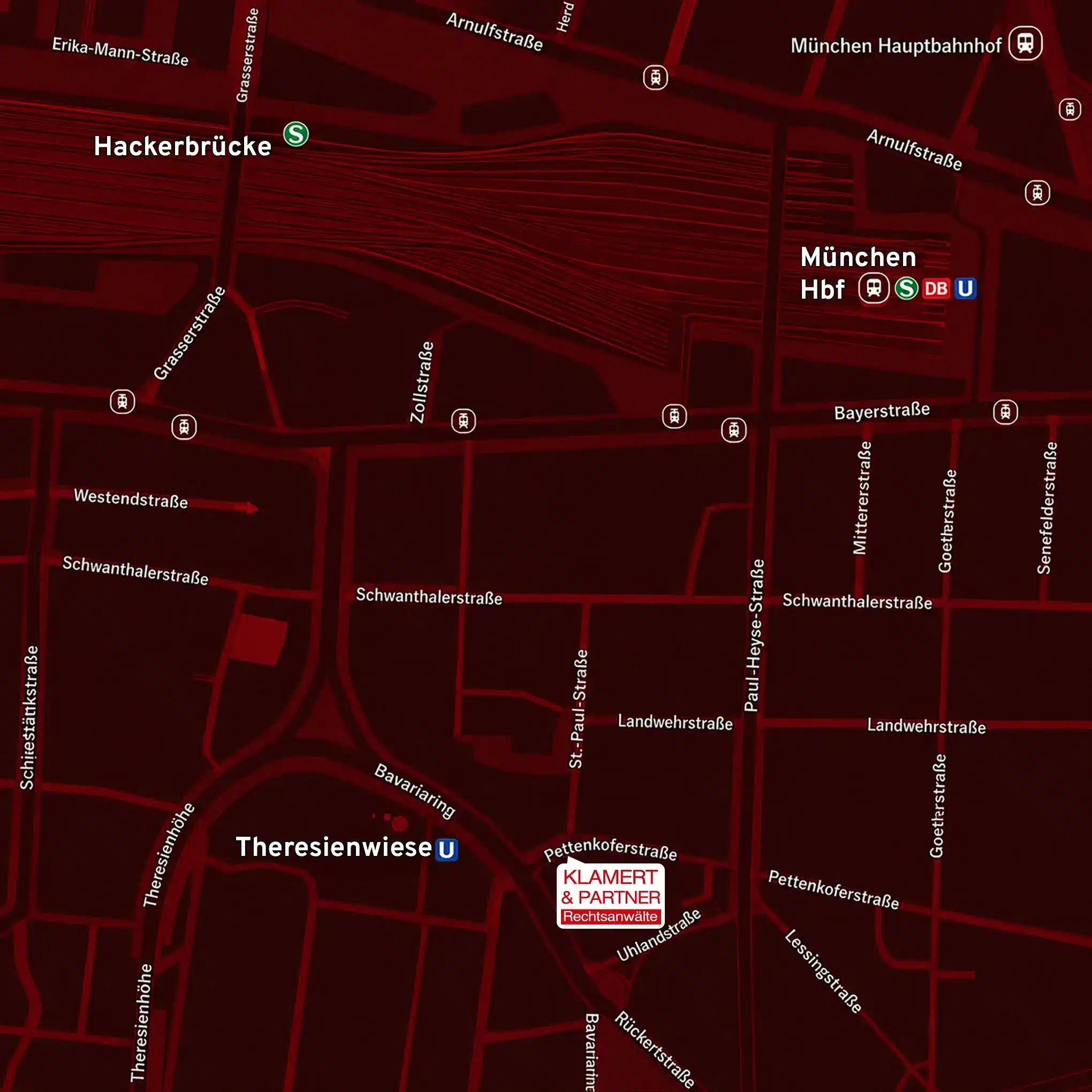
The Munich Foreigners’ Registration Office is part of the District Administration Office (KVR Munich) and is located at Ruppertstraße 11, 80337 Munich. It is accessible by subway (U3/U6 Implerstraße). Applications under the expedited skilled worker procedure are processed there. From our office at Pettenkoferstraße 37, you can reach the KVR Munich in about fifteen minutes.
Can you also handle cases from abroad?
Yes. We handle many cases before the client enters Germany—submitting visa applications in São Paulo, Mumbai, Kyiv, or Bogotá is the norm, not the exception. We communicate via video consultation, and signed powers of attorney are sent by mail or digitally. We speak directly with the diplomatic mission, prepare the application package, and remotely assist with the appointment in the client’s home country.
Free Initial Consultation with Your Skilled Worker Immigration Lawyer
Schildern Sie uns Ihre Lage in zwei bis drei Sätzen — wir prüfen unverbindlich, welcher Aufenthaltstitel passt (Blue Card EU, Chancenkarte, § 18a/§ 18b AufenthG, § 19c AufenthG, ICT-Karte), welche Voraussetzungen erfüllt sind und welche Schritte als nächstes sinnvoll wären. Online über unser Kontaktformular, telefonisch unter 089 540 239 0 oder persönlich in der Pettenkoferstraße 37 in München. Sprachen: Deutsch, Englisch, Ukrainisch, Russisch, Portugiesisch. Bei akutem Onboarding-Termin der Fachkraft, Visumablehnung mit Klagefrist (nur ein Monat!) oder laufenden Botschaftsterminen melden wir uns innerhalb eines Werktags zurück. Fachkräfteeinwanderung München ist bei KLAMERT & PARTNER eingebettet in unser Ausländerrecht-Hub — verantwortliche Partner Fachkräfteeinwanderung: Markus Klamert, Marc Frey und Johannes Goetz. Ukrainisch- und russischsprachige Vorberatung durch unseren Juristen Denys Osypenko; juristische Mandatsbearbeitung durch die zugelassenen Rechtsanwälte.