
Anwalt für Duldung
& Bleiberecht in München
Select your preferred language
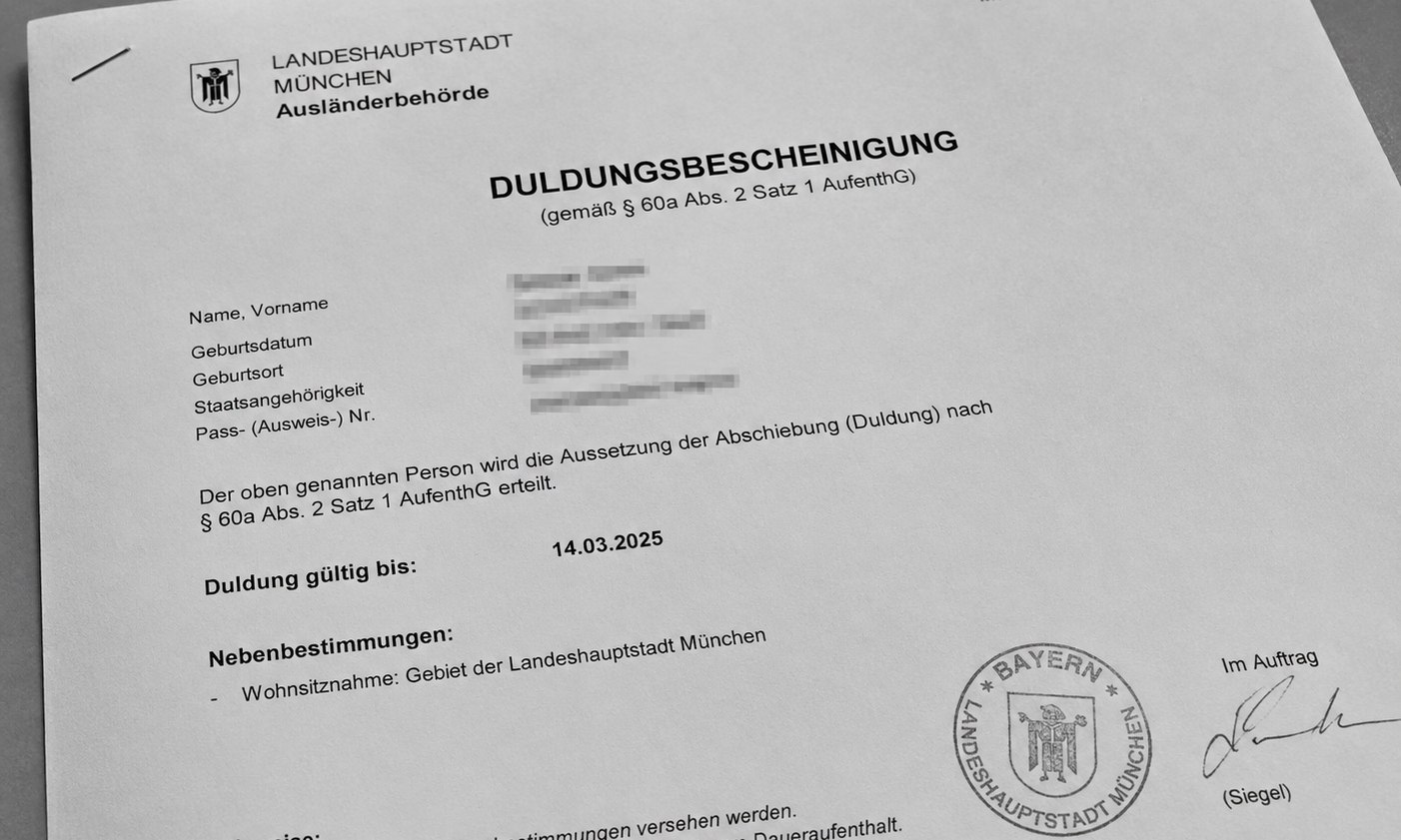
A "Duldung" in Munich is not a residence permit—it is official confirmation that deportation has been temporarily suspended. Those with a temporary stay permit live with a certificate in their pocket that, in many cases, is valid for only three or six months and must be re-justified with each renewal. This is precisely why legal advice is so crucial in this situation: It is rarely about extending the temporary stay permit itself—but rather about finding a path to a secure residence permit. At KLAMERT & PARTNER, we have been providing legal advice since 1987—as attorneys specializing in temporary residence permits and right of residence in Munich, we assist clients in transitioning from a temporary residence permit to a residence permit: through training-based temporary residence permits, employment-based temporary residence permits, the right of residence based on prospects, and the rights of residence under Sections 25a and 25b of the Residence Act (AufenthG). Languages: German, English, Ukrainian, Russian, Portuguese. Initial consultation free of charge.
When do you need a lawyer for temporary residence permits and the right to remain?
Toleration and the right to remain are matters of life, not mere administrative issues. Anyone living in Munich with a certificate of toleration knows the mechanics behind it from experience: every three or six months, the next appointment with the Immigration Office is due, each time bringing the question of whether the toleration will be extended or whether the authorities will initiate deportation this time. In between lies a daily life that feels almost normal—school, training, work, family—but which, legally speaking, could come to an end at any moment. That is precisely why legal counsel here is not a luxury, but a protective measure.
As attorneys specializing in temporary residence permits and the right to remain in Munich, clients typically come to us for three reasons. First, when the next renewal of their temporary residence permit is due and they are unsure whether the authorities will extend it or issue a denial. Second, when a concrete path to a secure residence permit becomes visible—training begins, a permanent employment contract is offered, or the right of residence based on opportunity under § 104c of the Residence Act comes within reach. Third, when there is an imminent threat of deportation —notification of a deportation date, a police summons, or sudden loss of temporary residence status.
What makes the field of temporary residence permits unique: it’s rarely just about the law. It’s almost always also about timing, strategy, and the courage to make a decision. The legal situation is narrow. But within these constraints, there are paths that many clients cannot see on their own—either because they are unaware of Sections 60c, 60d, 104c, 25a, and 25b of the Residence Act, or because they do not know which path is realistic in their specific situation. That is precisely the lawyer’s role.
FROM OUR PRACTICE – BAVARIAN OFFICE FOR FOREIGNERS AND MUNICH REGISTRY COURT
Depending on the circumstances, individuals in Munich who have a temporary stay permit are handled either by the Munich Foreigners’ Registration Office (KVR München) or by the Bavarian Central Immigration Office (ZAB, Werner-Heisenberg-Allee 102, 85748 Garching). The ZAB is specifically responsible for certain residence permits and follow-up asylum proceedings; the KVR Munich handles most extensions and transitional proceedings. From our experience: Anyone seeking to transition from a temporary stay permit to a residence permit should seek legal counsel before their next appointment with the authorities. The authority’s decision is often made at the appointment itself—what has been prepared in advance carries more weight than what is presented spontaneously during the meeting. We had to anonymize the case—§ 6 BORA (as amended)—but the logic behind it shows: The appointment itself is the decision, not the letter that follows.
Common issues clients bring to us regarding temporary residence permits and the right to remain:
- I’ve had a temporary residence permit for three years—can I apply for the right of residence based on prospects for integration?
- My son started an apprenticeship as an IT specialist at the beginning of the year—is there now a special permit for apprentices?
- I’ve been working at a hotel in Munich for two years with a temporary residence permit—is a work permit an option?
- I came to Germany seven years ago when I was 14 — Do I have a right to remain under Section 25a of the Residence Act?
- We have been living in Munich for eight years with temporary residence status, are well integrated, and speak German—do we have a right of residence under Section 25b of the Residence Act?
- I just received notice of a deportation hearing in two weeks—what can I do?
- My passport has expired, and my home country is refusing to renew it—does that mean my only option is a temporary residence permit?
- My asylum application was denied, and I now have temporary residence status—are there still options available to me?
“When it comes to temporary tolerance, I’ve seen the same mistake for years: clients wait too long. They hope the situation will improve on its own, that the authorities will eventually see reason, or that ‘politicians’ will come up with a solution. That’s not how immigration law works. It only works if someone actively seeks out a path—education, work, integration, language skills, and length of stay. The tools for this are found in Sections 60c, 60d, 104c, 25a, and 25b of the Residence Act. Making use of them is the first order of business.”
— Markus Klamert, attorney and founder of KLAMERT & PARTNER
What Is a Temporary Stay Permit? — An Explanation of Section 60a of the Residence Act
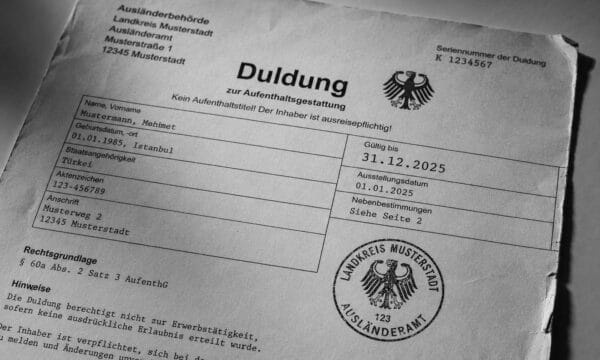
A “Duldung” under Section 60a of the Residence Act is, legally speaking, a “temporary suspension of deportation.” This means, first and foremost, that there is an enforceable obligation to leave the country—the holder of the Duldung would actually be required to leave Germany. However, the authorities suspend the deportation because it cannot be carried out for factual or legal reasons. This is precisely the key difference from a residence permit: A Duldung does not legalize the stay, but merely prevents its enforcement.
Factual and legal grounds for tolerance
Actual reasons include: lack of a passport, refusal by the home country to accept the individual, inability to travel due to health reasons, or lack of transportation options. Legal reasons include, among others: ongoing proceedings for a residence permit, an upcoming hearing in the asylum process, or family ties that prevent deportation. The authorities must grant temporary suspension of deportation if any of these reasons apply—they have no discretion in this regard.
Fixed-term contracts and extensions
Tolerance permits are generally issued for three or six months and are renewed as long as the grounds for the permit remain valid. With each renewal, the Immigration Office reviews whether the grounds are still valid—if they are no longer valid, the tolerance permit expires and deportation becomes enforceable again. This is precisely where the greatest source of uncertainty lies in daily life with a tolerance permit. Before each renewal, we check whether the previous reason still applies and whether additional pathways to a right of residence can be pursued.
What are you allowed to do with a temporary residence permit?
With a "Duldung," you are generally permitted to reside in Germany, but your ability to work is restricted—a work permit is not automatically included but must be granted separately by the Foreigners’ Registration Office. Those who have been granted temporary residence for a long time and meet the requirements are entitled to a work permit in many federal states. Freedom of movement within Germany is permitted; however, traveling abroad is generally not possible with temporary residence. Social benefits are provided in accordance with the Asylum Seekers Benefits Act, though they are reduced during the first few months.
What is a “residence requirement”?
Persons with temporary residence status are often subject to a residence requirement—they must establish their residence in a specific location, often in the federal state where they filed their asylum application or in the district where they were first received. Those with temporary residence status in Munich are usually restricted to the Munich or Bavaria area. A change of residence requires a justified application to the Office of Foreigners. We regularly assist with these applications, for example when family reunification or starting a job requires a move.
Temporary Residence Permit for Training Purposes under Section 60c of the Residence Act
Since its introduction in 2019, the training-based temporary residence permit under Section 60c of the Residence Act has been one of the most important tools for individuals granted temporary residence status in Germany—and particularly in the Munich metropolitan area, with its high demand for trainees in the skilled trades, healthcare, the restaurant industry, and IT. The idea behind it: Anyone undergoing qualified vocational training should be able to complete it during their period of temporary residence without facing the threat of deportation.
Requirements for a training permit
The following requirements must be met cumulatively: an existing apprenticeship contract with a recognized training company, qualified vocational training (lasting at least two years), residence in Germany for at least three months, no connection to serious criminal activity, and a verified identity (or ongoing cooperation in the identity verification process). The training permit is generally granted for the duration of the training—after which the residence permit under Section 19d of the Residence Act (employment permit for the profession) or another transitional permit is typically issued.
Clarifying one's identity as a major stumbling block
In Munich, applications for training-based temporary residence status most often fail due to issues with identity verification. Individuals arriving from crisis regions—such as Afghanistan, Syria, Somalia, Eritrea, and Iran—without a valid passport often cannot easily obtain their home country passport. Section 60c(7) of the Residence Act does not strictly require the submission of a passport, but rather ongoing cooperation in the identity verification process. We help document this cooperation—correspondence with home country embassies, affidavits, and the provision of other identity documents. This is a separate procedure alongside the training contract.

Practical Experience: From the Start of Training to Residency
We often advise clients even before their training begins—anyone who signs a training contract without having clarified their residency status risks the authorities refusing to grant a training permit, which could place the training company in a situation of perceived legal uncertainty. Before the contract is signed, we raise the issue of the application for a training permit, clarify the training company’s cooperation, and ensure a smooth transition.
Request a free initial assessment
Tell us about your case—quickly and with no obligation. We’ll assess your chances of success and get back to you shortly.
or call us directly at: 089 540 239 0
Temporary work permit under Section 60d of the Residence Act
Toleration of employment under Section 60d of the Residence Act is the equivalent of a training permit for adults in regular employment. Within the Munich Right of Residence Mandate, it is an important pathway for clients who have been working with a tolerance permit for years and have effectively integrated into the German labor market.
Requirements for a work permit
The following requirements must be met: at least 18 months of lawful full-time employment; proof of having supported oneself without public assistance for the past twelve months; residence in Germany for at least twelve months with a temporary residence permit; sufficient knowledge of German (usually A2 level); no convictions for intentional crimes (minor offenses are not a barrier); and verification of identity. Anyone who meets all these requirements is entitled to a work permit—the authorities have no discretion in this matter.
Practical Application and Documentation
From our experience: Documenting employment history is the most important factor. We build the application using pay stubs covering 18 months, employment contracts, tax assessment notices, social security records, and a complete set of documentation regarding means of support. For clients in Munich’s restaurant and care sectors, gainful employment often actually exists but is not consistently documented—this is where our record-keeping comes into play.

Conversion to a residence permit
Anyone who successfully completes 30 months of temporary employment authorization and continues to work is eligible for a path to a residence permit under Section 25b(6) of the Residence Act. This is the true strategic significance of temporary employment authorization: not the status itself, but the bridge to a secure residence permit.
Right of Residence for the Purpose of Seeking Employment under Section 104c of the Residence Act
The right of residence based on prospects under Section 104c of the Residence Act has been in effect since December 31, 2022, and has since significantly changed the landscape of residence rights under immigration law. The idea behind it: Anyone who, as of October 31, 2022, had been living in Germany for five years with temporary admission, a provisional residence permit, or a residence permit on humanitarian grounds, and who is well-integrated, should receive a provisional residence permit for 18 months—with the goal of meeting the requirements for a permanent right of residence under Section 25a or Section 25b of the Residence Act during this period.
Requirements for the Right of Residence Based on Prospects
Cutoff date and length of stay: As of October 31, 2022, at least five years of lawful residence in Germany (toleration, provisional residence permits, or humanitarian residence permits count toward this requirement). Commitment to the free democratic basic order. No serious criminal offenses. Proof of identity is required but must be provided within the 18-month probationary period. Important: The “Chance Residence Permit” is explicitly a transitional permit—it does not automatically lead to a right of residence but provides the opportunity to meet the requirements under Sections 25a and 25b of the Residence Act within the 18-month period.
What happens after 18 months?
Once the 18 months have expired, it is possible to transition to either § 25a or § 25b of the Residence Act (provided the requirements are met)—or the right of residence based on prospects for integration ends, and the original temporary stay permit is, in principle, reinstated. This is precisely why counseling is so important during this phase: The 18 months are not an extension, but a probationary period during which the applicant works specifically on meeting the requirements for the right to remain—language certificate, proof of sufficient means of support, length of stay, and clarification of identity.
Practical Note
Based on our experience at our Munich office: The Munich Foreigners’ Registration Office generally takes a constructive approach to the right of residence based on prospects. At the same time, we see that many potential clients do not file the application themselves—either because they misjudge the deadline or the requirements, or because they misunderstand the 18-month pathway as “merely a temporary reprieve.” Both of these misjudgments result in lost time. In our initial assessment, we will review free of charge whether Section 104c of the Residence Act is a realistic option in your specific situation.
FROM OUR PRACTICE – THE RIGHT OF RESIDENCE BASED ON OPPORTUNITIES IN PRACTICE
Since § 104c of the Residence Act took effect on December 31, 2022, we have observed a clear pattern: Clients who had completed the five-year residency requirement by October 31, 2022, and who consistently worked on language skills, gainful employment, and identity verification during the 18-month probationary period are highly likely to transition to the § 25a or § 25b pathway. Those who, on the other hand, passively wait out the 18 months often end up falling back into tolerated stay status. From our practice: The decisive factor lies not in the application for the right of residence based on prospects, but in the counseling that follows. We had to anonymize the case — § 6 BORA (new version) — but the logic behind it shows: 18 months is a short time if no one outlines the strategy.
“My favorite line in right-to-stay cases: ‘But I’ve already been granted the right of residence based on prospects.’ That’s exactly where the problem lies. The right of residence based on prospects is a tool, not a goal. Those who have received it are not yet safe—they have 18 months to secure their status. This difference determines the course of the next ten years. This is precisely where legal counsel is most valuable—not during the application process, but in the phase that follows.”
— Marc Frey, Attorney at Law, specializing in contract and property law (with experience in administrative law, particularly immigration law)
Right of residence under § 25a and § 25b of the Residence Act
Sections 25a and 25b of the Residence Act are the key provisions governing the right of residence for well-integrated individuals with temporary toleration status. They apply regardless of the effective date of the right of residence based on prospects for integration and serve as the actual pathway from temporary toleration to secure residence.
§ 25a of the Residence Act — Right of residence for well-integrated adolescents and young adults
Section 25a of the Residence Act applies to adolescents and young adults between the ages of 14 and 27 who have lived in Germany for at least three years (with temporary suspension of deportation, provisional residence status, or a residence permit), are currently attending or have attended school in Germany, have successfully completed their schooling or vocational training, are committed to the free democratic basic order, and are expected to be integrated. The connection to German schools—middle school, secondary school, high school, or vocational school—is often the decisive factor for our clients in Munich. We carefully review school transcripts, vocational training certificates, and letters of recommendation—in practice, these are the key pieces of evidence.
§ 25b of the Residence Act — Right of Residence for Tolerated Persons Who Are Sustainably Integrated
Section 25b of the Residence Act is the second major provision governing the right to remain and applies to adults who can demonstrate that they are sustainably integrated. The requirements are cumulative: at least six years of residence with temporary suspension of deportation; for families with minor children, at least four years; a largely secure means of support; sufficient knowledge of German (generally A2 level); commitment to the free democratic basic order; no conviction for an intentional criminal offense (minor offenses are not a hindrance); clarification of identity. Anyone who meets all requirements is entitled to a residence permit under § 25b AufenthG—the authorities have only limited discretion in this regard.
§ 25b(6) of the Residence Act — Transition to a work permit
A special provision of Section 25b is Section 25b(6) of the Residence Act: Anyone who has successfully completed 30 months of temporary employment authorization and remains employed is granted a residence permit. This is the path we have been preparing for many of our clients in Munich working in nursing, skilled trades, and the restaurant industry for years—temporary employment authorization as a bridge, followed by Section 25b(6) as a transition.
In Practice: What Does “Sustainable Integration” Mean?
“Sustainable integration” as defined in Section 25b of the Residence Act is not a legally precise term—it is assessed by the Immigration Office on a case-by-case basis. Indicators include: a continuous employment history, language certification, social integration (clubs, volunteer work), children’s school attendance, payment of taxes and social security contributions, consistent rent payments, and regular attendance at appointments with government agencies. We structure the application under Section 25b of the Residence Act using an integration dossier that systematically documents these indicators—it is precisely the combination that is decisive, because individual points are often insufficient.
Request a free initial assessment
Tell us about your case—quickly and with no obligation. We’ll assess your chances of success and get back to you shortly.
or call us directly at: 089 540 239 0
Transition from Temporary Stay to Residence Permit
The transition from temporary tolerance to a residence permit is the true strategic core of all cases involving temporary tolerance. As long as someone is “only” tolerated, their status remains precarious—the situation can change with every renewal. Only a residence permit provides legal certainty regarding their stay.
What specific paths are there?
Seven main pathways from temporary tolerance to a residence permit: first, Section 25a of the Residence Act (minors/young adults with a high school diploma); second, Section 25b of the Residence Act (adults who are permanently integrated); third, Section 25b(6) of the Residence Act (via employment-based temporary tolerance); fourth, Section 19d of the Residence Act (residence permit following completion of qualified training), fifth, Section 25(5) of the Residence Act (humanitarian grounds), sixth, Section 25(3) of the Residence Act (prohibition of deportation established), seventh, the right of residence based on prospects under Section 104c of the Residence Act as a transitional phase. Which path is realistic in a specific situation depends on the length of stay, family situation, employment status, language skills, and individual background.
Strategic consulting rather than isolated measures
In our Munich consulting practice, the most important step is almost always strategic clarification: Which path is the fastest and safest in this specific situation? We examine all seven paths in parallel and prioritize them—for a 22-year-old with a secondary school diploma, Section 25a of the Residence Act is within reach; for a family with two children enrolled in school in Munich and seven years of temporary residence status, Section 25b of the Residence Act is the key; for an adult with 24 months of full-time work, temporary residence for employment purposes is the transition. This initial differentiation is crucial.
Clarifying identity — the common stumbling block
One theme runs through all these paths: establishing identity. People who have come to Germany from crisis-stricken regions without a valid passport often struggle with this hurdle for years. We handle identity verification as a separate process—correspondence with home country embassies, certified translations of existing documents, affidavits, and participation in court-ordered identity determinations. In every right-to-remain case, identity verification constitutes at least a separate sub-mandate.
Protection Against Deportation — Urgent Application and Prohibition of Deportation
When deportation is imminent, legal counseling is not a traditional retainer but rather a crisis intervention. A notice of a deportation hearing in two weeks, a police summons, a sudden loss of temporary residence status—in these situations, every hour counts, and legal measures must take effect immediately.
Prohibition on deportation under Section 60(5) and (7) of the Residence Act
Before any deportation, it must be determined whether a prohibition on deportation can be established under § 60(5) of the Residence Act (violation of the European Convention on Human Rights, particularly Art. 3 of the ECHR—risk of inhuman treatment) or § 60(7) of the Residence Act (significant concrete danger to life, limb, or liberty). If the Foreigners’ Registration Office or the Federal Office for Migration and Refugees (BAMF) identifies a prohibition on deportation, the deportation is halted; in many cases, this leads to a residence permit under Section 25(3) of the Residence Act. We examine prohibitions on deportation, particularly in cases of serious illness, lack of medical care in the home country, and country-specific risk situations.
Urgent motion filed with the Munich Administrative Court
If deportation is imminent, the urgent application is the most important tool. In the case of decisions terminating residence that are immediately enforceable, we apply for suspensive effect under § 80(5) VwGO; in cases of imminent danger of enforcement, we apply for a preliminary injunction under § 123 VwGO. The Munich Administrative Court at Bayerstraße 30 typically rules on urgent matters within a few days—and within 24 hours in cases of an imminent threat of deportation. If deportation is imminent, the rule is: hire a lawyer immediately; every hour counts.
Follow-up asylum application
If new evidence emerges, the situation in the home country changes, or new medical conditions arise, a subsequent asylum application under § 71 of the Asylum Act can halt deportation. The requirements are strict—the subsequent application must contain substantially new information and be filed within three months of becoming aware of the new circumstances. We assess the merits of the case and collaborate with medical specialists, country reports, and experts if the new circumstances require medical or political substantiation.
Hardship Commission and Petition
In clear-cut humanitarian cases where legal remedies are no longer effective, an appeal may be made to the Bavarian Hardship Commission. It may recommend to the Minister of the Interior that a residence permit be granted on humanitarian grounds. A petition to the Bavarian State Parliament or the parliamentary assistance of individual members of parliament are also tools in urgent situations—they do not replace legal defense, but they complement it. We coordinate this with counseling centers and social welfare organizations where appropriate.
FROM OUR PRACTICE – EMERGENCY MOTION IN THE FACE OF IMMINENT DEPORTATION
In the case of a client whom the Munich KVR had notified would be deported in 14 days: Our experience clearly shows that in such situations, the first 48 hours are decisive for the outcome. We filed the urgent motion under § 80(5) VwGO with the Munich Administrative Court within one day, simultaneously submitted a medical report on the lack of healthcare in the home country, and involved the Hardship Commission through the counseling center. The Munich Administrative Court ordered the suspensive effect a few days later. We had to anonymize the case—Section 6 BORA (as amended)—but the logic behind it shows: Those who wait when facing the threat of deportation lose. Those who use the tools in parallel usually gain at least a breather.
“Im Bleiberechts-Mandat habe ich gelernt, dass juristische Korrektheit allein nicht reicht. Was zählt, ist der Wille der Mandantin oder des Mandanten, durch das System zu navigieren — Sprache lernen, arbeiten, Identität klären, Termine wahrnehmen. Unsere Aufgabe als Anwalt für Duldung in München ist es, diesen Willen mit den richtigen Paragraphen zu verstärken. Wir haben das in der Heimeranstraße seit Jahrzehnten so verstanden — und genau deshalb arbeiten wir hier integriert: Aufenthaltsrecht, Familienrecht, gegebenenfalls Strafrecht, gegebenenfalls Arbeitsrecht. Ein Mandat aus einer Hand.”
— Johannes Goetz, Attorney at Law, specializing in banking and insurance law (with experience in administrative law, particularly in the area of immigration law)
Consultations in Ukrainian and Russian — Denys Osypenko
At KLAMERT & PARTNER, we have Denys Osypenko, a lawyer who assists clients in Ukrainian and Russian. In the area of temporary residence permits and the right to remain, this language combination is particularly valuable—the consultation process is highly sensitive, often a matter of survival, and clients need the opportunity to express themselves in their native language. Denys Osypenko is a trained lawyer with ties to Ukraine; he is not a licensed attorney under German law at our firm—the legal handling of Ukrainian- or Russian-speaking right-of-residence cases is handled by the licensed attorneys Markus Klamert, Marc Frey, and Johannes Goetz.
What Denys Osypenko does for clients with temporary residence permits is act as a linguistic and cultural bridge. He translates official notices, explains the process for obtaining a residence permit in Ukrainian or Russian, assesses the chances of success, and prepares clients for their initial consultation with a licensed attorney. For Russian-speaking clients, advice on the right to remain often involves complex family situations—an elderly mother from Belarus with a daughter in Munich, an elderly father from Kazakhstan without a valid passport, or a family with varying residency statuses across generations. Language support doesn’t solve every case on its own—but it ensures that nothing falls through the cracks due to translation and that you understand what your lawyer is doing.
How Your Lawyer Works on Temporary Residence Permits and Right of Residence — Four Steps
1. Free initial assessment within 24 hours
Sie schildern uns Ihre Lage in zwei bis drei Sätzen — über das Kontaktformular, telefonisch oder vor Ort in der Heimeranstraße 37. Sprachen: Deutsch, Englisch, Ukrainisch, Russisch, Portugiesisch. Wir melden uns innerhalb eines Werktags mit einer ersten Lageeinschätzung: Welcher Bleiberechts-Pfad — § 25a, § 25b, § 25b Abs. 6, Chancen-Aufenthaltsrecht, Ausbildungsduldung, Beschäftigungsduldung — ist in Ihrer Konstellation realistisch. Bei akuter Abschiebungsbedrohung priorisieren wir die Rückmeldung deutlich — bei drohenden Abschiebungsterminen rufen Sie bitte sofort an.
2. Strategy Development and Administrative Work
Once we’ve been retained, we review the case file: temporary residence permits, asylum decisions, school and training records, pay stubs, language certificates, and correspondence with embassies regarding identity verification. We develop a concrete strategy and prioritize—which path to take, which documents are missing, and in what order. For training or employment cases, we also collaborate with the training company or employer when appropriate.
3. Application to the Office of Immigration and Naturalization
We submit the application for a residence permit (under § 25a, § 25b, § 25b(6), or another route) to the competent immigration office—the Munich City Immigration Office (KVR) at Ruppertstraße 19 or the Bavarian Central Immigration Office in Garching, depending on the circumstances. In the event of delays, we file an action for failure to act with the Munich Administrative Court; in the event of a rejection notice, we file an action for annulment. If deportation is imminent, we simultaneously file an urgent application under § 80(5) VwGO or § 123 VwGO.
4. Decision and Follow-Up Planning
Once a residence permit is granted, the period of temporary tolerance ends—and the next steps begin. We assist with the transition to a long-term residence permit, and later, if applicable, to a settlement permit, and in many cases, to naturalization. For us, temporary tolerance in Munich does not end with the initial decision, but only when lasting legal certainty regarding residence status is achieved.
Frequently Asked Questions About Temporary Stay Permits and the Right to Remain
What is a "Duldung"?
A “toleration” under Section 60a of the Residence Act is the official “temporary suspension of deportation.” It is not a residence permit—the stay remains technically unlawful, but the authorities do not enforce it because factual or legal grounds prevent deportation. A Duldung is generally issued for three or six months and is extended as long as the grounds for the Duldung continue to exist.
How much does a lawyer cost for temporary residence permits and permanent residence rights?
The initial assessment of your case is free of charge at KLAMERT & PARTNER. Any further consultation will be provided after you retain our services—either based on RVG fees calculated according to the value of the matter (typically €5,000 for right of residence cases) or according to an individual fee agreement. If you have legal expense insurance that includes administrative law coverage, we will handle the coverage inquiry on your behalf. If you are facing financial hardship, we will explore options for legal aid and, if applicable, court-appointed legal assistance—this is often available in cases involving the right of residence.
What is the difference between temporary residence status and a residence permit?
Temporary residence authorization under § 55 of the Asylum Act (AsylG) is the status granted during an ongoing asylum proceeding—residence is provisionally permitted until the asylum proceeding is concluded. Tolerated stay under § 60a of the Residence Act (AufenthG) applies only after the asylum proceeding has been concluded, when the asylum application has been rejected but deportation is not possible. Those who have been granted a stay of deportation have generally already completed the asylum proceedings.
When can I obtain a residence permit under Section 25a of the Residence Act?
Section 25a of the Residence Act applies to well-integrated youths and young adults between the ages of 14 and 27 who have resided in Germany for at least three years, have successfully completed school or vocational training in Germany, are committed to the free democratic basic order, and have a positive integration prognosis. In Munich practice, a school diploma—from a Mittelschule, Realschule, Gymnasium, or vocational school—is often the key piece of evidence. We will review free of charge whether § 25a is a realistic option in your specific situation.
When am I eligible for a residence permit under Section 25b of the Residence Act?
Section 25b of the Residence Act applies to adults who are permanently integrated, have resided in Germany for at least six years (four years for families with minor children), have a largely secure means of support, possess German language skills at the A2 level, are committed to the free democratic basic order, have no significant criminal convictions, and have a verified identity. Anyone who meets all the requirements is entitled to this status—the authorities have only limited discretion in this regard.
What is the right of residence based on prospects?
The right of residence based on prospects under Section 104c of the Residence Act has been in effect since December 31, 2022, and grants tolerated persons who had been living in Germany for at least five years as of October 31, 2022, an 18-month provisional residence permit—with the aim of meeting the requirements for a permanent residence permit under Section 25a or Section 25b of the Residence Act during this period. It is explicitly a transitional status, not the ultimate goal.
How does the training permit work?
The training-based temporary residence permit under Section 60c of the Residence Act protects individuals with temporary residence status from deportation while they are undergoing qualified vocational training (at least two years). Requirements: a valid training contract, a minimum stay of three months, ongoing cooperation in the process of establishing identity, and no serious criminal offenses. Upon completion of the training, a residence permit under Section 19d of the Residence Act (employment in the trained profession) is typically considered. In Munich, we see this pathway particularly frequently in nursing, skilled trades, the restaurant industry, and IT.
What is a work permit?
The employment-based temporary stay permit under Section 60d of the Residence Act protects individuals with temporary stay status who have at least 18 months of full-time employment, a secure means of support for the past twelve months, and A2-level language proficiency from deportation. After 30 months of employment-based temporary residence, the pathway leads to a residence permit under Section 25b(6) of the Residence Act. We regularly assist clients in Munich working in the care, hospitality, and skilled trades sectors with this pathway over the course of several years.
What can I do if I'm facing deportation?
Immediate legal consultation—when deportation is imminent, every hour counts. We will file an urgent motion under § 80(5) VwGO (suspensive effect) or § 123 VwGO (preliminary injunction) with the Munich Administrative Court, while simultaneously filing a follow-up asylum application based on new evidence, prohibition of deportation under Section 60(5)/(7) of the Residence Act (AufenthG) in cases of illness or danger, and, if necessary, a submission to the Bavarian Hardship Commission. If a deportation date is imminent: Call us or write to us immediately. In urgent cases, a free initial assessment is provided within a few hours.
Which government agency is responsible for my case?
In Munich, the KVR Munich (Ruppertstraße 19, Foreigners’ Affairs Division) is responsible for most tolerated persons. In certain cases—particularly those involving rejected asylum seekers and follow-up asylum proceedings—the Bavarian Central Immigration Authority (ZAB) at Werner-Heisenberg-Allee 102 in Garching takes over. We determine jurisdiction during the initial assessment and routinely work with both authorities.
Can I work with a temporary residence permit?
A temporary stay permit does not automatically include permission to work—this must be granted separately by the immigration office. In principle, employment is prohibited during the first three months of the temporary stay permit; after that, the immigration office may grant a work permit, and in many states, individuals are even entitled to one after a prolonged stay. We regularly handle applications for work permits in conjunction with applications to extend temporary stay permits.
What about my children and school?
Children of parents with temporary residence status are subject to compulsory education in Germany—they are enrolled in the appropriate local school in Munich, often in a transitional class or a program offering targeted language support. The children’s school attendance and academic performance are crucial for the family’s future assessment of their right to remain—Section 25b of the Residence Act specifically provides for a shortened residence period of four years for families with minor children. We recommend consistently collecting school report cards and letters from homeroom teachers—they will serve as evidence later on.
Request a free initial assessment
Tell us about your case—quickly and with no obligation. We’ll assess your chances of success and get back to you shortly.
or call us directly at: 089 540 239 0
Free Initial Consultation with Your Lawyer Specializing in Temporary Residence Permits and Right of Residence
Schildern Sie uns Ihre Lage in zwei bis drei Sätzen — wir prüfen unverbindlich, welcher Bleiberechts-Pfad in Ihrer Situation realistisch ist und welche Schritte als nächstes sinnvoll wären. Online über unser Kontaktformular, telefonisch unter 089 540 239 0 oder persönlich in der Heimeranstraße 37 in München. Sprachen: Deutsch, Englisch, Ukrainisch, Russisch, Portugiesisch. Bei drohender Abschiebung, Mitteilung über Abschiebungstermin oder akut auslaufender Duldung rufen Sie bitte sofort an — wir reagieren in Eilfällen innerhalb weniger Stunden. Duldung und Bleiberecht in München ist bei KLAMERT & PARTNER eingebettet in unser Ausländerrecht-Hub und in eine integrierte Beratung über Familien-, Aufenthalts- und gegebenenfalls Arbeitsrecht hinweg — verantwortliche Partner: Markus Klamert, Marc Frey und Johannes Goetz. Ukrainisch- und russischsprachige Vorberatung durch unseren Juristen Denys Osypenko; juristische Mandatsbearbeitung durch die zugelassenen Rechtsanwälte.